

The backhoe survives on Missouri crews for an unglamorous reason: it is the machine that can dig the service trench, set the pipe bedding, backfill it and then remove itself from the street without occupying a lowboy that is needed somewhere else. On a small outfit that flexibility is the difference between two machines and four.
This page follows the machine out of the gate. Missouri classifies it with unusual precision, licenses the business behind it at the municipal level rather than the state one, and puts its two largest markets against state borders — three facts that shape an equipment schedule here more than the machine’s specification does. For the mechanical behavior that is identical in every state, the backhoe insurance pillar is the better page.
What backhoe insurance costs in Missouri
There is no responsible way to publish a rate, and a figure printed here would be a number invented to look like an answer. The Missouri variables that actually count are how many jurisdictions a normal month puts the machine into, how much of its movement is under its own power rather than on a deck, whether it returns to a fenced yard nightly or stays out with the job, the valuation basis you choose, and your own claim record. Two identical backhoes, one working inside a single municipality and one crossing a metro area that straddles a state line, price differently for good reasons.
Missouri backhoe regulations: road operation
Self-propelled construction equipment is ‘special mobile equipment’ — not designed or used primarily to transport persons or property and only incidentally moved over highways — expressly including road construction/maintenance machinery, ditch-digging apparatus, power shovels, cranes, graders, and rollers.
The definition is worth reading rather than taking on trust, and it is published: RSMo § 301.010 carries the special mobile equipment definition, and we link it because we fetched and read it. The companion section our record holds for highway operation, § 301.133, is named here and deliberately not linked — it has not been through the same check, and describing a document we have not read would be worse than leaving a gap where one is. What the definition does is remove the machine from ordinary registration. What it does not do is make the highway part of your jobsite or answer for the vehicle in the next lane. Above that sits the licensing picture, which runs the other way entirely: with no statewide general-contractor license, the requirements attach to the city or county you are working in, so a backhoe that moves across a metropolitan area during one week may be working under several sets of rules while the machine itself never changes.
Common backhoe risks in Missouri
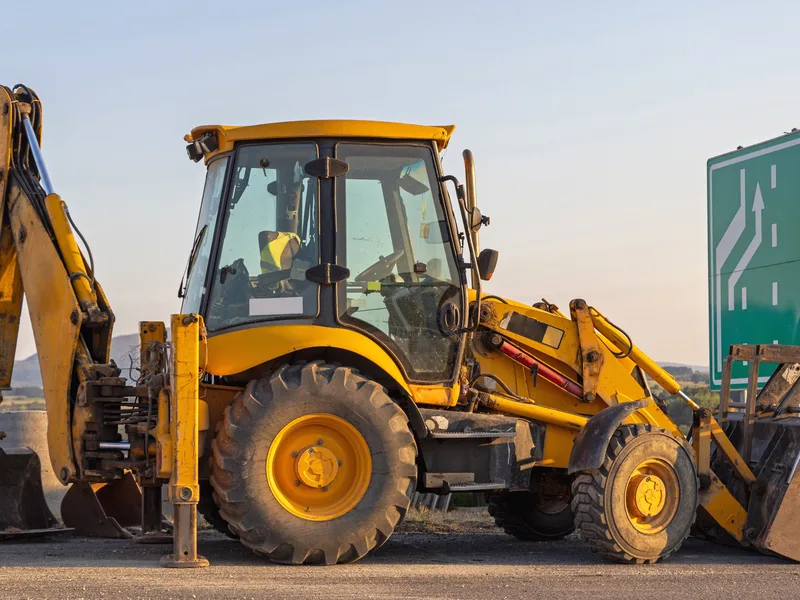
The pattern here is defined by short-to-medium self-propelled movement inside metropolitan areas that happen to have borders through them. A Missouri backhoe spends genuine hours on public pavement, in traffic, at a speed that annoys everybody behind it — which is exactly the setup for the low-speed collision and struck-object losses that dominate this class. Its own two habits come along unchanged: a boom that swings into what the operator cannot see, and a stabilizer that finds heavy clay far softer after a wet week than it was during a dry one. Southern Missouri adds shallow rock, which punishes a bucket and the pins behind it, and winter adds frost movement in ground the machine has to trust.
Common Missouri backhoe claims we see
- Low-speed collision during a self-propelled road move. The signature file on this class in Missouri, and the one the registration exemption is most often mistaken for covering.
- Stabilizer subsidence in saturated clay. Ground that carried the machine on Monday gives way on Thursday, taking the surface and the machine’s level with it.
- Boom or bucket contact behind the operator. Swing radius against a wall, a parked vehicle or a utility pedestal on a constrained urban lot.
- Impact damage on shallow rock. Concentrated in the southern half of the state, where a routine trench turns into a fight the linkage was not designed for.
- Cross-border movement that outruns the territory on the policy. Easy to fix in advance, expensive to discover afterward in two metros that both sit on a state line.
Why Missouri backhoe owners choose Equipment Guard Insurance
Monoline equipment placement earns its keep in a state where the paperwork is municipal. A contractor holding registrations in several jurisdictions has an insurance program shaped around them, and being told to unpick that to schedule one machine properly is not advice, it is a nuisance. We do not offer it. We ask how far and how often the backhoe drives itself, we settle the territory question before it becomes a claim question, and we place through markets — named on our homepage — that will underwrite a Missouri equipment schedule on its own facts.
Major Missouri backhoe markets
- St. Louis and St. Louis County. Deep utility and rehabilitation work over old infrastructure, in a market with two separate issuing authorities and a river border a few minutes away.
- Kansas City. A metropolitan area split by a state line, where a routine self-propelled move can change which state’s treatment applies to the machine.
- Springfield. The southern hub, where shallow rock and hill grades change both the digging and the towing side of the account.
- Columbia. Institutional and campus work on a steady calendar in the middle of the state, with long approaches from either metro.
- Independence. Established suburban and small commercial work on tight lots, where the machine works close to finished surfaces all day and then drives home past them.
- Jefferson City and St. Joseph. Public and river-adjacent work at a distance from the major markets, where recovery after a breakdown takes days rather than hours.
Related
- Backhoe insurance — the machine physics that hold in every state.
- Skid Steer insurance in Missouri — the same crew’s other machine, and the one a Missouri filing office has an opinion about.
- All equipment insurance in Missouri — the state hub.
- Equipment floater · Rented & leased equipment
Primary sources
- RSMo § 301.010 — Missouri Revisor of Statutes (road use and registration)
Missouri backhoe insurance FAQs
How specific is Missouri about what counts as construction equipment?
More specific than most. Rather than leaving the category to inference, the definition of special mobile equipment enumerates the machinery it means — road construction and maintenance machinery, ditch-digging apparatus, power shovels, cranes, graders and rollers — alongside the general test of a vehicle not built primarily to move persons or property and only incidentally taken over the highway. A backhoe answers to that description on both halves, which is a rare thing to be able to say without hedging.
Does that definition settle the road exposure?
It settles the registration question and leaves the expensive one open. A classification decides paperwork; it does not allocate the cost of a collision. When a backhoe is lawfully on a Missouri highway and something goes wrong, the floater deals with the machine and a liability form deals with everything the machine touched. Owners who assume the exemption folded the second question into the first are the ones who find out during a claim.
Who licenses a Missouri earthwork contractor?
Your city or county, and that is the whole answer. Missouri issues no statewide general-contractor license; the state Division of Professional Registration handles particular trades such as electrical contracting, and everything else is set locally by jurisdictions including Kansas City, St. Louis city, St. Louis County, Springfield and Columbia. A crew that works across a metropolitan area is therefore working under several different rulebooks at once, and the machine moving between those jobs does not care which one it is under.
Both big Missouri markets sit on a state line. Does that matter for a backhoe?
It matters more than it does for a machine that only ever rides a trailer. Kansas City and the St. Louis area both spill across a border, so a short self-propelled move can put the machine under another state’s treatment of the same class without anyone planning it. That is a coverage-territory question rather than a philosophical one, and it is worth settling on the application rather than in a loss adjustment.
What does Missouri weather do to this machine?
It runs the machine through a full annual cycle rather than a season of it. Winter freeze-thaw heaves the ground a stabilizer relies on and works on seals and hoses that were flexible in July; summer heat and humidity load the cooling and hydraulic systems on the same iron. Add heavy clay that holds water long after rain and shallow rock in the southern half of the state, and a Missouri backhoe accumulates wear on two clocks at once.
Will you write the backhoe by itself?
Yes — Equipment Guard Insurance places equipment monoline in Missouri. The machine and its attachments can be scheduled without disturbing liability or workers compensation arrangements that your municipal registrations and your general contractors are already holding certificates against.