
The backhoe is the machine a small Montana outfit buys when it can only justify buying one. It digs, loads, backfills and lifts, and it can put itself on the road to the far end of a job without waiting for a truck — which in this state is less a convenience than a working assumption.
What follows is about the consequences of that assumption here: how Montana classifies the machine once it is on a public road, what the state asks of the contractor operating it, and what genuinely long distances do to a schedule. The mechanical behavior that travels with the machine everywhere — boom reach, stabilizer geometry, the loader end — belongs to the backhoe insurance pillar rather than to this page.
What backhoe insurance costs in Montana
There is no useful number to print here, and one printed anyway would be a guess wearing a decimal point. The Montana variables that actually move it are road miles, remoteness and season: how much of the machine’s year is spent moving between jobs rather than working inside one, how far from support the furthest job sits, whether it winters behind a fence or on an open site, plus the valuation basis and your own record. Two identical machines, one working municipal jobs inside a single town and one running the length of a valley, are not the same risk and should not carry the same price.
Montana backhoe regulations: road operation
A self-propelled backhoe is ‘special mobile equipment’ — a vehicle not designed for transporting persons or property on highways but incidentally moved over them — and is exempt from standard vehicle registration.
The definitional section is recorded in the Montana code at MCA 61-1-101, and we name it rather than link it: this page cites only documents that were fetched and read, and that one has not been verified to the standard the rest of our citations meet. What the exemption does and does not do is the part worth being precise about. It removes the machine from ordinary registration; it does not convert a public road into a jobsite. A backhoe traveling under its own power is sharing that road with traffic, and damage it causes out there is answered by liability cover rather than by the floater that repairs the machine. Above that sits Montana’s other distinguishing feature: contractor status here is a registration keyed to workers compensation rather than a competency license, so the paperwork that proves you are a going concern is largely insurance paperwork.
Common backhoe risks in Montana
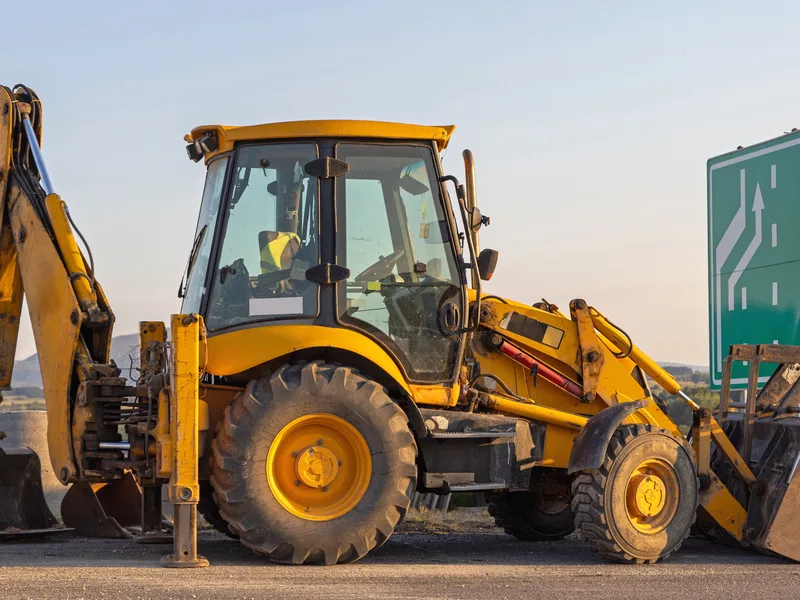
Distance organizes the risk on a Montana backhoe. The machine spends an unusual share of its life either self-transporting on rural highways or riding a trailer between towns, and transit and road movement are where this class concentrates its losses — loading and tie-down damage, the ramp, and collision exposure while the machine is legitimately in traffic. Its own two mechanical habits follow it here as everywhere: the boom swinging into something the operator cannot see, and a stabilizer punching through ground that looked solid. Winter then adds the specifically Montana problem, which is not cold itself but absence — a machine parked out on a remote site for months is one nobody is checking on.
Common Montana backhoe claims we see
- Collision or struck-object while the machine is on a rural highway. The exposure the registration exemption is most often misread as having removed.
- Loading and tie-down damage on a long haul. The single most concentrated loss on this class in a state with these distances.
- Boom contact behind the operator. Swing radius against a structure, a fence or a vehicle on a constrained lot.
- Stabilizer subsidence into soft or frost-heaved ground. Takes the surface, the level and sometimes a buried service.
- Loss discovered late on a remote or overwintered site. Where the delay, not the event, drives the cost.
Why Montana backhoe owners choose Equipment Guard Insurance
Writing equipment on its own suits how Montana contractors are actually organized. When contractor status runs through a workers-compensation registration, the last thing an owner wants is to unpick that arrangement to get one machine covered properly — so we do not ask. We take the road and transit exposure seriously instead of pricing the backhoe as though it never leaves a site, we ask where it spends the winter before rather than after a claim, and we place through markets — named on our homepage — willing to read a Montana equipment schedule on its own merits.
Major Montana backhoe markets
- Billings. The largest construction market in the state and the base for crews whose jobs routinely sit well outside it.
- Missoula. Valley and river work on constrained ground, where boom-swing and surface-damage claims concentrate.
- Great Falls. Municipal, utility and agricultural site work putting the machine in the public right of way more weeks than not.
- Bozeman. The fastest-growing build-out in the state, with tight residential lots and finished surfaces close to the machine.
- Butte and Helena. Older infrastructure, reconstruction and utility replacement, where what is buried is rarely exactly where the drawing says.
- Kalispell and the north-west. Seasonal, dispersed work with the longest approaches and the slowest recovery when a machine goes down.
Related
- Backhoe insurance — the machine physics that hold in every state.
- Skid Steer insurance in Montana — the compact machine that rides rather than drives.
- All equipment insurance in Montana — the state hub.
- Equipment floater · Rented & leased equipment
Primary sources
We do not link a Montana vehicle-code section here. The road-use treatment described above follows how Montana classifies self-propelled construction equipment; where the state publishes a section that states it directly, this page links it.
Montana backhoe insurance FAQs
Is a Montana backhoe registered like a highway vehicle?
No. The vehicle code treats self-propelled construction machinery as special mobile equipment — built for work rather than for carrying people or goods, and only incidentally moved along a highway — and that classification keeps it outside standard vehicle registration. It does not, however, decide anything about who answers for damage the machine does while it is out there.
Does Montana license contractors, or is it something else?
Something else, and the distinction matters on an equipment account. Montana runs a registration keyed to workers compensation rather than a competency license: a contractor with employees registers, and an independent contractor may instead hold an exemption certificate. Nobody sits an exam. What a general contractor or an owner can actually check about you is therefore your certificates, which puts more weight on the insurance documents than a licensing state does.
What does the driving distance in Montana do to a backhoe policy?
It changes which exposure dominates. In a compact metro a backhoe mostly works inside a site; here it either self-transports over meaningful road distances or spends real hours on a trailer between towns. Both put the machine where the worst claims happen — in traffic, on a ramp, or strapped to a deck — so the road and transit picture drives this schedule more than the jobsite picture does.
How does winter change the exposure on this machine?
It shortens the season and lengthens everything else. Frozen ground resists a bucket and punishes the boom and the stabilizer feet; cold thickens hydraulic oil and hardens seals; and a machine parked through a long winter on a remote site is one nobody looks at for months, which is when an undiscovered loss becomes an expensive one. Where the backhoe overwinters is a question worth answering on the application rather than after a claim.
If the machine works a job hours from town, what actually goes wrong?
Time to help. A breakdown or a loss on a remote Montana job is not resolved the same day, and the second-order costs — a stalled crew, a rented replacement, a recovery vehicle sent a long way — are usually what the owner did not plan for. We would rather size those into the coverage at the outset than discover the gap while the machine sits.
Can the backhoe be insured without touching the rest of my cover arrangements?
Yes. Equipment Guard Insurance writes equipment monoline in Montana, so the machine can be scheduled on its own while your existing liability and workers compensation stay exactly where they are — which on a registration keyed to workers comp is not a trivial convenience.