
A compact loader is the machine a Montana crew buys first and keeps longest, because it is the one that can substitute for three others on a site hours from the nearest rental counter. It grades, digs, hauls, clears brush and moves snow, and when it is down the job stops — there is rarely a spare sitting nearby to take over. That combination of usefulness and irreplaceability is the whole underwriting story here.
Two things about Montana shape the account and neither is about the uniform lien rules. The state registers contractors on a workers’-compensation basis rather than testing competency, which puts unusual weight on the insurance documents you produce; and the sheer scale of the place changes how machines are owned, stored and recovered. For the physics that hold in every state — attachment mechanics, skid steering, the forward-tip pattern — see the skid steer insurance pillar.
What skid steer insurance costs in Montana
We do not quote a figure in the abstract, because the honest one comes out of your machine list, where it lives and how far it goes. In Montana the dominant levers are remoteness and winter: a loader that returns to a fenced and covered yard is a different submission from one that stays on a remote site for a season, and a machine wintered outdoors is priced as a machine wintered outdoors. After those come the number and value of attachments named on the schedule, the valuation basis, whether telematics are fitted — worth more here than almost anywhere, because recovery depends on it — the deductible, and your own loss history.
Montana skid steer regulations: title, lien and ownership
A skid steer is untitled special mobile equipment, not a DMV-titled vehicle; a lender perfects its lien by filing a UCC-1 financing statement with the Montana Secretary of State.
With nothing titled, the financing filing and the serial number are jointly the proof of ownership, and the policy needs to match both. A lender on a financed loader is named as loss payee against the scheduled unit so that a settlement is issued jointly, and the schedule and the filing have to describe the same serial — a lienholder still listed against a machine that has been paid off or traded is the plainest sign an account has drifted. Montana then puts an unusual amount of weight on your paperwork one layer up. Because the state credential is a registration keyed to workers’ compensation rather than a competency license, the documents a project owner can actually evaluate are your certificates and your schedule — so a stale equipment list is not just an insurance problem here, it is the thing being read instead of a qualification.
Common skid steer risks in Montana
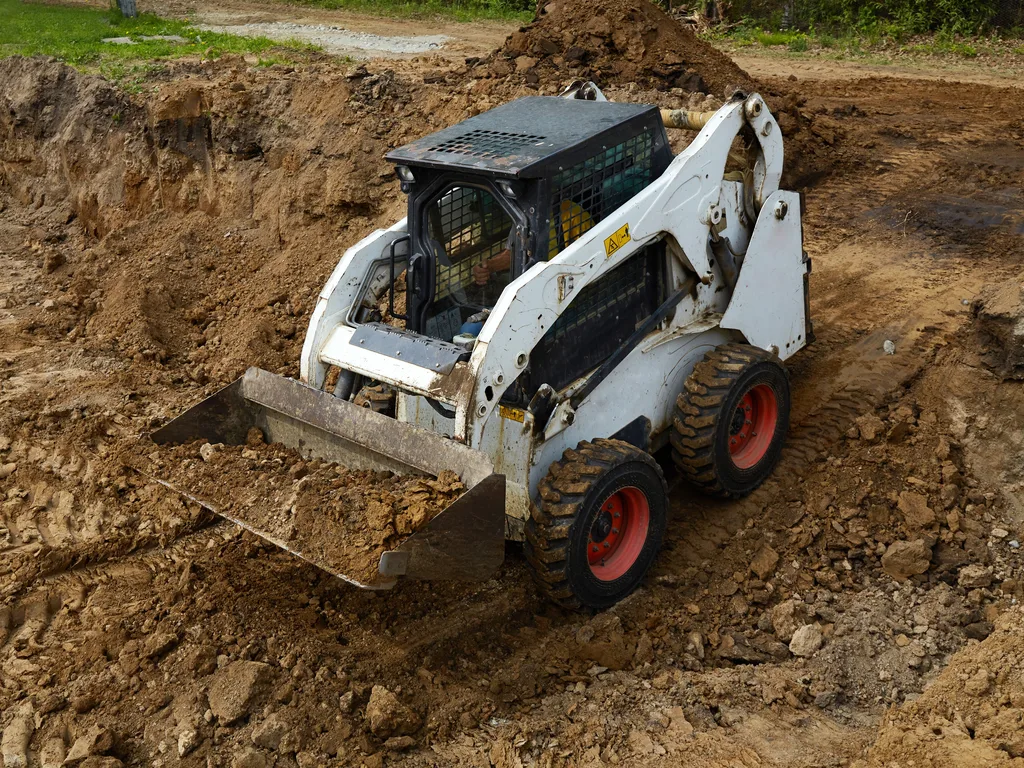
Theft on this class in Montana is a story about time rather than traffic. A loader taken from a remote site may not be missed for a day or more, and the roads leaving that site go a very long way before they reach anywhere a machine looks out of place — so the difference between a recovery and a total loss is usually whether a tracking unit and a serial number were both in place before the loss. Winter is the second exposure and it is severe: sustained cold on hoses, seals, glass and batteries, snow load on cabs and racked attachments, and machines standing idle for months at a time. Terrain contributes its own share — gravel access, mountain grades under a trailer, and dust on hydraulics through the dry season. The rest is the machine: the forward tip with the arms loaded and up, and loading damage on uneven ground.
Common Montana skid steer claims we see
- Machine gone from a remote site, missed a day late. The signature Montana loss, where the head start matters more than the fencing and only the serial record survives it.
- Attachment stolen or damaged with a long replacement lead time. The tool is the smaller loss; the days of stopped work waiting on a head from a distant dealer are the larger one.
- Cold-weather damage to iron wintered outdoors. Burst hoses, split cylinders, cracked glass and snow load on a cab, on a loader that never came under a roof.
- Trailer and haul damage on gravel and grade. Undercarriage, tires and cylinders taking the cost of a long access road rather than of the job itself.
- Forward tip on unimproved ground. Arms up and loaded on a surface that never was level and was not going to be.
Why Montana skid steer owners choose Equipment Guard Insurance
Equipment on its own is the right shape for a Montana operator. Many crews here are small, own most of what they run, and have workers’ compensation arranged specifically because the state registration depends on it — and nobody wants that disturbed to get the loader scheduled properly. So we schedule the iron by itself, name attachments individually with their values, and account for the occasional rented-in machine. The markets we place through — named on our homepage — will read a Montana equipment schedule as its own submission rather than as an accessory to something larger.
Major Montana skid steer markets
- Billings. The largest jobsite market in the state and its supply base, with energy and industrial work reaching out into country where nobody is watching a machine overnight.
- Missoula. Constrained valley development and institutional work, where sites are tight, staging space is scarce and loaders stay put between visits.
- Bozeman. The fastest-growing market here, running residential and resort-adjacent build-out with high machine values and dispersed sites in every direction.
- Great Falls. Municipal, industrial and agricultural work on open ground, where an unfenced yard is the norm rather than an exception.
- Kalispell. Resort and second-home construction on mountain access roads, with grade and gravel taking their share of the machine on every trip in.
- Helena. Public-sector and institutional programs on long schedules, meaning long stretches with iron staged and idle on site.
Related
- Skid steer insurance — the machine physics that hold in every state.
- Dozer insurance in Montana — the machine the acre-based land-disturbance permit is aimed at.
- All equipment insurance in Montana — the state hub.
- Equipment floater · Rented & leased equipment
Primary sources
We do not link a Montana filing document here. The ownership and lien rules described above follow Article 9 as Montana has adopted it; where a state publishes a document that states the rule directly, this page links it.
Montana skid steer insurance FAQs
Is a skid steer titled through Montana Motor Vehicle Division?
No. The state classes it as special mobile equipment, which keeps it outside the titled-vehicle system entirely, so there is no document to hand across at a sale and none to produce for a police report. Identity rests on the serial number, the invoice and any financing filing behind it — and out here, where the nearest office of anything can be a long drive, having that record already assembled matters more than usual.
What does Montana actually require of a contractor?
A registration rather than a license, and the basis is insurance rather than skill. Contractors with employees must hold Construction Contractor Registration through the Department of Labor and Industry, and an independent operator with no employees may instead hold an Independent Contractor Exemption Certificate. There is no examination and no competency classification. Read the consequence carefully: because the state credential proves coverage status and not ability, the documents a general contractor or a project owner scrutinizes are your certificates — so an equipment schedule and a certificate that are out of date are doing more damage here than in a state with a competency license to fall back on.
Why does distance change this class in Montana?
Because it changes every assumption underneath it. The state’s markets are hours apart, so a loader on a job is genuinely remote from its own yard rather than inconveniently far from it, and it stays on that job. Rental supply is thin outside the larger towns, which pushes crews toward owning the machine they need rather than hiring it — so the schedule carries more owned units than a comparable crew in a dense state. And a machine taken from a site with no neighbors has a long head start before anyone notices, let alone reports it.
Which attachments should be named on the schedule?
Anything you would have to replace before you could work again — which, on a Montana account, is most of them. Blanket attachment limits carry a per-item cap sized for buckets, and augers, breakers, grapples, brush cutters and snow equipment routinely sit above it. There is a second reason to name them here: the nearest dealer with the right head in stock may be hours away, so an attachment loss costs you days of work as well as the value of the tool.
How much does the Montana climate matter on a loader?
A great deal, in two directions. Winter is long and genuinely cold, so hoses, seals, glass and batteries take real damage on machines left outdoors, and snow load builds on cabs and racked attachments. Elevation and mountain grades then work on cooling systems and on trailer haulage, and gravel and unimproved access roads chew tires, undercarriage and cylinders on the way in and out. A covered overnight location is the highest-value control on this class here for reasons that have nothing to do with theft.
Will you write the equipment on its own?
Yes — it is the way Equipment Guard Insurance prefers to write it. Loaders, attachments and any rented-in units go on a single equipment schedule, and the workers’ compensation your registration depends on stays exactly where it is.