

A backhoe is what a Nebraska crew buys when the job list is long and varied and the yard is not. It trenches for a water service in the morning, moves spoil after lunch, sets a section of pipe before knocking off, and then drives itself to whatever is booked for tomorrow.
This page is about what Nebraska specifically does with that machine and that habit: a statute that handles the classification more cleanly than most, a contractor regime that registers rather than examines and that reaches further down the chain than owners expect, and weather that treats an unsheltered machine as a target. What holds for a backhoe in any state belongs on the backhoe insurance pillar.
What backhoe insurance costs in Nebraska
There is no honest figure to put on this page. What we can say is which Nebraska facts actually move the number: the split between driven miles and hauled miles, whether the machine stands under cover or in the open through storm season, how far the furthest regular job sits from your yard, the age of the unit and the valuation basis you choose against it, and your own record. Storage is a bigger input here than it is in most states, and it is the one an owner can change. A machine that overnights inside and a machine that overnights on an open lot are not the same risk, whatever else is identical about them.
Nebraska backhoe regulations: road operation
Road and general-purpose construction and maintenance machinery not designed or used primarily to transport persons or property (including ditch-digging apparatus, bucket loaders, graders, earthmoving equipment, crawler tractors) is statutorily excluded from the definition of ‘motor vehicle,’ and so is not subject to motor-vehicle registration.
Read that carefully, because it is doing something most states do not. The section — Neb. Rev. Stat. § 60-339 — does not carve an exception out of a registration requirement; it writes this class of machine out of the meaning of the term before any requirement attaches. Cleaner reasoning, same practical outcome, and a much shorter argument if anyone ever questions the classification. Where it stops is the same place every version of this rule stops. A definitions section does not decide who pays when a backhoe under its own power catches a passing vehicle, a fence line or a mailbox, and that is a liability question answered by a different form entirely. Above it sits the contractor regime, which in Nebraska is a registration with the Department of Labor rather than a competency license — no examination, and it applies to subcontractors performing work on real property as well as to the contractor above them. Owner-operators who assumed the requirement stopped at the prime are inside it, and the registration and the equipment schedule are both documents a general contractor may reasonably ask to see.
Common backhoe risks in Nebraska
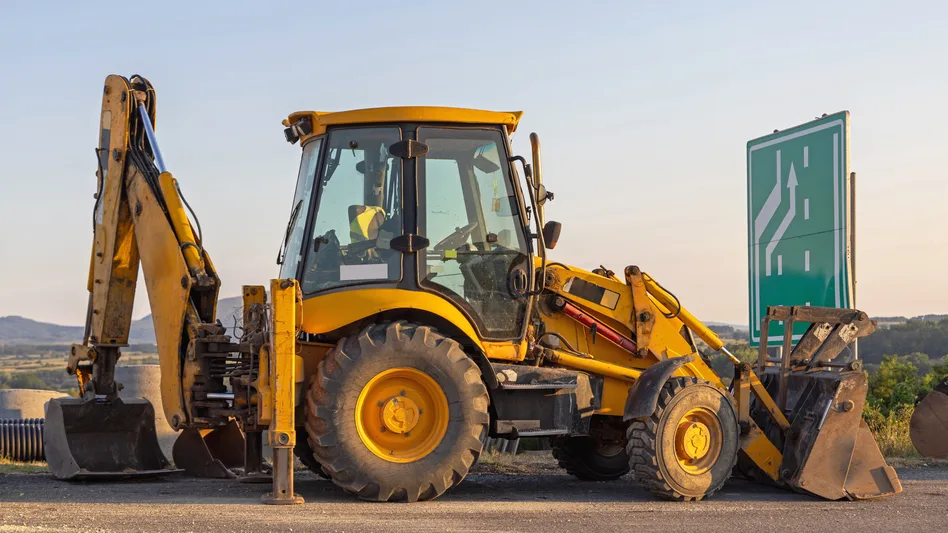
Weather leads the risk picture here, and it leads for a reason owners are slow to accept: a backhoe is a large, expensive, entirely unsheltered object standing in one of the more active severe-storm regions in the country. Hail reaches glass, lights, mirrors, coolers, exposed rods and hoses; straight-line wind moves anything not tied down into the machine. None of that has anything to do with how well the unit is operated, which is exactly why it is worth pricing deliberately rather than discovering in a June adjustment.
Ground and road fill in behind it. The eastern counties sit on deep wind-laid silt that cuts cleanly and then fails suddenly once wet, which is a trench-wall problem and a pad-placement problem at the same time; westward the profile turns sandy, easing the sidewall and worsening the footing. The road exposure then runs along the interstate spine, because that is how Nebraska is laid out — the towns are strung along it, the jobs follow the towns, and the machine either drives or rides between them with a ramp at each end of every trip.
Common Nebraska backhoe claims we see
- Hail damage to an unsheltered machine. Glass, lights, coolers and rods, and a repair bill that surprises owners who thought of the machine as weatherproof.
- Trench-wall collapse taking a stabilizer with it. The eastern-silt loss, where ground that stood up all morning lets go after rain.
- Contact with a road user on a driven move. The interstate corridor concentrates both traffic and jobs into the same narrow band of the state.
- Boom or bucket contact behind the operator. Municipal and utility work in occupied streets, where what is behind the machine changes during the job.
- Loading and ramp damage on a long western haul. Distance out here is measured in hours, and every hour has a ramp at both ends of it.
Why Nebraska backhoe owners choose Equipment Guard Insurance
Equipment-only placement is the whole of what we do, and Nebraska makes the case for it easily. Your state standing rests on a registration, not on an examination or a program structure, so nothing about moving one machine onto its own schedule threatens anything you have already established. We ask about storage and storm season as underwriting facts rather than as small talk, we treat the driven-versus- hauled split as the road question it is, and we place through markets — named on our homepage — that will read a Nebraska equipment schedule on its own merits.
Major Nebraska backhoe markets
- Omaha. The largest site-development and utility market in the state, and the one where short moves through occupied streets are constant.
- Lincoln. Institutional, municipal and residential work with the deepest silt profiles and the trench-wall discipline that goes with them.
- Bellevue. Steady suburban and installation-adjacent site work, with tight lots and finished surfaces inside the swing.
- Grand Island. Agricultural processing and municipal infrastructure at the center of the state, and a natural base for jobs in several directions.
- Kearney. Corridor commercial and irrigation-related earthwork, where the machine spends real time on the highway getting to work.
- North Platte. Rail, ranch and small-municipal work with the longest approaches and the slowest recovery when a machine goes down.
Related
- Backhoe insurance — the machine physics that hold in every state.
- Skid Steer insurance in Nebraska — the machine a filing office knows about, rather than a definitions section.
- All equipment insurance in Nebraska — the state hub.
- Equipment floater · Rented & leased equipment
Primary sources
- 60-339. Motor vehicle, defined — Nebraska Legislature (road use and registration)
- Contractor Registration — Nebraska Department of Labor (contractor licensing)
Nebraska backhoe insurance FAQs
Is a Nebraska backhoe exempt from registration, or something else?
Something else, and the difference is worth understanding. An exemption lets a vehicle out of a requirement it would otherwise meet. Nebraska instead writes road and general-purpose construction and maintenance machinery — ditch-digging apparatus, bucket loaders, graders, earthmoving equipment, crawler tractors — out of the statutory meaning of motor vehicle in the first place. The machine is not excused from registration so much as never inside its scope. The practical result looks similar; the reasoning is cleaner, and it makes the classification much harder to argue with.
If the state does not call it a vehicle, does road liability go away?
It does not, and this is where the definitional point can mislead an owner. What a statute calls a machine governs how that machine is recorded and taxed. It has no bearing on the ordinary duty owed to everyone else using the road. A backhoe under its own power on a county highway is a slow, wide obstruction with poor rearward sightlines regardless of which chapter defines it, and the damage it does to another vehicle or a roadside structure is a liability matter that the equipment floater was never written to settle.
Does Nebraska license the contractor running the machine?
It registers rather than licenses, and the reach of the registration is the part people miss. Every contractor and subcontractor performing work on real property must register with the Department of Labor — there is no competency license and no examination, so registration proves standing rather than skill, and it catches the owner-operator working as a sub just as squarely as it catches the general contractor above them. If you have ever assumed a registration requirement stopped at the prime, this is the state that corrects the assumption.
What is the hail exposure on a machine like this?
Real, and routinely underinsured because owners think of hail as a roof problem. A backhoe stands outside by default, and a severe convective storm reaches glass, lights, mirrors, the coolers and every exposed hose and cylinder rod on the machine. Nebraska sits in the part of the country where those storms are a season rather than an event. Where the machine spends the night, and whether the schedule reflects what it would actually cost to put right, is a conversation worth having in spring rather than in June.
Does eastern Nebraska ground behave differently from the west?
Distinctly. The eastern counties sit on deep wind-laid silt that stands up beautifully in a fresh cut and then lets go without much warning once it takes water, which is hard on trench walls and harder on a stabilizer pad set close to the edge. Move west and the profile turns sandy and free-draining, where the sidewall problem eases and the footing problem sharpens. The same machine on the same job earns a different set-up discipline at either end of the state.
Will you write the backhoe by itself?
Yes — Equipment Guard Insurance places equipment monoline in Nebraska. The machine gets its own schedule and your liability and work comp stay put, which suits a state where the credential you file is a registration rather than a license and there is no exam result behind it to protect.