

A backhoe earns its place on a small Nevada crew by being two machines at once — a loader at the front, an excavating boom at the back — and by getting itself to the next part of the job under its own power. That last habit is what separates it from everything else on the schedule.
Everything below is about what happens when the machine moves. Nevada gives it a specific place in the vehicle code, the Contractors Board gives your business a ceiling that shapes the fleet behind it, and the geography puts long empty distances between the places you work. For the machine mechanics that do not change at a state line — the boom, the stabilizers, the loader end — see the backhoe insurance pillar.
What backhoe insurance costs in Nevada
Nobody can price this machine from a webpage, and a figure quoted without your details would be invented rather than estimated. What actually moves a Nevada backhoe premium is how much of its life is spent on public roads rather than inside a site, the length of the hauls between your jobs, whether the machine sleeps behind a fence, the valuation basis you pick, and your own loss record. A backhoe working one fenced valley site prices unlike an identical one trailered between the north and the south.
Nevada backhoe regulations: road operation
A self-propelled backhoe is ‘special mobile equipment’ — a motor vehicle not designed or used primarily for transporting persons or property and only incidentally moved upon a highway.
That classification is the hinge the whole account turns on. Because the machine is special mobile equipment under the Nevada vehicle code, it is not registered the way a truck is — and owners frequently read that as meaning the road exposure has been dealt with. It has not been. Registration status answers a titling question, not a liability one, so a backhoe that damages a curb, a parked vehicle or an undercarriage while moving between jobs raises a claim that the floater alone was never written to settle. One layer up sits the license: Nevada grades contractors by classification with a bid limit tied to demonstrated financial capacity, so what you may bid, what you own and what you insure are three views of the same balance sheet and are best kept consistent.
Common backhoe risks in Nevada
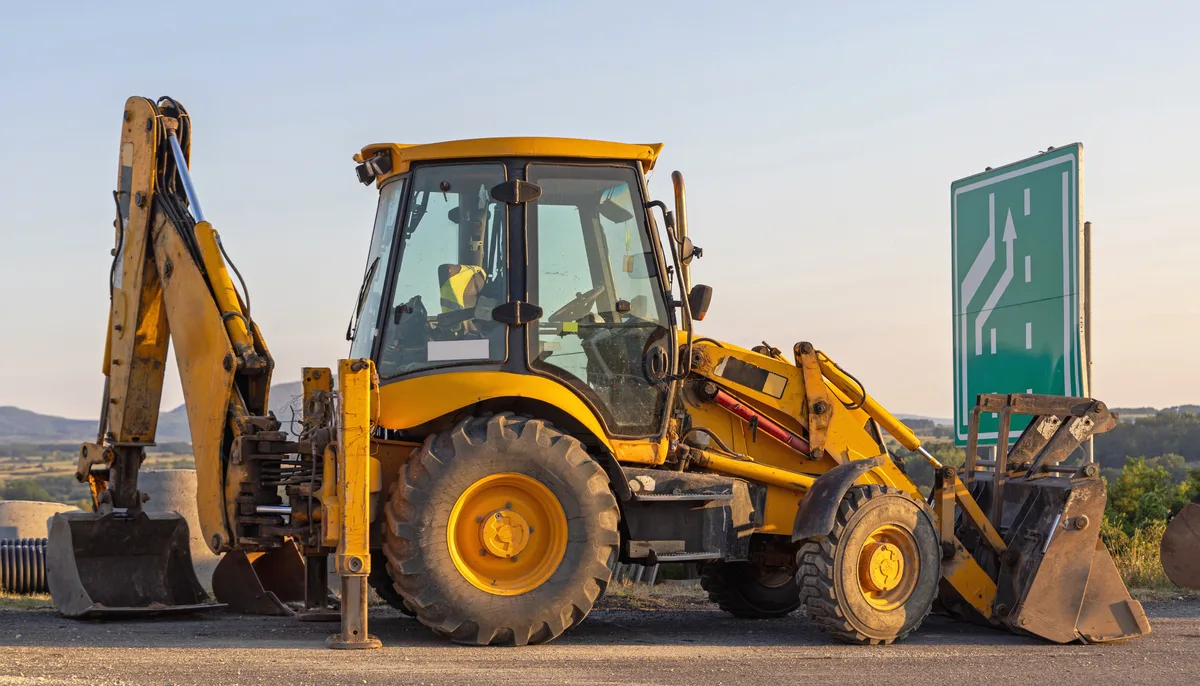
The defining Nevada exposure is transit, not theft. A backhoe is too slow and too conspicuous to be a soft target the way a compact loader is, but it spends real time on public roads and real time strapped to a deck, and both are where this class loses money. After that come the two failure modes the machine creates for itself: the boom swinging into something behind the operator, and the stabilizers punching into ground that looked firmer than it was. Nevada then adds its own wear pattern — heat on hydraulics through the southern summer, and fine grit that shortens the life of every pin and bush on the machine.
Common Nevada backhoe claims we see
- Struck-object damage during a road move. The signature Nevada backhoe claim: the machine is legally on the highway, and what it hits is somebody else’s.
- Boom or bucket contact behind the operator. Swing radius against a wall, a fence line or a parked vehicle on a tight urban lot.
- Stabilizer subsidence. A leg through soft or filled ground, taking the surface, the machine’s level and occasionally a buried service with it.
- Loading and tie-down damage on the long legs. Concentrated on the hauls between the northern and southern markets, where most of the state’s mileage sits.
- Heat-related hydraulic failure mistaken for a covered loss. Worth separating early, because wear is not a peril and the distinction decides the claim.
Why Nevada backhoe owners choose Equipment Guard Insurance
Equipment-only placement is the whole point of how we work, and on a Nevada backhoe it removes a specific obstacle: a licensed contractor here has liability and work comp arranged around a classification and a bid limit it does not want reopened, and being told to move the entire program to get one machine scheduled properly is not a serious proposal. We do not make it. We look at the road exposure honestly rather than assuming a site-only machine, and we place through markets — named on our homepage — that will read a Nevada equipment schedule on its own terms.
Major Nevada backhoe markets
- Las Vegas valley. The largest and densest jobsite market in the state, where short road moves between tight lots put the machine on public pavement several times a week.
- Henderson and North Las Vegas. Sustained residential and industrial build-out, with the boom-swing and stabilizer claims that come with working close to finished surfaces.
- Reno and Sparks. The northern industrial and distribution corridor, and the other end of every long haul in the state.
- Carson City. Municipal and utility work where a backhoe spends much of its week in the public right of way rather than inside a fence.
- Elko and the mining north-east. Remote work with long approaches, thin local support, and a recovery time measured in days rather than hours when a machine goes down.
Related
- Backhoe insurance — the machine physics that hold in every state.
- Skid Steer insurance in Nevada — the machine that answers to a filing office instead of a highway rule.
- All equipment insurance in Nevada — the state hub.
- Equipment floater · Rented & leased equipment
Primary sources
- NRS Chapter 482 — Motor Vehicles and Trailers — Nevada Legislature (road use and registration)
- License Classifications — Nevada State Contractors Board (NSCB) — Nevada State Contractors Board (contractor licensing)
Nevada backhoe insurance FAQs
What is a backhoe classed as on a Nevada highway?
Special mobile equipment. Nevada defines that as a vehicle not designed or used primarily to carry people or property and only incidentally moved along a highway, which is exactly what a backhoe does when it drives from one end of a job to the other. The classification is why it is not registered like a truck — and why the coverage question is not the one an ordinary fleet policy answers.
If it is not registered like a truck, do I still need auto coverage for it?
Usually yes, and this is where owners get caught out. A classification that excuses a machine from ordinary registration does not decide who pays when it hits something on a public road. The floater answers for damage to the backhoe itself; liability arising out of its road movement is a separate question we work through against how far and how often the machine actually travels.
Does my Nevada contractor license class affect how the machine is insured?
Indirectly, and more than most states. Nevada licenses by classification with a bid limit set against demonstrated financial capacity, so the ceiling on the work you can take is already a financial statement about your business. An equipment schedule that does not match the scale of work the license permits is the kind of mismatch an underwriter notices, and it is worth having the two tell the same story.
What breaks on a backhoe in Nevada that does not break elsewhere?
Heat and abrasion do the work that freeze and corrosion do in colder states. Sustained summer temperatures across the southern valleys are hard on hydraulics and seals, and fine desert grit accelerates wear on pins, bushings and the stabilizer feet. None of that is an insured loss on its own, but it shapes the condition of the machine an adjuster inspects after one.
How exposed is a backhoe on the long hauls between Nevada jobs?
That is the structural exposure here. The distance between the southern and northern markets is real, and a machine that can drive itself short distances still travels the long legs on a trailer. Loading, tie-down and the transit leg concentrate a disproportionate share of claims on this class, which is why the trailer and the machine want to be looked at together rather than on separate policies.
Will you write the backhoe on its own?
Yes — Equipment Guard Insurance places equipment monoline in Nevada. The machine and the work it does can be scheduled without moving the liability or the work comp you already have, which matters when those are arranged around a license classification you would rather not disturb.