

Nevada takes contractor credentials more seriously than most of the states around it. The board issues classified licenses and attaches a monetary limit to what you may bid, set against demonstrated financial capacity — so a small grading outfit is not merely permitted to work, it is permitted to work up to a size. That makes the equipment on your schedule part of a financial picture rather than just a list of machines.
Two other things shape a Nevada equipment account: the state has two real economies, at opposite corners, with very little in between them, and the climate does its damage slowly through heat, sun and abrasive dust rather than suddenly through hail or freeze. For the mechanical side of the machine — attachments, skid steering, the forward tip — see the skid steer insurance pillar.
What skid steer insurance costs in Nevada
We do not print a premium, because the number is put together from your machine list and the way the machines are kept. In Nevada the levers that move it most are the yard question — fenced, lit, and actually used, versus a loader left on a subdivision pad — and the distance between your jobs, because a machine that follows work between the two metros is exposed in a way one working a single valley is not. Attachment values and count, valuation basis, telematics, deductible and loss history follow. Heat and dust show up in the maintenance and claim record rather than as a separate charge.
Nevada skid steer regulations: title, lien and ownership
A skid steer is special mobile equipment, not a DMV-titled vehicle; a lender perfects its lien by filing a UCC-1 financing statement with the Nevada Secretary of State.
The practical effect is a paperwork one. With no certificate of title in existence, the financing statement and the serial plate are the ownership record, the lender that filed sits on the policy as loss payee against the scheduled unit, and settlements are issued jointly. Where Nevada asks more of a contractor than its neighbors do is one layer up: the classification on your license controls the kind of work you may take, the bid limit attached to it controls the size, and both are reviewed against your financial position rather than assumed. In that setting an equipment schedule carrying honest values is not administrative housekeeping — it is part of how the business presents itself to a board, a surety and a general contractor at the same time.
Common skid steer risks in Nevada
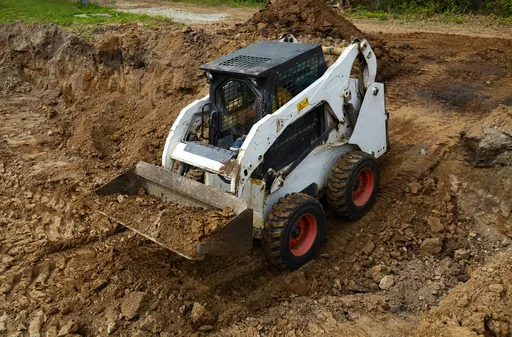
Theft leads, as it does on this machine everywhere, and southern Nevada concentrates it: continuous subdivision and commercial development, open pads with no perimeter, and a highway network that puts a trailered loader out of the valley quickly. Portable machines go far more often than large tracked ones. The second exposure is environmental but gradual — sustained heat on hydraulics, hoses and tires, and fine abrasive dust into filters, pins, bushings and cylinders, which is why two loaders with identical hours can be in very different condition here. Distance is the third: a machine working out of a remote market is days from a part rather than hours, so a modest failure becomes a long downtime claim. Loading damage and the forward tip account for most of the rest.
Common Nevada skid steer claims we see
- Overnight theft from an open subdivision pad. No fence, no lighting, and a file built from the serial plate because no title was ever issued for the machine.
- Attachment taken separately. A breaker, auger or forks off a rack while the loader stays where it is, then found to sit under a blanket per-item cap rather than scheduled by name.
- Heat-related hydraulic and hose failure. On a machine worked hard through a desert summer, where the loss is sudden but the cause was not.
- Dust ingress damage. Cylinders, pins, bushings and filters on a windy site, the slow claim owners least expect to be arguing about.
- Extended downtime on a remote job. Not the repair but the distance: a loader stranded a long way from the nearest parts counter.
Why Nevada skid steer owners choose Equipment Guard Insurance
We write equipment monoline, and in a classified-license state that turns out to be exactly what a contractor wants. The liability side of a Nevada program is usually arranged around a license classification and the requirements of the people you build for; nobody wants it reopened because one loader is scheduled at a value nobody has revisited in years. So we take the equipment on its own, list the attachments by name because that is where value quietly collects on a skid steer, and place through markets — named on our homepage — that will read a Nevada equipment schedule on its own merits.
Major Nevada skid steer markets
- Las Vegas. The largest jobsite market in the state, with continuous commercial and resort-adjacent work, the deepest rental counter, and the sharpest open-pad theft exposure.
- Henderson. Master-planned residential and commercial build-out where machines follow phases across large sites and rarely see a fenced yard mid-job.
- North Las Vegas. Industrial and distribution site work with wide-open lots, heavy dust, and easy highway access in both directions.
- Reno. The northern market, with industrial and infrastructure development and a set of loss patterns closer to a mountain climate than a desert one.
- Sparks and Carson City. Industrial parks and state institutional work, where accounts tend to run from a fixed yard and the schedules are easier to keep accurate.
- Elko. Mining and utility support work at the far end of the state, where distance to parts and support is itself part of the risk.
Related
- Skid steer insurance — the machine physics that hold in every state.
- Forklift insurance in Nevada — the machine whose operator training runs through this state plan rather than the federal one.
- All equipment insurance in Nevada — the state hub.
- Equipment floater · Rented & leased equipment
Primary sources
- License Classifications — Nevada State Contractors Board (NSCB) — Nevada State Contractors Board (contractor licensing)
We do not link a Nevada filing document here. The ownership and lien rules described above follow Article 9 as Nevada has adopted it; where a state publishes a document that states the rule directly, this page links it.
Nevada skid steer insurance FAQs
Which license class covers running a compact loader in Nevada?
It depends on the work rather than the machine, and Nevada is unusually specific about it. The State Contractors Board issues classified licenses in three families — general engineering, general building, and specialty, the last with a long list of subclassifications — and grading, excavation and site work sit in particular ones. A compact loader is a tool used inside whichever classification your license names; it does not have a classification of its own.
Do bid limits have anything to do with insurance?
Indirectly, and it is worth understanding. Nevada ties a monetary bid limit to demonstrated financial capacity, so the board’s review reaches your financial position rather than only your competence, and general contractors on larger projects tend to ask for the same kinds of documents. An equipment schedule that reflects what the machines are actually worth is part of presenting that picture honestly; a schedule carrying values nobody has revisited in years undercuts it.
Is a skid steer titled or plated here?
No. It is special mobile equipment rather than a road vehicle, so nothing is issued for it at a motor-vehicle office and no certificate changes hands at resale. Identity comes from the serial plate, the purchase paperwork and the central financing record — which is the whole file after a theft, since there is no title for law enforcement or an adjuster to work from.
Where is a lien on financed equipment filed in Nevada?
Centrally, with the Nevada Secretary of State, where UCC financing statements against equipment are filed and searched. The lender is then added to the policy as loss payee against the scheduled unit, so a settlement on that machine is issued jointly and the two records need to stay in step. The routine failure is drift rather than error: a paid-off loader still carrying a lienholder, or a newer machine that quietly replaced an older one on the yard but not on the schedule.
What does desert heat and dust actually do to a loader?
It attacks the parts that keep the machine working rather than the parts that make it look new. Sustained heat is hard on hydraulic fluid, hoses, seals and tires; fine abrasive dust reaches filters, cylinders, pins and bushings, and it gets into everything on a windy site. Sun exposure degrades glass seals, lights and cab interiors on machines parked out all summer. None of that is dramatic on any single day, which is exactly why it turns up as a claim rather than as maintenance.
Can I put the loader on its own policy?
Yes. Equipment Guard Insurance writes equipment monoline in Nevada, so the machine and its attachments can be scheduled on their own without reopening the liability program you built around your license classification. The iron is underwritten as iron, at values we go through with you.