

For a New Hampshire crew the backhoe is often the only machine on the truck insurance schedule that has to be right, because it is the only machine there is. It digs the trench, sets the tank, loads the spoil and backfills behind itself, and then it drives to the next town without waiting for a lowbed.
What follows is about the road half of that life and about the ground the other half happens in — how the state treats the machine once it is on public pavement, who is actually standing behind the contractor operating it, and what a state built on shallow rock does to iron. The behavior that travels with every backhoe everywhere belongs to the backhoe insurance pillar instead.
What backhoe insurance costs in New Hampshire
There is no honest figure to publish, and a made-up one would be worse than silence. The variables that actually set a New Hampshire backhoe premium are frequency and ground: how many separate road moves the machine makes in a typical week, how much of the work is rock and boulder rather than soil, whether the yard is fenced and lit or simply the far end of a dooryard, how the machine is stored across a long off-season, the valuation basis on the schedule and your own history. A backhoe doing seacoast utility work and a backhoe digging foundations in ledge country wear differently, and the pricing should follow the wear.
New Hampshire backhoe regulations: road operation
Self-propelled construction equipment such as a backhoe is generally treated as special mobile equipment not registered as an ordinary motor vehicle and only incidentally operated on public roads.
We name no section for that and we link nothing, because our New Hampshire record carries the treatment without a locator, and inventing one to look thorough would be the opposite of thorough. The substantive point survives the missing citation intact. Being outside ordinary registration is a bookkeeping fact about the machine; it is not a shield, and it does not follow that the road has become an extension of the jobsite. A backhoe under its own power on a town road is a slow heavy object among traffic, and the bill for what it strikes is answered by liability coverage rather than by the floater that puts the machine back together. The licensing picture reinforces the point rather than softening it. New Hampshire licenses trades through state boards and leaves general contracting to towns and cities, so for most equipment owners here there is no state credential to point at — which puts the whole weight of proof on the certificates, and therefore on the accuracy of what sits behind them.
Common backhoe risks in New Hampshire
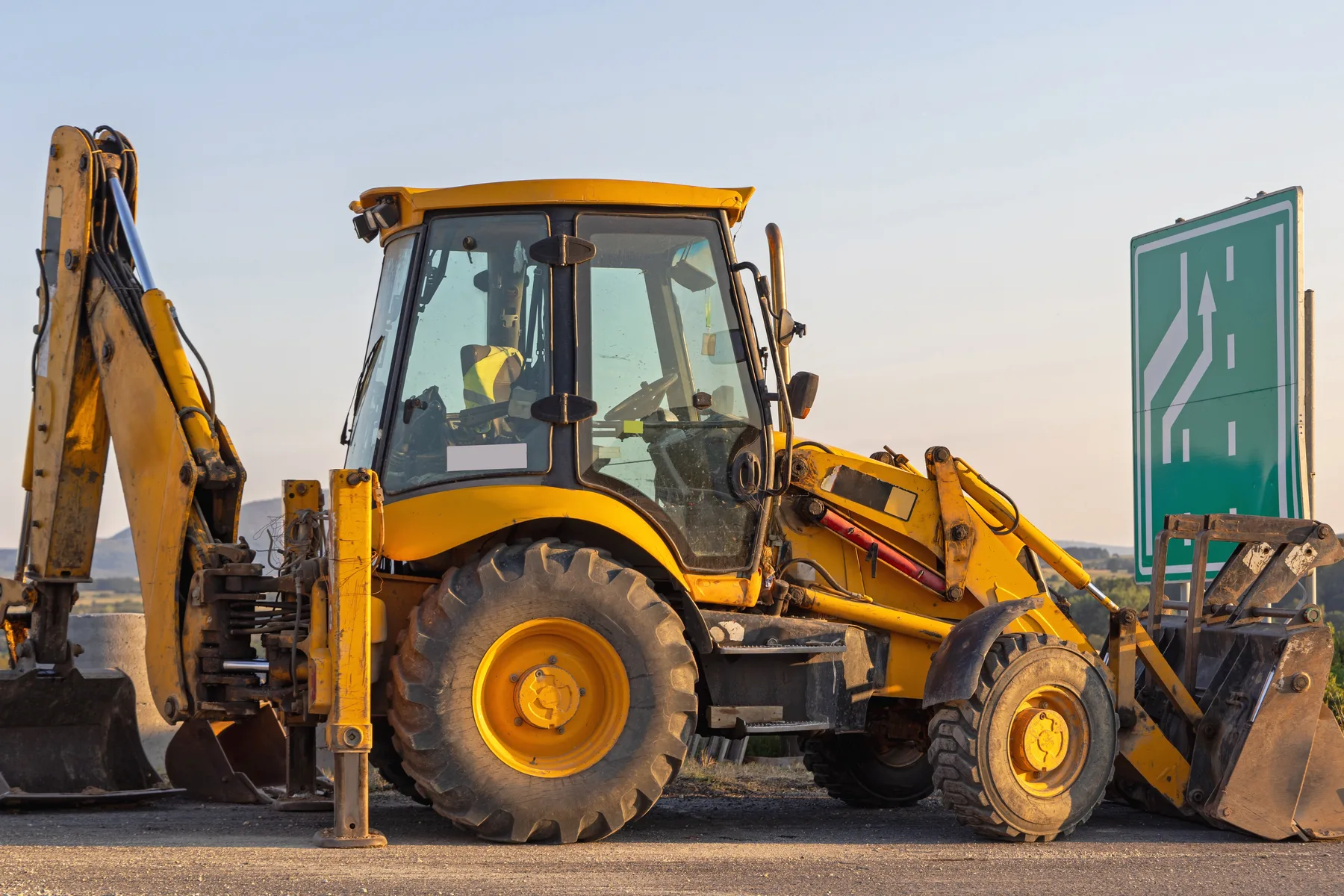
Rock organizes the risk on a New Hampshire backhoe. Bedrock close to the surface and till packed with boulders mean the machine spends its working life meeting resistance it was not designed to meet, and the result is accumulated strain rather than a single spectacular event — cracked dipper welds, worn pins, hydraulic circuits that fail long after the day that hurt them. Around that sit two more state-shaped exposures. Short distances between jobs tempt every crew into driving the machine rather than hauling it, which multiplies road-contact opportunities across the year. And a long off-season leaves iron standing still in weather, where slow damage goes unnoticed until spring.
Common New Hampshire backhoe claims we see
- Structural damage from bucket contact with ledge. The signature New Hampshire loss, and usually argued over whether it happened in one moment or over a season.
- Boulder strikes during trenching in till. Sudden load into the dipper and the boom pivot, with the invoice arriving later than the impact.
- Road-move contact on narrow town roads. Stone walls, guardrail ends, mailboxes and shoulder drops on roads with no room to give.
- Stabilizer settlement in saturated spring ground. Where thaw has taken the bearing capacity out of soil that held fine in October.
- Off-season damage discovered at start-up. Where the delay between the event and the discovery is what makes the file expensive.
Why New Hampshire backhoe owners choose Equipment Guard Insurance
Writing the machine on its own fits how New Hampshire contractors are actually built. Most are small, their liability and workers compensation are placed where they are for reasons that have nothing to do with equipment, and moving the whole program to schedule a backhoe correctly is a bad trade. We do not propose it. We ask how often the machine drives rather than rides, we ask what the ground is before we ask what the machine is worth, and we place through markets — named on our homepage — that will take a single New Hampshire machine seriously.
Major New Hampshire backhoe markets
- Manchester. The state’s largest contractor base, with enough infill and redevelopment work to keep a machine moving between sites inside one week.
- Nashua. Border-market density and steady commercial sitework, where lots are tight and finished surfaces sit close to the swing arc.
- Concord. Government, institutional and municipal utility work that keeps the machine in the public right of way rather than behind a fence.
- Derry. Residential and septic work in ledge-heavy ground, which is where the shock-loading claims on this class concentrate.
- Dover and Rochester. Growing seacoast-adjacent development with older buried systems and a great deal of short-hop machine movement.
- Portsmouth. Constrained historic-district and waterfront work, with salt air on the machine and almost nowhere to stage it off the street.
Related
- Backhoe insurance — the machine physics that hold in every state.
- Skid Steer insurance in New Hampshire — the unit that answers to a filing office rather than to the ledge.
- All equipment insurance in New Hampshire — the state hub.
- Equipment floater · Rented & leased equipment
Primary sources
We do not link a New Hampshire vehicle-code section here. The road-use treatment described above follows how New Hampshire classifies self-propelled construction equipment; where the state publishes a section that states it directly, this page links it.
New Hampshire backhoe insurance FAQs
Does New Hampshire register a backhoe as a highway vehicle?
Generally not. Self-propelled work machinery is treated as equipment rather than as a road vehicle, on the reasoning that it exists to dig rather than to carry and reaches the pavement only in passing, and that treatment keeps it outside ordinary registration. We state it that way deliberately — our record for this state describes the treatment without pinning a section, and we would rather be accurate about the shape of the rule than precise about a citation we cannot show you.
Why does this page cite no New Hampshire statute at all?
Because there is nothing to cite honestly. Where a state publishes a section that states the road-use rule directly and we can open and read it, we link it. Our New Hampshire record carries the treatment but not a section reference, so naming one would mean inventing a locator. An absent citation is the truthful outcome here, not an oversight.
Who licenses a general contractor in New Hampshire?
Nobody at the state level. New Hampshire licenses specific trades — plumbing, electrical, abatement work — through state boards, and leaves general contracting to individual municipalities. For an equipment owner that means there is no state credential standing behind you when a general contractor or an owner asks who you are. Your certificates do that work instead, so what appears on the schedule is the document being relied on.
What does New Hampshire ground actually do to this machine?
It shock-loads it. Bedrock sits close to the surface across much of the state and the soil above it is glacial till full of boulders, so a bucket that expects dirt regularly finds something that does not move. The damage is rarely dramatic — it is cumulative strain on the boom, the dipper, the pins and the hydraulics, showing up as a failure months later that somebody then wants to call sudden. Sorting wear from peril early is worth more here than almost anywhere.
Our jobs are all within an hour of the yard. Does that reduce the road exposure?
It reduces the mileage and raises the frequency, which is not the same trade. Short distances are exactly the ones a crew decides to drive rather than trailer, so the machine ends up on public roads several times a week instead of a few times a season. Exposure per mile falls and exposure per week rises, and it is the weekly figure that shows up in the loss run.
Can you insure the backhoe without touching our other policies?
Yes. Equipment Guard Insurance places equipment on its own in New Hampshire, so the machine gets scheduled properly while your liability and workers compensation stay exactly as arranged — which matters in a state where those policies are doing the job a license does elsewhere.