

In New Hampshire a compact loader has two jobs a year. From the thaw to the first hard freeze it does site prep, backfill, material handling and cleanup on lots that are often carved out of ledge and trees. Then the bucket comes off, a pusher or a blower goes on, and the same machine spends the winter clearing lots — or it goes into a shed and does nothing at all until April.
Both of those halves matter to the policy, and so does one thing about the state: nobody at state level licenses a general contractor here, so the authority you answer to is the town, and there are a great many towns. The loader-level material — steering by wheel speed, the forward weight bias, why the attachment end drives the schedule — sits on the skid steer insurance pillar.
What skid steer insurance costs in New Hampshire
Nothing on this page is a price. A figure worth acting on comes out of your machine, your storage and your record, and in New Hampshire it turns on two questions before any of the usual ones: does the loader work through the winter, and where does it live when it is not working. A machine that runs snow contracts is exposed twelve months and priced accordingly; a machine wintered in a locked shed is a lower operating risk with a longer discovery window on theft. Then the ordinary levers — scheduled value, the attachment list including the winter equipment, the valuation basis, whether a tracker is fitted, rented-in iron, and your own claim history. High utilization inside a short season reads differently from the same hours spread over a year.
New Hampshire skid steer regulations: title, lien and ownership
A skid steer is untitled construction equipment, not a DMV-titled motor vehicle; a security interest is perfected by filing a UCC-1 financing statement under New Hampshire’s UCC Article 9 with the Secretary of State.
The practical effect is that the ownership record is a filing plus a serial plate, and both of them need to be right before you need them. A lender financing the loader is named on the policy as loss payee against that scheduled unit, so a settlement is issued to both parties, and a lienholder still shown against a machine you sold two winters ago is the reliable sign that nobody has reviewed the schedule since. One layer up, New Hampshire runs almost the opposite of a centralized regime. The state licenses trades — plumbing, electrical, and asbestos and lead abatement — through boards under the Office of Professional Licensure and Certification, and leaves general-contractor requirements to municipalities. Because the state is built from many small towns rather than a few big cities, the practical consequence is that the permitting counter changes as often as the jobsite does, while nothing about the loader changes at all. The name you register with a town, the name on your certificate of insurance and the name on your equipment schedule should be one name, and it is the general contractor or the property owner who will check.
Common skid steer risks in New Hampshire
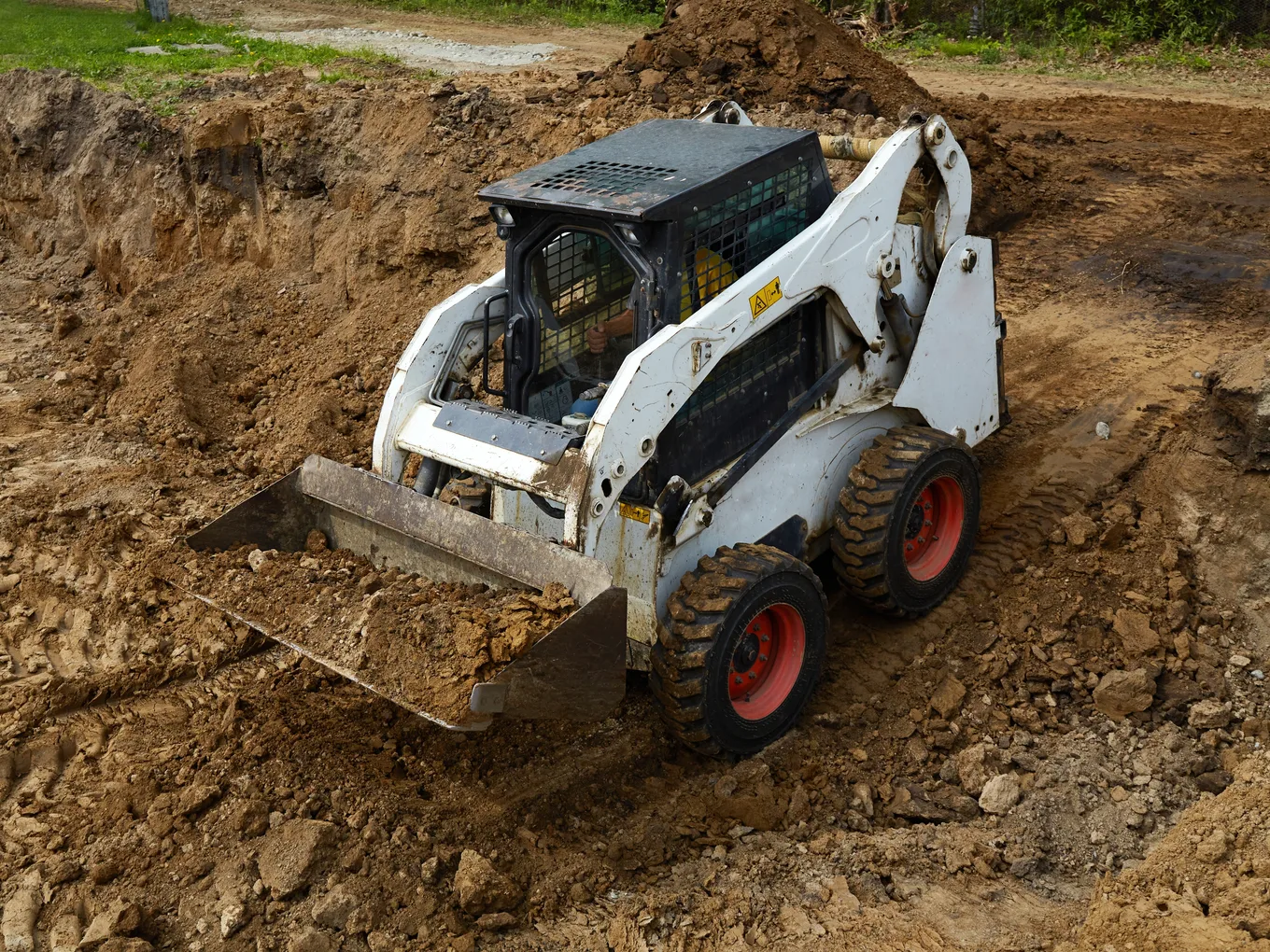
The season organizes the risk here more than the map does. Winter is the sharpest quarter: road salt on machines and trailers, obstructions buried under snowpack, damage to curbing, hydrants and irrigation heads that nobody can see, and cold-start and freeze losses on anything left outside. Spring inverts it — frost coming out of the ground turns access roads and pads soft, and a loader working saturated ground strains undercarriage, tires and hydraulics while cutting ruts into surfaces somebody expects restored. Theft runs underneath all of it, with two New Hampshire wrinkles: the southern tier sits inside a much larger out-of-state metropolitan orbit, so a machine taken from a Nashua or Derry job is over a state line quickly, and a loader stored through the winter can be gone for weeks before anyone notices. Going over the front with a raised load rounds out the list, and that one belongs to the machine.
Common New Hampshire skid steer claims we see
- Off-season theft from a stored machine. The most distinctly New Hampshire claim on this class: the loss happens in January, the discovery happens in March, and the serial record is the only thing that survives the gap.
- Winter property damage under snowpack. Curbing, hydrants, irrigation heads and pavement struck by a pusher or bucket working ground nobody could see.
- Frost-season rutting and restoration. Damage to lawns, drives and finished surfaces by a machine working soft ground during the thaw — frequently a liability question rather than an equipment one.
- Snow attachment left off the schedule. A pusher or blower that was never added, discovered at the worst moment to be uninsured while the loader beside it is covered.
- Cold-weather and salt damage. Freeze losses, cold-start failures and corrosion on machines and trailers that winter outdoors, which read as maintenance until compared with sheltered units.
Why New Hampshire skid steer owners choose Equipment Guard Insurance
We write equipment monoline, and on a New Hampshire account that avoids a pointless fight. A small contractor here has liability coverage arranged around whatever the towns it works in expect, plus a snow contract or two, and no interest whatsoever in rebuilding the program so a loader can be scheduled correctly. We take the equipment by itself. Winter attachments go on the schedule with the summer ones, by name and serial number, because a pusher is as easy to steal as a bucket and considerably more expensive. We place through markets — named on our homepage — that will underwrite a seasonal equipment schedule on its own terms.
Major New Hampshire skid steer markets
- Manchester. The state’s largest jobsite market, with mill-district redevelopment and commercial site work, and the widest range of overnight storage arrangements on one account.
- Nashua. The southern edge, inside a much larger out-of-state metropolitan orbit, so crews, machines and stolen trailers all cross the line as a matter of routine.
- Concord. State and institutional work with a steady municipal pipeline and long hauls out to surrounding town jobs.
- Derry. Residential build-out and snow contracts on the same machines, which is where the twelve-month exposure question comes from.
- Dover and Rochester. Seacoast-adjacent growth on constrained lots, with salt in the air on top of salt on the roads.
- Portsmouth. Dense historic-district and waterfront work where machine access is the hard part and finished-surface damage drives the claims that are not thefts.
Related
- Skid steer insurance — the machine physics that hold in every state.
- Backhoe insurance in New Hampshire — the unit that raises the road-registration question this one does not.
- All equipment insurance in New Hampshire — the state hub.
- Equipment floater · Rented & leased equipment
Primary sources
We do not link a New Hampshire filing document here. The ownership and lien rules described above follow Article 9 as New Hampshire has adopted it; where a state publishes a document that states the rule directly, this page links it.
New Hampshire skid steer insurance FAQs
Does New Hampshire title a skid steer?
No. A loader is untitled construction equipment rather than a registered road vehicle, so there is no certificate at purchase, none to sign over at resale, and none to produce when a machine disappears from a yard in February. The serial plate, the purchase paperwork and the lien filing carry the whole weight of proving what the machine is and whose it was.
Which authority licenses a contractor to run equipment in New Hampshire?
For general contracting, none at state level. New Hampshire licenses only specific trades — plumbers, electricians, and asbestos and lead abatement — through state boards under the Office of Professional Licensure and Certification, and leaves general-contractor requirements to municipalities. Because this is a state of many small towns rather than a handful of large cities, that means the authority you answer to can change several times across one working week, and the office you ask is the town office. What none of it changes is the rules touching the machine, which are the same everywhere in the state.
The loader runs snow in the winter. Does the schedule need to change?
The attachments do, and that is the part people forget. A pusher, a blower or a bucket-mounted plow is a scheduled item like any other, and a snow attachment left off the schedule is uninsured exactly when it is being used hardest. Winter work also changes the loss picture: road salt, hidden obstructions under snowpack, and property damage to curbing, hydrants and irrigation heads you cannot see. Tell us if the machine works snow, because a loader that runs twelve months is underwritten differently from one that stops in November.
What if the machine is stored all winter and not used at all?
Say so, and say where. A stored machine is a genuinely lower operating risk and a genuinely higher theft risk, because nobody looks at it for weeks at a time and a loss can be discovered long after it happened. Barn, pole shed, fenced yard or open field are four very different answers, and the last one is where off-season claims come from. Do not cancel or suspend the equipment coverage over the winter to save money — the exposure that remains is the one that pays out.
Does frost and mud season change how the machine is underwritten?
It changes what breaks. Deep frost means frozen ground in one month and saturated ground in the next, and mud season puts compact machines on soft roads and soft pads where they sink, slide and work harder than the ground can support. That drives undercarriage and tire damage, hydraulic strain, cold-start failures and rutting damage to surfaces you may be responsible for restoring. A short building season also means high utilization while the window is open, which underwriters read as intensity rather than mileage.
Can the loader be insured on its own?
Yes, and that is the way we prefer to do it. Equipment Guard Insurance writes equipment monoline, so the loader, the buckets and the winter attachments go on one schedule, and a general liability policy that already works for you is left where it is.