
Ask a New Jersey site contractor why the backhoe stays on the books long after bigger machines have been traded, and the answer is rarely about digging. It is that the machine can finish a trench, load the spoil, and then take itself to the next address without a truck, a driver and half a morning of scheduling.
This page is about the price of that last convenience in the most crowded state in the country: how the classification works once the machine is on a public road, what New Jersey asks of the business operating it, and which of those short trips actually generate the claims. Reach, breakout force and the mechanics that behave identically in every state belong to the backhoe insurance pillar.
What backhoe insurance costs in New Jersey
A number printed here would be fiction dressed up as guidance, so there is not one. The New Jersey inputs that genuinely move it are the count of road movements in a normal week rather than the miles those movements cover, where the machine sits overnight in a market where fenced yard space is scarce and expensive, whether attachments travel with it or stay behind, the valuation basis you choose, and what your own claim history says. A backhoe that lives inside one fenced industrial site and a backhoe that hops four addresses a week are different risks wearing the same paint.
New Jersey backhoe regulations: road operation
Self-propelled construction and road-building machinery such as a backhoe is generally treated as non-conventional/road machinery exempt from motor-vehicle registration while used in construction and only incidentally moved on public roads.
Read that sentence carefully, because owners routinely read one word too many into it. The exemption is about registration; nothing in it decides who answers for a wing mirror, a bollard or a parked car. We name no section and link no document for this rule, and that is deliberate rather than an oversight — this page cites only what we have fetched and read, and we hold no verified New Jersey section reference for the classification. Above the road question sits a licensing landscape with the same shape: New Jersey issues no statewide general contractor license, so home-improvement contractors register annually with the Division of Consumer Affairs and new-home builders register under the New Home Warranty program. Registration proves you filed, not that anyone examined you, which pushes the burden of proof onto certificates — and makes an equipment schedule that matches the work you actually take on more useful than it looks.
Common backhoe risks in New Jersey
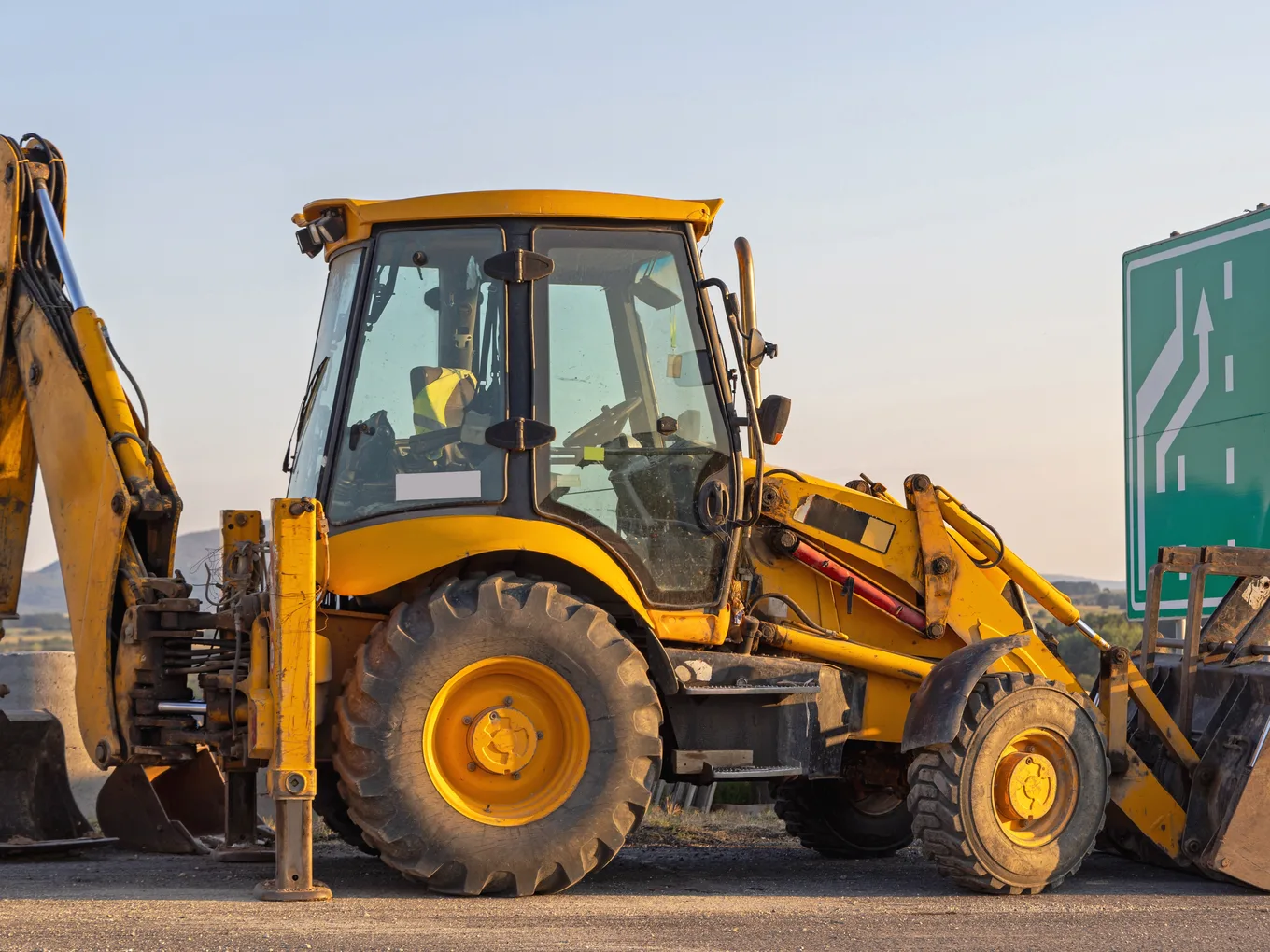
Density is the whole story. A New Jersey backhoe is rarely more than a few miles from its next job, so it moves under its own power constantly, and it does that movement in traffic rather than on an empty rural highway. That produces a claim pattern weighted toward low-speed contact with things that were never on the operator’s route plan: parked vehicles, curb lines, street furniture, and the corner of a building the boom cleared on the way in but not on the way out. Working close to finished surfaces compounds it, because the tolerance between the machine and something expensive is often measured in inches. Add winter road brine and coastal salt air working on pins and rams, and the condition of the machine an adjuster inspects is part of the exposure too.
Common New Jersey backhoe claims we see
- Contact with a parked vehicle during a street move. The most common file we open on this class here, and the one the registration exemption is most often assumed to have handled.
- Boom or counterweight strike on a building line. Urban lots leave no swing room, and the damage is to somebody else’s finished facade rather than to the machine.
- Stabilizer punch-through on saturated or made ground. Coastal sand, riverfront fill and old utility trenches all give way differently from what the operator felt an hour earlier.
- Damage while loading on a narrow street. Ramp angle, a cambered road and no room to reposition the trailer is a combination that bends decks and cracks glass.
- Corrosion presented as a sudden failure. Salt does slow damage that surfaces suddenly, and settling the wear-versus-peril line early keeps the claim honest.
Why New Jersey backhoe owners choose Equipment Guard Insurance
Placing equipment on its own is the entire model here, and in New Jersey it removes a specific piece of friction. An outfit whose registration renewals and general-contractor prequalification packets already depend on existing certificates has no appetite for rebuilding the whole program to get one machine scheduled properly, and we never suggest it. We ask how often the machine crosses public pavement rather than assuming it never does, we put the trailer and the attachments on the same schedule as the machine, and we place through markets — named on our homepage — that will underwrite a New Jersey equipment account on its own facts.
Major New Jersey backhoe markets
- Newark. The heaviest site-work market in the state, where a road move means merging into arterial traffic within a block of leaving the gate.
- Jersey City. Infill on parcels barely larger than the machine, with public sidewalk and street on at least two sides of most jobs.
- Elizabeth. Terminal and industrial-yard work with constant heavy vehicle movement around a machine that accelerates like a backhoe does.
- Paterson. Older street grids and utility repair work, where the machine occupies the travel lane rather than a fenced compound for most of the day.
- Edison and the central corridor. Warehouse and distribution ground work with longer approaches, so more of the movement happens on a trailer than under the machine’s own power.
- Toms River and the shore counties. Rebuild and drainage work on sand and low-lying ground, where stabilizer bearing and salt exposure both do their damage quietly.
Related
- Backhoe insurance — the machine physics that hold in every state.
- Skid Steer insurance in New Jersey — the machine that gets stolen off the same crowded lots this one drives away from.
- All equipment insurance in New Jersey — the state hub.
- Equipment floater · Rented & leased equipment
Primary sources
We do not link a New Jersey vehicle-code section here. The road-use treatment described above follows how New Jersey classifies self-propelled construction equipment; where the state publishes a section that states it directly, this page links it.
New Jersey backhoe insurance FAQs
Does a backhoe have to be registered like a truck in New Jersey?
Not while it is being used as construction machinery and only moved on public roads incidentally to that work — the road-machinery treatment keeps it outside ordinary motor-vehicle registration. What it does not do is convert the road into an extension of the jobsite. Every yard of pavement the machine covers is shared with people who have right of way, and that is a liability question rather than a registration one.
Why does this page not link a New Jersey code section?
Because we hold no section reference for this rule that we have fetched and read ourselves, and we would rather say so than gesture at a citation. The treatment described here is how the classification works in practice for self-propelled construction machinery. If a state publishes a section that states it directly and we can read it, it appears in the sources block on this page — nothing else does.
Is there a New Jersey license that covers running heavy equipment?
There is no statewide general contractor license to hold. Home-improvement contractors register annually with the Division of Consumer Affairs inside the Office of the Attorney General, and builders of new homes register under the New Home Warranty program instead. Registration is an administrative status rather than a demonstration of competence, so what a general contractor or an owner can actually verify about you is the paperwork behind you — much of which is insurance paperwork.
My jobs are twenty minutes apart. Does that make the road exposure smaller?
Smaller in miles, larger in incidents. A backhoe that self-transports several times a week across dense arterial roads accumulates far more exposed movements than one that makes a single long haul each month, and the surroundings are worse: live traffic, parked vehicles inches from the swing path, and curb lines that a wide machine cannot always keep off. Frequency of movement matters more here than distance, and we rate the account accordingly.
What does working near the shore do to the machine?
Two things, and they arrive on different timescales. Saturated sand under a stabilizer pad behaves nothing like the compacted fill the operator was on that morning, so subsidence claims cluster on coastal and low-lying work. Then there is salt, which along with the brine used on winter roads shortens the life of pins, rams and every electrical connection on the machine. Corrosion is wear rather than a peril, and separating the two before a claim saves an argument during one.
Can I insure the backhoe without disturbing my other policies?
Yes — Equipment Guard Insurance places equipment on its own in New Jersey. The machine, its attachments and the trailer it rides can be scheduled without reopening the liability or workers compensation that your registration renewals and your general contractors already have certificates for.