
New Jersey does not have room for big iron on most of its jobsites, and that is exactly why the compact loader carries so much of the work here. It gets through a driveway, turns inside a lot line, and swaps from bucket to breaker to broom without a second machine being mobilized. Every one of those virtues is also a reason it is the easiest serious machine on the site to drive away.
Three things shape this class in New Jersey and none of them are about the machine: the state registers contractors on an annual clock instead of licensing them, a district certifies the earthwork plan before dirt moves, and the whole state sits inside a couple of hours of a container terminal. For the physics that hold in every state — the attachment ecosystem, skid steering and the forward-tip pattern — read the skid steer insurance pillar.
What skid steer insurance costs in New Jersey
There is no honest premium to publish here, because the number is assembled from your own machine and your own habits. The dominant variable in New Jersey is storage, and storage is scarce: secure yard space is expensive on this side of the state and many crews genuinely have nowhere to put a loader other than the site it is working. A machine that returns behind a gate every evening is a different submission from one that lives on a job for a month. After that come the replacement value and count of attachments, the valuation basis, whether telematics are fitted, deductible, and your own loss record.
New Jersey skid steer regulations: title, lien and ownership
A skid steer is untitled construction equipment rather than a DMV-titled motor vehicle; a security interest is perfected by filing a UCC-1 financing statement under New Jersey’s UCC Article 9 with the Division of Revenue and Enterprise Services.
What that means day to day is that the paperwork carries the machine. A financed loader has a lender recorded against it, and that lender belongs on the policy as loss payee against the scheduled unit so settlement is issued jointly — which only works if the schedule and the financing record describe the same serial number. Payoffs and trades are where the two drift apart, and a lienholder still named against a machine you no longer own is the clearest signal a schedule has gone stale. One layer up, New Jersey checks the contractor rather than the loader: the entity named on a certificate of insurance and the entity holding the current Consumer Affairs registration have to be one and the same, because a general contractor comparing those two documents is the person who finds out first when they are not.
Common skid steer risks in New Jersey
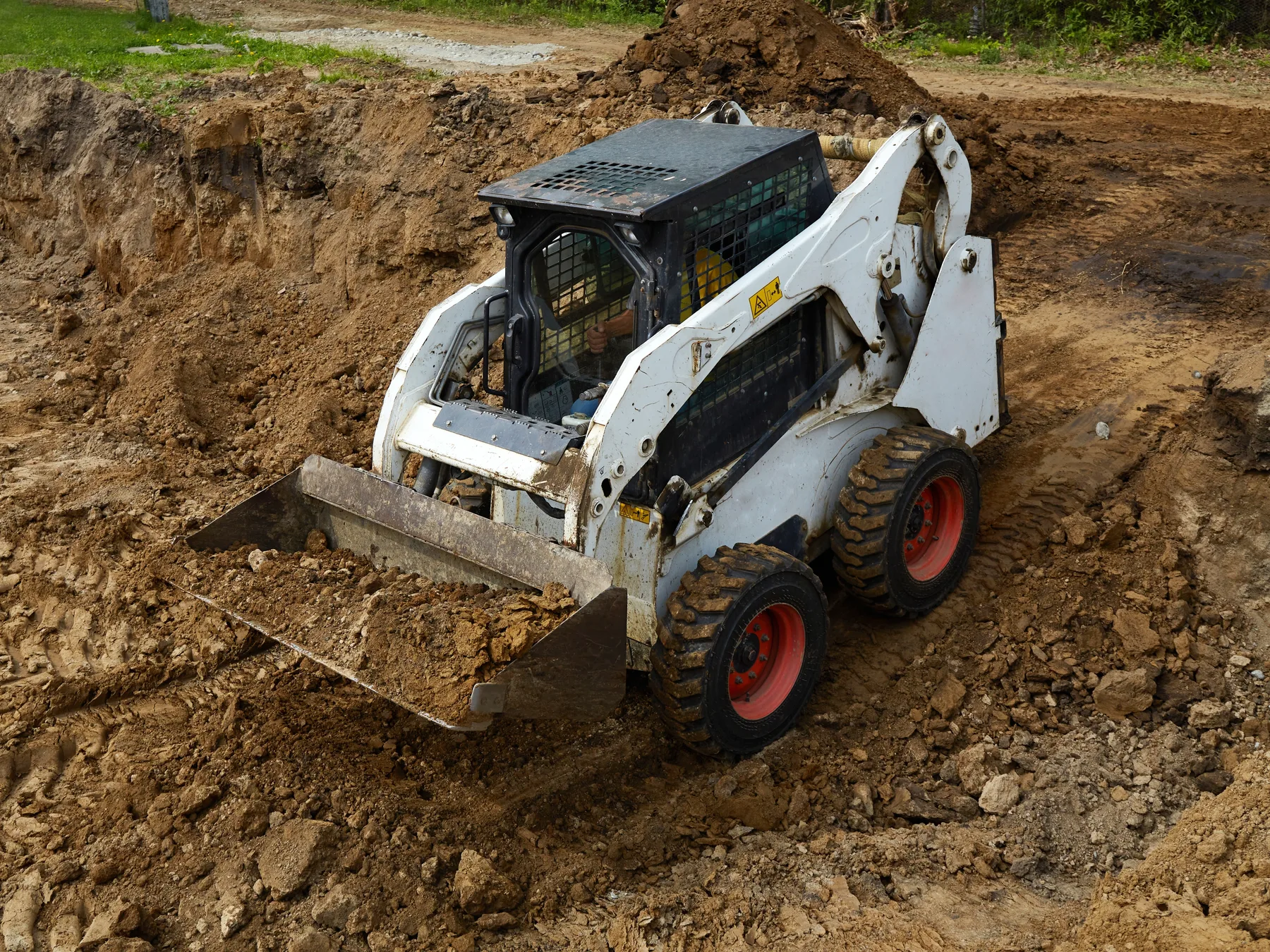
Theft leads, and in New Jersey it leads because of proximity rather than distance. Almost no site in the state is far from a marine terminal or a limited-access highway heading for one, so a trailered loader blends into ordinary traffic within minutes of leaving. Density does the rest of the work: urban infill lots are open to the street, fencing is temporary, and machines are staged for permit and certification windows they cannot control. Weather is the second exposure, and it splits — coastal wind and water at the shore, freeze-and-thaw damage on hydraulics, glass and cab seals inland. What remains is the physics: the forward tip with the arms loaded and up, and the damage a loader takes going on and off a trailer.
Common New Jersey skid steer claims we see
- Loader taken overnight from an open infill lot. The defining claim in this state, usually with the rack attachments and sometimes the trailer, and settled entirely against the serial record.
- Machine stolen while staged awaiting a certification window. Mobilized early, then left on a site nobody was watching for weeks before work could legally start.
- Breaker or auger lifted off a yard rack. Found afterwards to have been riding a blanket per-item cap rather than a named line on the schedule.
- Coastal storm damage to iron that could not be moved in time. Wind-driven water and debris on a machine parked at grade on an exposed shore site.
- Certificate that does not match the registration on file. Not an insured loss, but the most common reason a New Jersey crew is turned away at a gate.
Why New Jersey skid steer owners choose Equipment Guard Insurance
We place equipment on its own, which removes a specific obstacle in this state. A New Jersey crew has usually built its liability around a registration and a client list it has no intention of disturbing, and the answer to a badly scheduled loader is not a whole new program. So we schedule the iron, name the attachments individually as standard practice, and leave everything else where you have it. The markets we place through — named on our homepage — will underwrite a New Jersey equipment schedule on the strength of the schedule.
Major New Jersey skid steer markets
- Newark. The state’s largest concentration of site work and demolition, on lots that open straight onto public street frontage with nowhere secure to leave a machine.
- Elizabeth. Terminal and industrial-yard work where the freight infrastructure that makes the market also makes a trailered loader unremarkable traffic.
- Jersey City. Vertical infill and podium work on footprint-sized sites, where confined loading and finished-surface damage drive most of the non-theft claims.
- Paterson. Older-fabric rehabilitation and utility-adjacent repair, with narrow access that puts the compact loader on nearly every job.
- Trenton. Institutional and public-sector build-out on longer schedules, which means longer unattended intervals between active work days.
- Toms River and the shore. Resiliency and rebuild work on exposed sand sites, where storm staging and a slow trailer haul out are both part of the risk.
Related
- Skid steer insurance — the machine physics that hold in every state.
- Dozer insurance in New Jersey — the machine the acre-based land-disturbance permit is written for.
- All equipment insurance in New Jersey — the state hub.
- Equipment floater · Rented & leased equipment
Primary sources
We do not link a New Jersey filing document here. The ownership and lien rules described above follow Article 9 as New Jersey has adopted it; where a state publishes a document that states the rule directly, this page links it.
New Jersey skid steer insurance FAQs
Does a skid steer get a New Jersey title or plate?
Neither. Nothing goes through Motor Vehicle Commission for it, because it is business equipment rather than a road vehicle, so a sale moves on a bill of sale and a theft report has no title behind it. The serial number is the only permanent identifier the machine carries, and a schedule that lists loaders by make and color instead of serial is the document that lets a claim drift.
Do I need a contractor license to run a loader in New Jersey?
There is no statewide general-contractor license to hold. What the state requires instead is registration: home-improvement contractors register annually with the Division of Consumer Affairs, inside the Office of the Attorney General, and builders putting up new homes register separately under the New Home Warranty program. Registration renews on a clock rather than sitting on a shelf, so the practical risk is a lapse — and a lapsed registration is discovered by the same paperwork review that checks your certificate.
Does the soil-conservation-district process reach my equipment risk?
Indirectly, and more than most owners expect. Earthwork here runs through a soil-erosion and sediment-control plan certified by a district before dirt moves, layered on the state construction stormwater permit. That process decides when a machine may start, which means loaders and attachments are routinely mobilized to a site and then wait there — parked, staged and unattended — for a stretch nobody planned for. Staged iron is idle iron, and idle iron on a site with no gate is the single most exposed condition on this class.
Which attachments are actually insured?
The ones written onto the schedule by name. A blanket attachment limit with a per-item cap handles buckets and forks fine, and then quietly fails on the expensive heads — breakers, augers, mulchers, sweepers — which sit above the cap. Attachments also leave without the loader: a rack in a fenced yard is easier to reach than a cab with the keys pulled, so anything you would replace immediately belongs listed individually.
Does working the shore change how the machine is underwritten?
It adds a second story to the file. Rebuild and resiliency work along the coast means machines on exposed sand and marsh sites where a coastal storm arrives with wind, water and no high ground nearby, and where moving iron inland ahead of weather is a real operational task rather than a formality. Inland the exposure is the freeze-and-thaw cycle on hydraulics and glass. Both come back to the same underwriting question: where the loader sleeps.
Can the loader go on its own policy?
It can. Equipment Guard Insurance places equipment as a monoline account, so the machine, its attachments and any rented-in units sit on one schedule of their own. Liability you already hold stays untouched — we are not asking for the rest of the program to move.