
A backhoe is the machine that lets a small New Mexico outfit say yes to work in three counties. It trenches for a water service, digs a footing, loads out spoil and sets pipe — and when the job is inside a town, it gets itself to the next address without a truck being involved at all.
This page deals with the New Mexico half of that: how the state classifies the machine on a public road, how a classification-coded credential describes the work you may take, and what unpaved approaches and hard ground do to iron that lives outside. The machine behavior that never changes at a state line — reach, swing, stabilizer loading — belongs to the backhoe insurance pillar rather than here.
What backhoe insurance costs in New Mexico
No rate is printable here, and one printed anyway would be fiction with a decimal point. The New Mexico variables that move it are the balance between paved and unpaved travel, how far the furthest job sits from support, whether the machine returns to a secured yard or stays out on a lease, the age and attachment list, the valuation basis and your losses. An identical pair of machines — one on subdivision work inside a metropolitan area, one running caliche approaches in the southeast — are not the same risk, and a process that gives them one price is not underwriting.
New Mexico backhoe regulations: road operation
A self-propelled backhoe is ‘special mobile equipment’ — a vehicle not designed or used primarily for transporting persons or property and only incidentally moved over the highways.
This build records that definition at NMSA 66-1-4.16 and links nothing, because a citation on this site is a claim that the document was fetched and read, and that one has not been. The commercial reading is unaffected. Sitting outside ordinary registration is a titling outcome; it decides nothing about who pays when a machine on a public road hits a vehicle, a curb or a utility pedestal — that is liability, not a floater question, and the two are settled in different places. Alongside the road rule sits the credential, which in New Mexico is more informative than in most states. The Construction Industries Division licenses by classification under the Construction Industries Licensing Act — GB-98 for general building, GB-2 for residential, GA for general engineering and the specialty classes beneath them — so the code on a contractor’s card is a description of permitted scope rather than a formality. That makes it worth keeping the equipment schedule and the classification consistent with each other: an earthmoving fleet under a residential class, or the reverse, is a discrepancy somebody eventually reads aloud.
Common backhoe risks in New Mexico
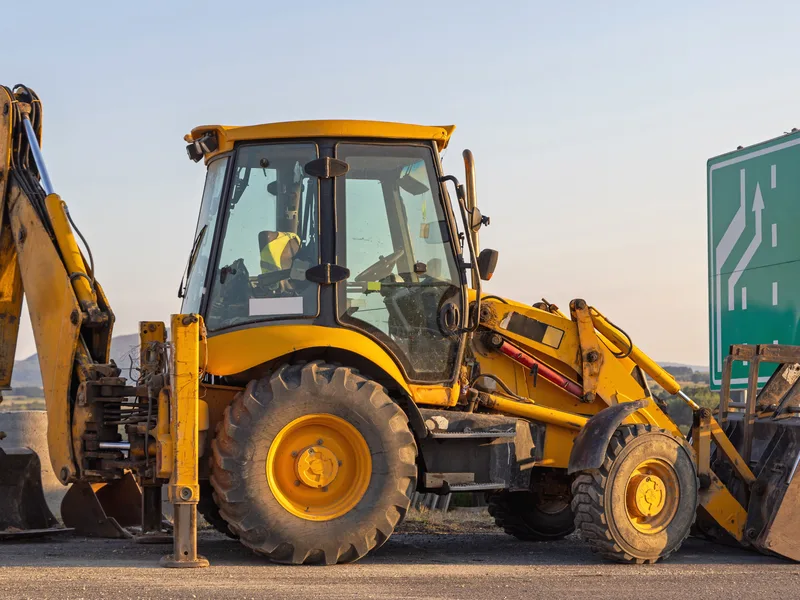
Two things dominate here, and neither is theft. The first is the approach: a large share of New Mexico site work is reached over unpaved county and lease roads, and the cumulative punishment of washboard, rock and dust on hoses, seals, glass and pins does more damage to a backhoe than any single event does. The second is hard ground — caliche and rock resist a bucket, the operator answers with force, and the force goes into the boom, the dipper and the pins. Around both sits the ordinary anatomy of the class: swing contact behind the operator, a stabilizer through arroyo fill, and long recoveries whenever the job is far from a dealer.
Common New Mexico backhoe claims we see
- Cumulative damage on unpaved approaches presented as a single event. The most common coverage argument on this class here, and the easiest to prevent by describing the access honestly up front.
- Boom, dipper or pin damage forcing hard ground. Caliche and rock turn operator technique into a structural loss faster than soft ground ever does.
- Stabilizer collapse into arroyo or wash fill. Material that looks like firm ground and behaves like nothing of the kind.
- Collision on a short in-town road move. The machine is legally out there, slow and wide, in traffic that is not expecting it.
- Extended downtime on a remote lease job. The distance from parts and a mechanic, not the failure itself, is what sets the size of the loss.
Why New Mexico backhoe owners choose Equipment Guard Insurance
Monoline equipment placement fits how licensed New Mexico contractors are organized. The liability and workers compensation behind a classification are settled arrangements, and being told to move all of it so that one machine can be scheduled properly is not an offer worth taking. We do not make it. We ask how the machine reaches its work rather than assuming pavement, we describe unpaved access as the wear exposure it is instead of leaving it to be argued later, and we place through markets — named on our homepage — that will underwrite a New Mexico equipment schedule against the classification it actually sits behind.
Major New Mexico backhoe markets
- Albuquerque. The state’s deepest market, with dense infill, aging buried services and short road moves between jobs several times a week.
- Rio Rancho. Sustained residential build-out on sandy ground, where subgrade behavior changes across a single lot.
- Santa Fe. Constrained historic streets and utility replacement, where the swing radius is the operating limit rather than the reach.
- Las Cruces. Agricultural, institutional and border-corridor work with a long working season and long approaches.
- Hobbs. Southeastern energy-country site work reached over lease roads, where the access does more damage than the digging.
- Farmington. San Juan basin work with hard ground, long distances to support, and the slowest recoveries in the state.
Related
- Backhoe insurance — the machine physics that hold in every state.
- Skid Steer insurance in New Mexico — the compact machine that rides out to the lease on a deck rather than driving there.
- All equipment insurance in New Mexico — the state hub.
- Equipment floater · Rented & leased equipment
Primary sources
- Construction Industries - NM Regulation and Licensing Department — New Mexico Regulation and Licensing Department (RLD), Construction Industries Division (CID) (contractor licensing)
We do not link a New Mexico vehicle-code section here. The road-use treatment described above follows how New Mexico classifies self-propelled construction equipment; where the state publishes a section that states it directly, this page links it.
New Mexico backhoe insurance FAQs
How does New Mexico license the contractor running a backhoe?
By classification. The Construction Industries Division inside the Regulation and Licensing Department issues credentials under the Construction Industries Licensing Act, and each one carries a class code — GB-98 for general building, GB-2 for residential, GA for general engineering, plus the specialty classes. The class is not decoration; it is a description of the scope you are permitted to take on, and the equipment behind it should be consistent with that scope.
Does the class code have anything to do with insurance?
Indirectly, and it is worth using. An underwriter reading a general-engineering classification expects to see earthmoving iron on the schedule; reading a residential classification, it expects less of it. When the class and the schedule disagree, somebody eventually asks why — usually at the least convenient moment. Getting them to tell the same story is free, and it removes a question from the file before it is asked.
Is a backhoe registered like a highway vehicle here?
No. The vehicle definitions place a self-propelled backhoe with equipment that is worked rather than driven and only incidentally moved over the highways, which keeps it outside ordinary registration. This state’s datum records the definition at NMSA 66-1-4.16; we name that and link nothing, because the page cites only documents that have been fetched and read, and that one has not.
Most of our access is unpaved. Does the road rule still matter?
It matters differently. A rule about highways says less about a machine that reaches its work over county roads, lease roads and two-track, and more of the actual damage happens on that unpaved approach than on pavement — washboard and rock working at pins, hoses and glass over long approaches. The exposure has not disappeared; it has moved from a liability question to a condition-and-wear question, and both belong on the application.
What does New Mexico ground do to the machine?
It is hard on the front and the back of it. Caliche and rock resist a bucket in a way the operator answers with force, which loads the boom, the dipper and the pins harder than soft ground ever does. Dust gets into everything with a seal; sun degrades hoses and glazing; and the arroyo fill that looks like firm ground can drop a stabilizer without warning. None of that is a peril by itself, but it sets the condition an adjuster inspects.
Will you write the machine on its own?
Yes — Equipment Guard Insurance places equipment monoline in New Mexico. The backhoe and its attachments can be scheduled without reopening the liability or workers compensation arranged around your classification, which is exactly the arrangement most licensed contractors here would rather not disturb mid-term.