
A skid steer is the machine that makes a New Mexico crew viable across distances that would otherwise require two of everything. It loads, grades, digs, breaks and lifts, it fits a walled courtyard lot as easily as a pad in the oil patch, and it goes on the same trailer that is already behind the truck. The catch is that a machine light enough to take anywhere is light enough for someone else to take anywhere.
What follows is specific to New Mexico: a state license defined by classification rather than by a simple threshold, a climate that wears equipment out through dust and sun instead of rust, monsoon water that arrives faster than the storm that made it, and very long gaps between the places a machine can be repaired or replaced. Attachment economics, skid steering and the forward-tip pattern belong to the machine rather than to any state, and they are covered on the skid steer insurance pillar.
What skid steer insurance costs in New Mexico
There is no premium on this page, because an honest one comes out of your machine, your ground and your record rather than a state average. In New Mexico the levers that matter most are range and storage together: how far the loader travels from its base, and whether it comes home at night or stays on a site in open country for the length of the job. Condition carries unusual weight here too, because a dusty climate rewards maintenance records and punishes their absence. After those come the value and number of attachments on the schedule, the valuation basis you choose, whether a tracking unit is fitted, and your own loss history. A loader working inside the Albuquerque metro and one working out of Hobbs are not the same risk, and the pricing reflects it.
New Mexico skid steer regulations: title, lien and ownership
A skid steer is special mobile equipment, not a DMV-titled vehicle; a lender perfects its lien by filing a UCC-1 financing statement with the New Mexico Secretary of State.
The ordinary consequence is that a financed machine is proved by the financing statement and the serial number rather than by a certificate, and the lender goes onto the policy as loss payee against the scheduled unit, so a loss payment is issued jointly. Keep both records current — a lienholder still named against a machine you paid off is the clearest sign a schedule needs review. What New Mexico adds sits one level up, at the licensing layer, and it is worth taking seriously because it is easy to be casually wrong about. The state license is scoped by classification, so the question at a jobsite gate is not only whether you hold a license and a certificate, but whether the classification on that license covers the work the loader is about to do. When the same machine moves between building, residential and engineering scopes in a single month, that is a question worth asking before the general contractor asks it.
Common skid steer risks in New Mexico
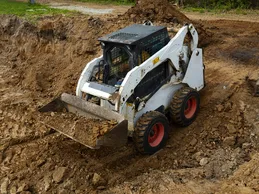
Theft leads, and in New Mexico it is a distance-and-corridor problem. There are few metros, a great deal of empty highway between them, an international border to the south, and interstate routes running the length and width of the state, so a trailered loader taken from an open site has hours before anyone is looking and several directions to go. Environmental wear is the second exposure and it is unusually steady: abrasive dust into filters, seals and cylinders, ultraviolet damage to hoses and glazing, and heat working on hydraulics all season. Monsoon flash flooding is the third and the least expected — fast water through low ground that was dry that morning. What is left is machine-shaped rather than local: the forward tip with the arms raised, and damage taken loading onto a trailer on uneven ground.
Common New Mexico skid steer claims we see
- Theft from an open site outside a metro. The defining claim here, with a long head start and a recovery that rests entirely on the serial record because no certificate of title exists.
- Dust-driven component failure. Hydraulic and engine damage traced to abrasive ingress, the kind of loss whose outcome depends on how well maintenance was documented.
- Flash flood damage in low ground. A loader parked in an arroyo bottom or a low crossing and caught by water from a storm that fell somewhere else.
- Attachment taken by itself. A breaker, auger or grapple lifted from a yard rack while the machine stays put, then found to sit under a blanket per-item cap instead of scheduled by name.
- Scope and classification mismatch at a gate. Not an insured loss, but a common stop: the work the loader arrived to do sits outside the classification the license covers.
Why New Mexico skid steer owners choose Equipment Guard Insurance
We write equipment monoline, which fits how New Mexico contractors are actually organized. A crew here holds a classified state license and a liability policy arranged around it, and rebuilding that program to get one loader scheduled properly is not a trade anyone should be asked to make. We do not ask for it. Attachments go on by name as a matter of course, because on a skid steer that is where value accumulates out of sight, and we place through markets — named on our homepage — that will read a New Mexico equipment schedule, dust and distance included, on its own merits.
Major New Mexico skid steer markets
- Albuquerque. The one genuinely deep market in the state: the most sites, the most rental capacity, and the best chance of replacing a machine the same week you lose it.
- Las Cruces. Southern growth, agricultural and border-corridor work, where a stolen loader has the shortest run to a route out of the country.
- Rio Rancho. Fast residential build-out on caliche and sand, hard on undercarriages and hard on the tires of a wheeled loader.
- Santa Fe. High-value historic and residential work on tight walled lots, where finished-surface damage and confined-site loading drive nearly everything that is not a theft.
- Farmington. San Juan Basin energy and utility support work in the northwest, with remote sites, long hauls and thin local support.
- Hobbs. Southeast oilfield country, where machines live on pads for weeks at a time and dust exposure is at its worst.
Related
- Skid steer insurance — the machine physics that hold in every state.
- Dozer insurance in New Mexico — the machine whose land-disturbance permit here is issued federally rather than by the state.
- All equipment insurance in New Mexico — the state hub.
- Equipment floater · Rented & leased equipment
Primary sources
- Construction Industries - NM Regulation and Licensing Department — New Mexico Regulation and Licensing Department (RLD), Construction Industries Division (CID) (contractor licensing)
We do not link a New Mexico filing document here. The ownership and lien rules described above follow Article 9 as New Mexico has adopted it; where a state publishes a document that states the rule directly, this page links it.
New Mexico skid steer insurance FAQs
Is a skid steer titled in New Mexico, or registered like a vehicle?
Neither. The state files it under special mobile equipment rather than titled motor vehicles, so there is no certificate for it and nothing to surrender when it sells. The serial number, the bill of sale and the financing record are the whole identity of the machine. In a state with this much open ground between jobs, that record is the difference between a recoverable loss and a story about somebody else’s loader.
What kind of contractor license does New Mexico require?
A statewide one, issued by the Construction Industries Division of the Regulation and Licensing Department under the Construction Industries Licensing Act — and the important part is that the license names a classification. General building work sits under one code, residential building under another, general engineering under another again, with specialty classifications alongside them. The question here is rarely whether you are licensed; it is whether the classification you hold covers the scope of the job you are bidding.
Why does a classification-based license matter for a loader?
Because a skid steer is the least specialized machine on any site and it drifts across scopes without anyone noticing. The same loader does site prep on a building job, trenching support on a utility job, and grading on what is really an engineering scope. That is a licensing question rather than an insurance one, but it becomes an insurance question at the gate: the certificate of insurance, the classification on the license and the entity holding both are read together, and a scope you are not classified for is the kind of thing that stops a machine before it is unloaded.
What does the desert actually do to the machine?
It grinds it. Fine abrasive dust reaches air filters, hydraulic seals, cylinder rods and radiator cores in a way that damp climates never manage, and it accelerates wear on exactly the components that make a loader expensive to fix. Sustained ultraviolet exposure hardens hoses, seats and glazing. Elevation costs engine performance across most of the state. None of that is a sudden loss, but all of it shows up in maintenance records that underwriters read, and in breakdowns during the weeks you can least afford one.
Is flooding a real exposure in a state this dry?
More than people expect, and in a distinctive form. Monsoon-season storms drop a great deal of water on ground that cannot absorb it, and it moves fast through arroyos and low crossings that were dry an hour earlier. A loader parked in the wrong low spot on a jobsite can be caught by water that arrived from a storm nobody on site actually saw. Where the machine sits overnight is worth thinking about for that reason as well as for theft.
Can I insure the loader by itself?
Yes. Equipment Guard Insurance writes equipment monoline, so the machine and its attachments go on their own schedule and the rest of your program stays as it is.