

A backhoe is the machine that lets a small New York crew open a street, do the work and close it again without a second piece of iron on site. It digs at one end, carries at the other, and moves itself to the next address on its own wheels when the block is finished.
This page is about the consequences of that mobility in this state — how the vehicle code classifies the machine once it is on public pavement, who actually licenses the business operating it, and what it costs to work a machine in the most congested built environment in the country. The mechanical questions that do not care about state lines belong to the backhoe insurance pillar.
What backhoe insurance costs in New York
A number typed here without knowing your operation would be invention, and we do not trade in it. What moves a New York backhoe premium is proximity: how much of the machine’s week is spent in the public right of way rather than behind a fence, how close the work sits to third-party property and pedestrians, the density and age of what is buried under the jobs you take, whether the machine returns to secured storage overnight in a market where nothing sits unattended, the valuation basis you choose, and your own loss record. A machine on an upstate greenfield pad and a machine opening a Manhattan sidewalk are different risks in every respect but the serial plate.
New York backhoe regulations: road operation
A backhoe is ‘special mobile equipment’ — a vehicle not designed for the transportation of persons or property upon a highway and only incidentally operated or moved over a highway — and is not registered as an ordinary motor vehicle.
The recorded home of that treatment is N.Y. Vehicle and Traffic Law § 2101(l). We name it and leave it unlinked: the copy on file returns a refusal to every automated request, so nobody here has read it, and we would rather publish a section number we can stand behind than a link we cannot. The consequence is where the money is. A classification that keeps the machine out of ordinary registration says nothing at all about who answers for a struck bollard, a cracked shopfront or an undermined sidewalk vault, and in this state those are not exotic outcomes — they are Tuesday. Above the vehicle question sits an unusual licensing picture: New York issues no statewide general contractor license, leaving the requirement to cities and counties, with New York City the most exacting of them. Where no state license exists to speak for a contractor, the insurance documents speak instead, and a schedule that does not match the machines actually on the job is a problem waiting for a certificate request.
Common backhoe risks in New York
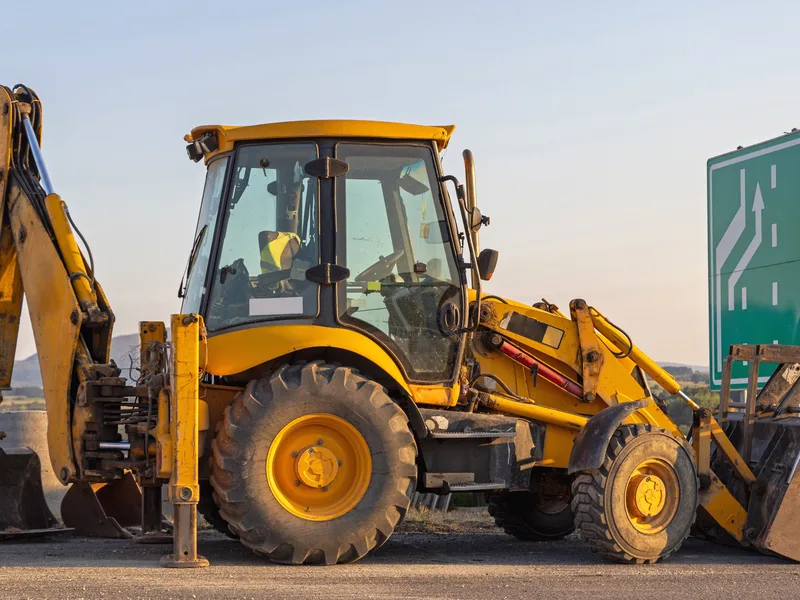
Third-party damage dominates this account, and it is not close. A backhoe working a New York street has finished property inside its swing arc, live traffic behind it, pedestrians beside it and a century of undocumented services beneath it, so the expensive events are the ones where the machine is undamaged and everything around it is not. Behind that sit the two problems the machine brings with it anywhere — the counterweight arc the operator cannot see, and a stabilizer leg finding a void under old pavement. Winter then does its slower work: a compressed upstate season concentrating hours, and road chemistry quietly eating the hardware that holds the machine level.
Common New York backhoe claims we see
- Damage to adjacent third-party property. Glazing, facade, storefront, railing or parked vehicle inside the swing arc — the defining New York claim.
- Sidewalk, vault or subsurface collapse under a stabilizer. Old pavement over older voids, with the leg finding the void first.
- Struck-object incidents during a self-propelled block-to-block move. Bollards, signal poles, hydrants and mirrors, none of them yours.
- Overnight loss from an unsecured urban work zone. Where the machine could not be returned to a yard and the block was the yard.
- Corrosion-driven component failure argued as a covered loss. Worth separating early, because deterioration is not a peril and the distinction settles the file.
Why New York backhoe owners choose Equipment Guard Insurance
Standalone equipment placement suits a state where the rest of a contractor’s program is often built to satisfy one municipality. Nobody in this market wants to unpick a liability or workers compensation arrangement that took a year to get accepted, simply to add a backhoe to a schedule — so we do not ask them to. We underwrite the street exposure as the main event rather than an afterthought, we ask where the machine sits between shifts before quoting rather than after a theft, and we place through markets — named on our homepage — that will read a New York equipment schedule on its own merits.
Major New York backhoe markets
- New York City. The most constrained operating environment in the country, where nearly every hour of machine time happens beside property somebody else owns.
- Buffalo. Industrial reconstruction and utility replacement in a heavy-snow market with a short, intense working season.
- Rochester. Institutional and infrastructure work over aging underground systems, where what is buried rarely matches the record drawing.
- Yonkers. Dense lower-Hudson redevelopment on constrained lots with almost no room to stage a machine off the roadway.
- Syracuse. Central-county highway, campus and utility work with long daily approaches from contractor yards outside the city.
- Albany. Government, campus and municipal-services work that keeps a machine in the public right of way most weeks of the year.
Related
- Backhoe insurance — the machine physics that hold in every state.
- Skid Steer insurance in New York — the compact unit that fits where a backhoe cannot, and disappears just as easily.
- All equipment insurance in New York — the state hub.
- Equipment floater · Rented & leased equipment
Primary sources
- N.Y. Vehicle and Traffic Law § 2101 — Definitions (New York State Senate) — The New York State Senate (Consolidated Laws of New York) (road use and registration)
- CONSUMER ALERT: NYS Department of State's Division of Consumer Protection Provides New Yorkers with Tips for Avoiding Home Improvement Scams — No statewide licensing agency — the New York Department of State does not license contractors; licensing is by local jurisdiction (e.g., NYC Department of Consumer and Worker Protection and various counties). (contractor licensing)
New York backhoe insurance FAQs
Is a backhoe a registered vehicle in New York?
Not in the ordinary sense. The vehicle and traffic law carves out machinery that is not built to move people or goods and reaches the road only incidentally, and a backhoe falls squarely inside that carve-out. What it does not do is convert the street into private ground, which is the assumption we spend most of our time correcting.
Who licenses a contractor in New York?
Not the state, which surprises people who have worked elsewhere. There is no statewide general contractor license here; the requirement is set city by city and county by county, with New York City running the most demanding regime of them all. The practical effect on an equipment account is that your certificates of insurance carry the weight a state license would carry somewhere else, so the accuracy of the schedule behind them matters more, not less.
Why is the code section named on this page but not linked?
Because we do not publish a link we cannot verify by reading. The recorded copy of that section answers automated requests with a refusal, so it has not been fetched and confirmed to the standard the rest of our citations meet. The section number belongs to our own New York record and we will name it; the link waits until somebody can open the page and read it.
What makes a backhoe in a New York City street different from one in a yard?
Everything within the swing radius belongs to somebody else. The machine works between live traffic on one side and finished facade, glazing, storefront and pedestrian route on the other, over subsurface congestion that is older and denser than the drawings admit. The claims that follow are almost never about the backhoe. They are about what the backhoe touched, and the third-party side of the account deserves at least as much attention as the machine itself.
Does upstate winter reach this machine?
It reaches it twice. Lake-driven snow shortens the working season across the western and central counties, which compresses more work into fewer weeks and puts more machine hours into shorter days. Then the road treatment that keeps those counties moving spends the rest of the year on the underside of anything that drives on them, and accelerated corrosion on pins, rams and stabilizer hardware is a condition question long before it is a claim question.
Can the machine be insured on its own here?
Yes. Equipment Guard Insurance writes equipment as a standalone placement in New York, which matters in a state where a contractor’s liability and workers compensation are often arranged around a specific municipal requirement that nobody wants disturbed to add one machine.