
A compact loader is the only serious machine that fits a New York job — through a gate, down a ramp, inside a footprint measured in feet rather than acres — and it is the machine that lets a small crew take work in a borough on Monday and a county an hour north on Thursday. Portability of that order is the whole reason the machine earns, and the whole reason it is hard to insure casually.
What follows is specific to New York: licensing written at the city and county level rather than by the state, a downstate storage problem that has no clean answer, and an upstate geography where the same loader behaves like a rural machine. Everything that is true of the unit regardless of address — attachment couplers, skid steering, the forward tip — belongs to the skid steer insurance pillar.
What skid steer insurance costs in New York
We quote no rate in the abstract; a real figure comes out of the unit itself, the attachments on it and the place it stands overnight. In New York the single largest lever is where the loader goes at the end of a shift, and the honest answer downstate is frequently nowhere good: a machine that stays inside a city footprint overnight, one that goes back on a trailer twice a day, and one that returns to a fenced upstate yard are three different risks wearing one model number. After that come the value and number of attachments, the valuation basis you choose, whether a tracking unit is fitted, how much of the work is below grade, and your own loss history.
New York skid steer regulations: title, lien and ownership
A skid steer is untitled construction equipment, not a DMV-titled motor vehicle; a security interest is perfected by filing a UCC-1 financing statement under New York’s UCC Article 9 with the New York Department of State.
The practical effect is that the paperwork is the ownership. A financed loader is perfected by that financing statement; the lender then appears on the policy as a loss payee against the scheduled unit, so a loss payment is issued jointly and a lienholder still named against a machine you sold last year is the plainest signal that a schedule needs review. New York then adds a layer of its own that has nothing to do with Article 9 and everything to do with getting paid: because licensing is issued by cities and counties rather than by the state, the entity named on a certificate of insurance has to be the entity that holds the relevant city or county license. A single-member company that licensed personally in one county and insures in the company name elsewhere discovers the mismatch at a general contractor’s compliance desk, which is the most expensive place to discover it.
Common skid steer risks in New York
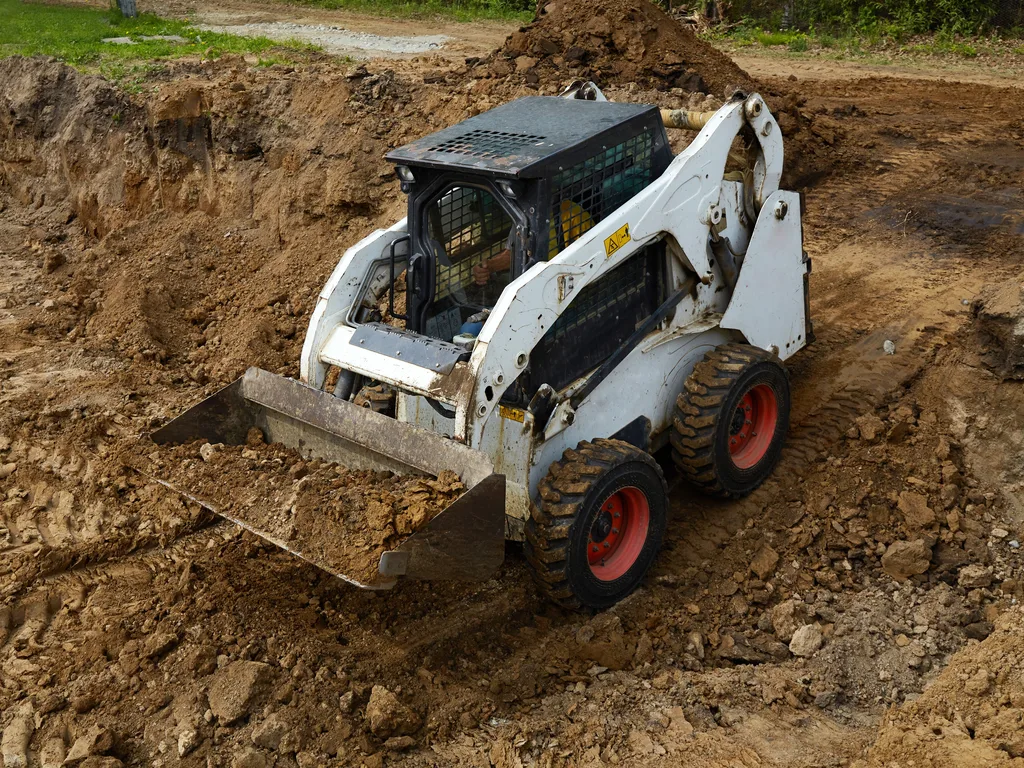
Theft is the exposure that defines this class in New York, and the state creates two separate versions of it. Downstate the machine is stolen from a site it could never be locked into, often during a paused phase when nobody is on the job; upstate it is stolen from distance, off a spread-out site along a corridor that reaches several other metro markets and two state lines within a few hours. Winter is the second exposure and it is heaviest west and north, where lake-effect snow loads sites, buries parked machines and pushes work into freeze-thaw conditions that punish hydraulics and glass. Below-grade and confined work supplies the rest: struck utilities, finished-surface damage, damage during loading down a ramp, and the forward tip with the arms raised.
Common New York skid steer claims we see
- Theft from a city site with nowhere to secure the machine. The defining downstate claim, argued on the serial number and the bill of sale.
- Damage during loading on or off a trailer in traffic. A twice-daily event on borough jobs, and a disproportionate share of the non-theft file.
- Snow-load and freeze damage at a paused upstate site. Cab, glass and hydraulic damage — sometimes discovered weeks later.
- Attachment taken separately. A breaker or grapple lifted from a rack while the loader stays put, then found to sit under a blanket per-item sublimit.
- License and certificate mismatch halting work. Not an insured loss, but the routine New York paperwork failure: the insured entity is not the license holder.
Why New York skid steer owners choose Equipment Guard Insurance
We write equipment monoline, and in New York that removes a specific obstacle. A crew here has usually built its general liability program around whichever city or county licensing regime it works under, and being told to move that program in order to schedule a loader properly is not a real option. We schedule attachments by name because on this machine that is where value hides, we write the storage answer down honestly rather than optimistically, and we place through markets named on our homepage that will read a New York equipment schedule on its merits.
Major New York skid steer markets
- New York City. The hardest storage problem in the country for this machine, its own licensing regime through consumer-protection enforcement, and jobs where the loader lives inside the footprint.
- Yonkers and the lower Hudson. Dense work under county rather than city licensing, with loaders crossing two or three regulatory boundaries in a working week.
- Buffalo. Industrial and institutional site work with its own municipal licensing and the heaviest lake-effect exposure in the state.
- Rochester. Steady mid-scale redevelopment on constrained lots, where finished-surface damage and confined loading dominate the non-theft claims.
- Syracuse and Utica. Corridor markets where machines travel far and spend more nights on site than in a yard.
- Albany. Government and institutional schedules with predictable sites and secured storage — usually the most favorably viewed storage answer here.
Related
- Skid steer insurance — the machine physics that hold in every state.
- Excavator insurance in New York — the machine the state dig-notice rule actually reaches.
- All equipment insurance in New York — the state hub.
- Equipment floater · Rented & leased equipment
Primary sources
- CONSUMER ALERT: NYS Department of State's Division of Consumer Protection Provides New Yorkers with Tips for Avoiding Home Improvement Scams — No statewide licensing agency — the New York Department of State does not license contractors; licensing is by local jurisdiction (e.g., NYC Department of Consumer and Worker Protection and various counties). (contractor licensing)
We do not link a New York filing document here. The ownership and lien rules described above follow Article 9 as New York has adopted it; where a state publishes a document that states the rule directly, this page links it.
New York skid steer insurance FAQs
Is a skid steer titled or registered in New York?
No. It is untitled construction equipment rather than a DMV-titled motor vehicle, so no plate is issued, nothing is surrendered at a DMV office when the loader is sold, and there is no title to hand an adjuster after a theft. What identifies the machine is the serial number, the bill of sale and the financing record on file.
Which New York license actually applies to me — the city one or a county one?
Possibly both, and possibly neither, depending on where the work is. New York has no statewide contractor license and the Department of State does not issue one. Licensing sits below the state: New York City licenses through its Department of Consumer and Worker Protection, and separately several counties license contractors in their own right — Suffolk, Nassau, Westchester, Putnam and Rockland — alongside city regimes such as Buffalo. One loader working across the lower Hudson can cross two county licensing boundaries in a week. None of it reaches the machine; it reaches who may hold the contract.
Where does a loader go overnight on a job with no yard?
That question is the underwriting conversation in downstate New York. On a dense borough or Yonkers site there is often no fence, no gate and no room, so the loader stays inside the footprint behind a sidewalk shed, sits in a below-grade garage level, or is trailered off at the end of every shift. Each answer prices differently, and the third moves the machine into a transit exposure it does not otherwise have. Upstate the same loader usually does come home to a yard — which is why one policy can look nothing like another inside one state.
Are attachments covered on a New York skid steer policy?
Only where they appear on the schedule by name. Blanket attachment limits carry a per-item sublimit that buckets and forks fit under comfortably and that breakers, augers, grapples and mulching heads frequently exceed. In city work the attachment problem has a second edge: a breaker is often the reason the machine is on the job at all, and it commonly stays on site overnight with the loader inside a shed rather than going back to a yard where it could be locked away.
Does upstate travel change the theft picture?
It changes what makes recovery possible. Compact machines are taken far more often than large tracked ones, and outside the metro core New York work is spread thin along the Thruway between Albany, Utica, Syracuse, Rochester and Buffalo, so a loader can be a long way from its owner before anyone looks for it. Lake-effect winters add a second wrinkle: a machine buried under snow at a paused site is not obviously missing.
Can I schedule the skid steer without moving my other policies?
Yes. Equipment Guard Insurance writes equipment monoline in New York, so the loader and its attachments go on their own schedule. That matters here more than in most states, because a downstate general liability policy is often arranged around city or county licensing requirements a crew has no wish to disturb. We leave that policy alone and write the iron.