
The backhoe survives in North Carolina for the same reason it survives anywhere — one operator, one machine, and a trench, a load and a backfill all done before lunch. What makes it a state-specific underwriting problem is that it can also take itself to the next address, on the same roads as everybody else.
This page is about what North Carolina does with the machine once it is out there, what the state’s licensing structure says about the business running it, and how ground that changes three times between the ocean and the ridgeline changes the risk. The mechanical questions that hold everywhere — reach, breakout, the loader end — live on the backhoe insurance pillar.
What backhoe insurance costs in North Carolina
No responsible figure can be published here, and one published anyway would be a guess dressed as a quote. The things that actually set a North Carolina backhoe premium are the share of the machine’s year spent in the public right of way, the distance and frequency of hauls across a wide state, the soil the work sits on and how it behaves wet, whether the machine returns to a secured yard, the valuation basis you select, and your own record. A machine on a fenced Piedmont grading job and one working utility cuts on the coastal plain price differently, and they should.
North Carolina backhoe regulations: road operation
A self-propelled backhoe is classed as ’Special Mobile Equipment’ under the motor-vehicle definitions and is not registered as an ordinary vehicle when only incidentally moved on highways.
That treatment sits in the motor-vehicle definitions North Carolina keeps at G.S. 20-4.01, which is the document we read rather than a summary of it. The important thing is what the classification leaves untouched. Being outside ordinary registration resolves a paperwork question about the machine; it decides nothing about who pays when a backhoe on its own wheels takes out a mailbox stand, a parked vehicle or a section of new curb between two jobs, and the floater that repairs the machine is not that answer. One level above sits the license, and North Carolina’s is unusually informative: it is issued under Chapter 87, Article 1 above a defined project-cost threshold, graded into Limited, Intermediate and Unlimited tiers against financial capacity, and divided into classifications — Building, Residential, Highway, Public Utilities, Specialty. The classification in particular tells an underwriter whether this machine lives in the right of way or only visits it, and an equipment schedule that contradicts the license is a discrepancy somebody will eventually notice.
Common backhoe risks in North Carolina
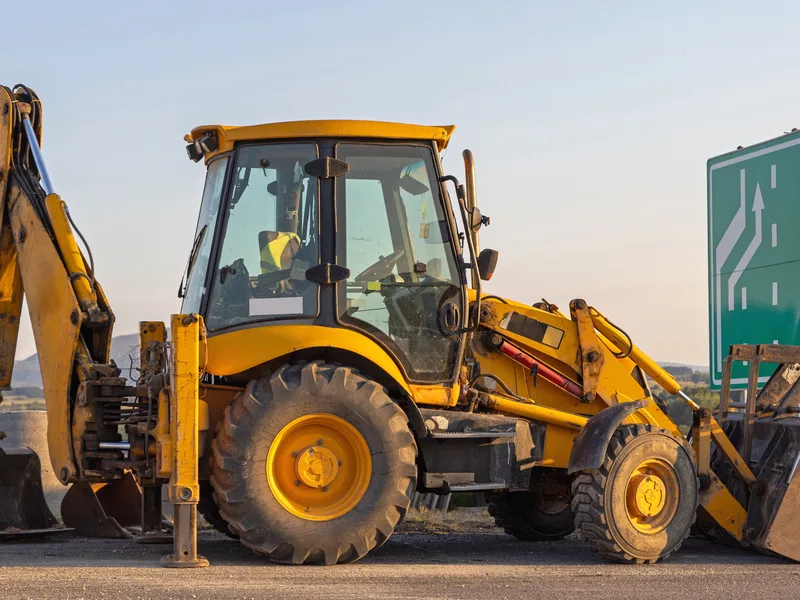
Water sets the pace on a North Carolina backhoe. Heavy rainfall arrives here in quantities that change soil behavior for days afterward, and the machine that suffers most from that is the one whose whole working posture depends on the ground holding still under two legs. Sandy coastal-plain soils drain and then run; Piedmont clay holds water and then slides. Layered on top of that is a wide state with a lot of transit in it, so a real share of the exposure sits on trailers and ramps rather than on jobsites. Then come the two habits every backhoe brings along — a swing arc the operator cannot fully see, and a bucket that meets things nobody marked.
Common North Carolina backhoe claims we see
- Stabilizer settlement after heavy rainfall. The characteristic North Carolina loss, and often the trigger for a much larger surface-damage claim.
- Right-of-way third-party damage on utility and highway-classification work. Where the machine is legitimately in the road and everything it touches belongs to somebody else.
- Trench-wall or embankment failure in saturated ground. With the machine, the excavation and the neighboring surface all involved at once.
- Loading, tie-down and ramp damage on cross-state hauls. Few events per year, and the largest average cost on this class.
- Counterweight and boom contact with finished work. On tight infill lots where new concrete and new siding sit inside the arc.
Why North Carolina backhoe owners choose Equipment Guard Insurance
Placing equipment on its own is what this agency is for, and in North Carolina it answers a specific objection. A contractor who has qualified for a license tier has a liability and workers compensation program built around that qualification, and asking them to move all of it to schedule one backhoe correctly is not advice. It is an inconvenience wearing a recommendation. We take the road-use side of this machine as seriously as the physical damage side, we ask what the license classification actually says about where the machine works, and we place through markets — named on our homepage — that will read a North Carolina equipment schedule on its own terms.
Major North Carolina backhoe markets
- Charlotte. The state’s deepest sitework market, with enough simultaneous jobs that a single machine may road-move between three of them in a week.
- Raleigh. Sustained institutional and technology-campus build-out, where utility cuts run through finished landscape and paving.
- Greensboro. Industrial and logistics pad work on Piedmont clay, which behaves very differently wet than dry.
- Durham. Dense infill and campus redevelopment on constrained lots with older buried systems underneath.
- Winston-Salem and Fayetteville. Municipal, institutional and utility replacement work that keeps machines in the public right of way most weeks.
- Asheville. Mountain sitework on grade, with long approaches, steep access and the slowest recovery in the state when a machine goes down.
Related
- Backhoe insurance — the machine physics that hold in every state.
- Skid Steer insurance in North Carolina — the machine whose state question is a filing rather than a right-of-way.
- All equipment insurance in North Carolina — the state hub.
- Equipment floater · Rented & leased equipment
Primary sources
- G.S. 20-4.01 — North Carolina General Assembly (road use and registration)
- Chapter 87, Article 1 — General Contractors — North Carolina General Assembly (contractor licensing)
North Carolina backhoe insurance FAQs
How does North Carolina classify a backhoe on the highway?
As special mobile equipment, under the definitions the motor-vehicle chapter uses for everything that moves. The test is what the machine is for and how it uses the road — built to work rather than to carry, and on the pavement only in passing — which is a fair description of a backhoe crossing town between two jobs. That keeps it out of ordinary registration, and it does nothing else.
Does the general contractor license tier change how the machine is underwritten?
It changes the conversation around it. North Carolina grades the license into Limited, Intermediate and Unlimited tiers set against financial capacity, and it issues classifications — Building, Residential, Highway, Public Utilities, Specialty — that describe what kind of work you may take. Both are public statements about your business. An equipment schedule that reads inconsistently with the tier and classification you hold invites a question, and it is a much easier question to answer before a loss than after one.
Does a Highway or Public Utilities classification matter for a backhoe policy?
More than any other detail on the license. Those classifications describe work that happens inside the public right of way by definition, which means the machine is not an occasional visitor to the road — it lives there. Road-use liability stops being a secondary consideration on that kind of account and becomes the first thing we size.
What does North Carolina weather do to this machine?
It saturates the ground it stands on. Tropical remnants and heavy convective rainfall arrive here in volume, and the exposure that follows is not wind but water in the soil: bearing capacity that was adequate on Friday and is not on Monday, trench walls that no longer behave, and stabilizer legs that find that out first. The coastal plain and the Piedmont clays fail in different ways, and knowing which one your work sits on is part of pricing it.
Our crews work from the coast to the mountains. Does that matter?
It multiplies the transit exposure, which is where this class concentrates its worst single losses. A machine that runs the width of the state spends real hours as cargo, and loading, tie-down, ramp incidents and highway contact do more damage per event than anything that happens inside a jobsite. We would rather look at the trailer, the tie-down practice and the haul pattern alongside the machine than pretend the schedule ends at the serial plate.
Will you write the backhoe by itself?
Yes — Equipment Guard Insurance places equipment monoline in North Carolina. The machine can be scheduled properly without disturbing the liability and workers compensation program you assembled to support your license tier, which is usually the arrangement an owner least wants reopened.