
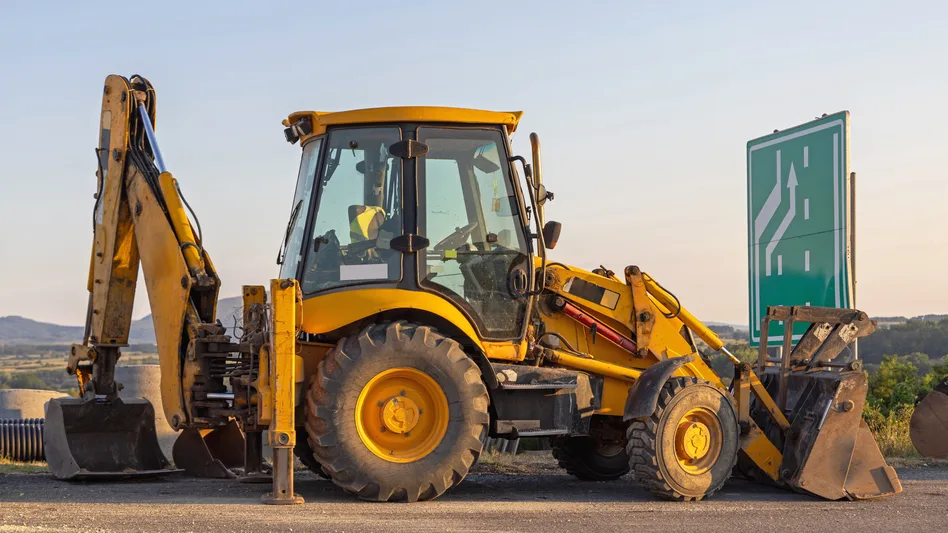
A backhoe is a compromise machine, and North Dakota is a state where compromise machines earn their place. One unit that trenches, backfills, lifts pipe and then takes itself down a section road to the next job is worth more than two specialists when the nearest dealer, the nearest rental counter and the nearest crew are all a long way off.
This page deals with what happens once that machine is on the road: how the state describes it, what North Dakota asks of the contracting business behind it, and how distance and cold reshape a loss that would be routine elsewhere. Boom geometry and the rest of the machine’s universal behavior are covered on the backhoe insurance pillar.
What backhoe insurance costs in North Dakota
No figure belongs on this page, and one placed here would be a guess formatted to look like research. The North Dakota inputs that genuinely drive a backhoe rate are the distance between your yard and your furthest active job, how much of the machine’s movement happens under its own power on section and state roads, whether it overwinters indoors or on an open site, the valuation basis you select and your own record. Two identical machines — one working municipal jobs inside a single city, one supporting energy work in the west — are not the same risk and it would be strange to price them alike.
North Dakota backhoe regulations: road operation
Self-propelled construction equipment is ‘special mobile equipment,’ which together with road construction and maintenance machinery that cannot be operated on highways in a normal manner is exempt from motor-vehicle registration fees.
Read the shape of that carefully. The exemption our record describes is aimed at registration fees, and the machinery it groups together is machinery that cannot travel a highway in a normal manner — a description a backhoe fits by design rather than by argument. Our record names N.D. Cent. Code § 39-01-01 for the definition and § 39-04-18 for the fee exemption; we name both and link neither, because neither has cleared the check we require before publishing a citation. The sources block on this page carries a licensing document only — nothing there supports the road-use rule above, and we would rather say so than let a populated list of sources imply otherwise. What the exemption never touched is liability: a backhoe on a public road can damage a vehicle, a gate or an approach, and that is answered by liability coverage rather than by the form that repairs the machine. The licensing layer is separate again, and unusual for the region — contractor licensing runs through the Secretary of State, in four classes graded by the value of the work.
Common backhoe risks in North Dakota
Distance sets the terms here, and it does it twice. First, it puts the machine on the road far more than a metropolitan account would — long self-propelled legs on section and state roads, or hours riding a deck, both of which are where this class loses money. Second, it changes what a loss costs after the event: a machine down four hours from anywhere stops a crew, and the recovery, the substitute and the lost days usually outrun the repair bill. Layer on ground that freezes deep and thaws unevenly, western energy-support work with heavy traffic on gravel approaches, and long stretches when a remote site sees nobody, and the shape of the North Dakota exposure is set less by the machine than by where it happens to be standing.
Common North Dakota backhoe claims we see
- Collision or struck-object on a long self-propelled leg. The exposure a fee exemption is most often misremembered as having removed.
- Loading, ramp and tie-down damage on a western haul. The most concentrated transit file on accounts that support the energy counties.
- Stabilizer subsidence in thawing or frost-heaved ground. Bearing changes week to week in spring, and the machine finds out before the operator does.
- Downtime cost that dwarfs the repair. A stalled crew, a recovery vehicle sent a long way, and a rental sourced from a market that may not have one.
- Loss discovered late on a remote or overwintered site. Where the interval, not the event, drives what the claim finally costs.
Why North Dakota backhoe owners choose Equipment Guard Insurance
Equipment-only placement matters more in a thin market than a thick one. A North Dakota contractor holding a license class and the insurance requirements that come with it should not have to reopen the whole program to get one machine scheduled properly, and that is exactly what we avoid. We ask how far the furthest job really is, we put the downtime consequences on the table rather than leaving them to be discovered, we schedule trailer and attachments with the machine, and we place through markets — named on our homepage — that will read a North Dakota equipment account by itself.
Major North Dakota backhoe markets
- Fargo. The largest construction market in the state and the easiest place to source a replacement machine, which makes it the cheapest place here to have a bad week.
- Bismarck. Institutional and municipal work with a base from which crews routinely take jobs a long way west.
- Grand Forks. Flat valley ground where spring water and soft bearing matter more to a stabilizer than anything the traffic will do.
- Minot. Mixed municipal and energy-support work, where machines regularly spend the night somewhere other than a yard.
- Williston. Pad construction and reclamation on remote sites, with the longest approaches and the heaviest traffic sharing narrow gravel.
- Dickinson. Southwest energy and ranch-country work with the same distances and a thinner support base behind them.
Related
- Backhoe insurance — the machine physics that hold in every state.
- Skid Steer insurance in North Dakota — the compact machine that goes to the same remote pads and comes back on somebody else’s deck.
- All equipment insurance in North Dakota — the state hub.
- Equipment floater · Rented & leased equipment
Primary sources
- Contractors — North Dakota Secretary of State (contractor licensing)
We do not link a North Dakota vehicle-code section here. The road-use treatment described above follows how North Dakota classifies self-propelled construction equipment; where the state publishes a section that states it directly, this page links it.
North Dakota backhoe insurance FAQs
What exactly is a North Dakota backhoe exempt from?
Registration fees, on the record we hold, which is a narrower statement than the blanket exemption owners often assume. The special mobile equipment category sits alongside road construction and maintenance machinery that cannot be operated on highways in a normal manner, and that grouping is what the fee exemption attaches to. It is worth reading the exemption for what it says rather than for what it is remembered as saying, because the remembered version tends to grow.
Why does this page name sections but not link them?
Because naming what our record holds and linking what we have read are two different acts, and collapsing them is how citations go stale without anyone noticing. Our record carries N.D. Cent. Code § 39-01-01 for the definition and § 39-04-18 for the fee exemption. Neither has been through the clearing check we require before a link goes on a page, so both are named here and neither is linked. The licensing document in the sources block below did pass that check, which is why it is there.
Does a North Dakota contractor need a license to run a backhoe?
The license attaches to the contracting business rather than to the machine. North Dakota is one of the states that runs contractor licensing through the Secretary of State, issued in four graded classes according to the value of the work being taken on. That is unusual company for a Plains state, and it means the class you hold is a public statement about the scale of your jobs — worth keeping consistent with the equipment schedule that supports them.
What do the distances out here do to an equipment policy?
They change which loss hurts. In a compact market a damaged machine is repaired or replaced within a day; on a job several hours west of your yard it is a stalled crew, a recovery vehicle sent a long way and a rental sourced from wherever one exists. The second-order costs of a North Dakota loss routinely exceed the direct ones, and a schedule that only contemplates repairing the iron has answered half the question.
How much of the cold is actually an insurance problem?
Less than owners fear directly, and more than they expect indirectly. Frost drives deep enough to change what a bucket is fighting and what a stabilizer is standing on, and it lifts and drops ground that seemed stable when the job started. Cold hardens seals and thickens hydraulic oil, which is wear rather than a peril. The real exposure is absence: a machine left on a remote site through months when nobody visits is one where a loss and its discovery can be separated by a long time.
Can I schedule just the backhoe?
Yes — Equipment Guard Insurance places equipment monoline in North Dakota. The machine, its attachments and the trailer can be written on their own while the liability and workers compensation behind your license class stay untouched.