
In North Dakota a skid steer does the work of a crew. It loads, grades, digs, breaks, lifts, clears snow and cleans up a pad, it goes where a full-size machine cannot be justified, and on a great many jobs it is the only piece of iron on site. It is also the piece most easily driven onto a trailer and taken a very long way before anyone notices it has gone.
What follows is specific to North Dakota: a licensing office that is also the lien-filing office, an oilfield economy in the west that puts compact machines a long way from anywhere, a farmed and flood-prone valley in the east, and a winter that decides half the calendar. None of the machine-level material changes here, so attachments, skid steering and the forward tip are left to the skid steer insurance pillar.
What skid steer insurance costs in North Dakota
No premium is published here, because an honest one is built from your machine, your ground and your record. The North Dakota lever that moves furthest is distance: a loader working within sight of a Fargo yard is a different proposition from one living on a pad in the oil counties, and the difference shows up in every part of the quote. Storage comes next — indoors, gated, or wherever the last job left it — then the value and number of attachments on the schedule, the valuation basis you choose, whether a tracking unit is fitted, how the machine gets hauled between jobs, and your own losses. The thin replacement market is worth raising early, because it changes what a sensible claim outcome looks like.
North Dakota skid steer regulations: title, lien and ownership
A skid steer is off-road construction equipment that is not issued a motor-vehicle certificate of title; a lender perfects its security interest by filing a UCC-1 financing statement with the North Dakota Secretary of State.
Two things follow, and the second is the North Dakota part. First the ordinary consequence: with no title in existence the financing statement and the serial number together are the ownership record, and the lender on a financed loader goes onto the policy as loss payee against the scheduled unit, so a loss payment is issued jointly and the two records need to stay in step. A lienholder still named against a machine you paid off is the clearest sign a schedule wants review. Second, the local wrinkle: because contractor licensing in this state runs through the Secretary of State as well, the office that grades your license by class also holds the index a lender searches. That is convenient, and it also means the entity name you registered, the entity named on your certificate of insurance and the entity that owns the machine are all visible in the same place — so they had better match.
Common skid steer risks in North Dakota
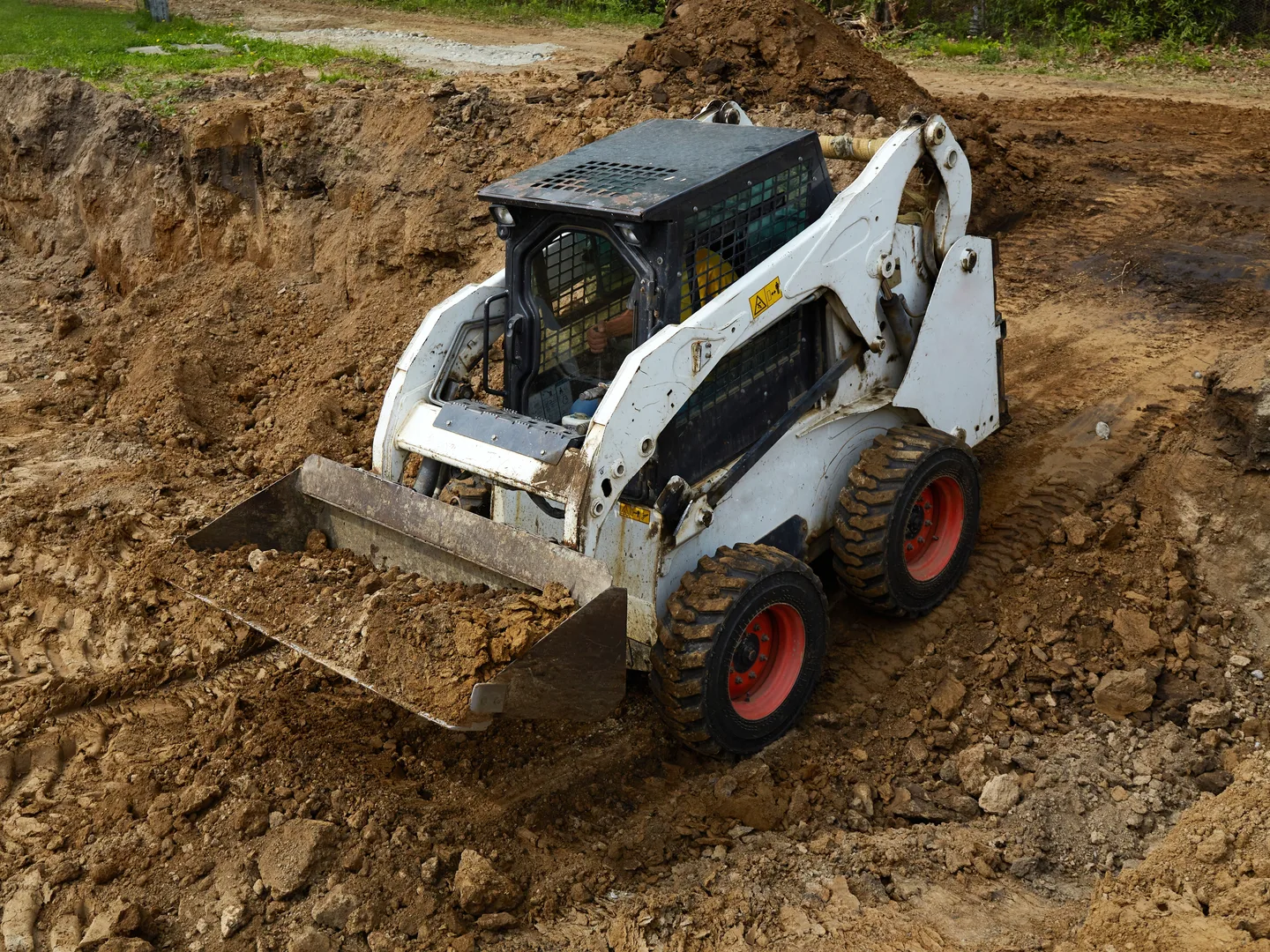
Distance shapes almost everything on this class in North Dakota. Theft is the leading loss, but the local version is less about a busy corridor and more about isolation: a machine on a remote pad or a section-line approach is unobserved for long stretches, and by the time it is missed it has had hours or days on empty highways, with the Canadian border and the Minnesota, South Dakota and Montana lines all reachable. Cold is the second exposure and it is unusually severe — frost depth, sub-zero starts, and the wear a short hard season puts on a machine run flat out. Spring melt in the Red River Valley adds genuine flood and saturated-ground exposure on flat terrain that drains slowly. Beyond those, the claims are machine-shaped: the forward tip with a raised load, and damage taken loading onto a trailer in wind or on ice.
Common North Dakota skid steer claims we see
- Theft from a remote site. The signature claim out here — an unobserved machine, a long head start, and a settlement resting entirely on the serial record because no title exists.
- Cold-start and freeze damage. Cracked lines, failed batteries and seal damage on a loader that overwintered outdoors, usually found on the first job of the season.
- Spring melt on flat ground. A machine caught by standing water or bogged on saturated valley soil where the water has nowhere to go and no slope to leave by.
- Extended downtime after a breakdown. Not always an insured loss, but the one that hurts most where the nearest comparable machine to rent may be several hours away.
- Attachment taken separately. A grapple, breaker or snow blade lifted from a yard or a pad while the loader stays put, then found to sit under a blanket per-item cap rather than scheduled by name.
Why North Dakota skid steer owners choose Equipment Guard Insurance
We write equipment monoline, which suits a North Dakota operator for a plain reason: the businesses out here are often small, the machines are worth real money, and the liability policy was arranged around the license and the jobs rather than around the iron. Being told the whole program has to move to schedule one loader properly is how a machine ends up carrying a limit nobody has revisited since it was delivered. We do not ask for that. Attachments go on by name as a matter of course, and we place through markets — named on our homepage — that will read a North Dakota equipment schedule, oilfield distance included, on its own merits.
Major North Dakota skid steer markets
- Fargo. The largest jobsite market in the state and the deepest place to rent or replace a machine, which makes it the cheapest place in North Dakota to have a bad day.
- Bismarck. State institutional and municipal work with steady certificate scrutiny, and a base from which crews reach a long way west.
- Grand Forks. Valley residential, campus and drainage work on flat farmed ground, where spring water rather than theft is often the first thing on an owner’s mind.
- Minot. Mixed municipal, base-adjacent and energy-support work, a market where machines regularly overnight away from any yard.
- Williston. The heart of the oil counties: pad construction and reclamation, remote sites, long hauls, and the thinnest supervision a loader will ever work under.
- Dickinson. Southwest energy and ranch-country work with the same distances and a smaller support base, where a serial record and a tracking unit do most of the recovery work.
Related
- Skid steer insurance — the machine physics that hold in every state.
- Excavator insurance in North Dakota — the machine the nonprofit one-call center and its locate period were built around.
- All equipment insurance in North Dakota — the state hub.
- Equipment floater · Rented & leased equipment
Primary sources
- Contractors — North Dakota Secretary of State (contractor licensing)
We do not link a North Dakota filing document here. The ownership and lien rules described above follow Article 9 as North Dakota has adopted it; where a state publishes a document that states the rule directly, this page links it.
North Dakota skid steer insurance FAQs
Does North Dakota issue a title for a skid steer?
No. It is off-road equipment in the eyes of the state, so no motor-vehicle certificate of title exists for it and none can be produced to a deputy or an adjuster. The serial number, the bill of sale and the filing record carry the whole weight of proving what you owned — and out here, where a machine may be a long way from the nearest town when it goes missing, that record is often the only thread anyone has to pull.
Who licenses a contractor in North Dakota, and does it reach the loader?
The Secretary of State does, which surprises people who expect a construction board. A license is required once the cost of a job passes a threshold set in statute, and it is issued in four classes graded by the value of work the license permits. None of that regulates the machine itself. What it does mean is that the same office holding your license record also holds the financing-statement index, so the state-level paper trail on a financed loader and on the business operating it sits in one place.
What does oilfield work do to the exposure on a compact loader?
It stretches every distance that matters. Pad construction, reclamation and site cleanup in the west put a skid steer on ground that may be an hour from pavement and much further from a secured yard, sometimes for weeks at a stretch. Nobody drives past it at night. A machine in that position is not being watched, its recovery window is long, and the practical controls are the ones you fit before it leaves: a tracking unit, keys out, and a serial number already on the schedule.
How does the winter change how this machine is insured?
It shortens the earning season and lengthens the storage one, and it does real physical damage in between. Deep frost, extended sub-zero spells and block-heater dependence are ordinary here, and a loader stored outdoors through it pays in hydraulics, batteries, glass and seals. The season also compresses the work: crews run machines hard for a short window, which raises both breakdown frequency and the value of getting a replacement quickly in a state where there may not be one nearby.
Why does downtime matter more in North Dakota than elsewhere?
Because the rental market is thin outside the larger centers. In a dense metro a broken loader is replaced the same afternoon; here it may mean a long haul, a wait, or a job that stops. That makes the practical conversation about a claim less about the repair figure and more about how quickly a machine can be back on the pad — which is worth deciding before you need it rather than during it.
Can the loader go on its own policy?
Yes. Equipment Guard Insurance writes equipment monoline, so the machine and its attachments sit on their own schedule and nothing else you carry has to change.