
Ohio site work runs on machines that do more than one thing, and the backhoe is the original example. Trench at the back, load at the front, lift what needs lifting, and then drive itself around the corner to the next address rather than tying up a truck for twenty minutes of transport.
What follows deals with the state rather than the machine. Ohio has taken an unusually direct approach to what this equipment is on a road, licenses only a handful of trades at state level, and puts the work into a freeze-thaw and salt climate that shortens the life of everything exposed. Boom geometry, swing arc and hydraulic duty are constant everywhere and live on the backhoe insurance pillar.
What backhoe insurance costs in Ohio
There is no rate that can be published without your details, and one published anyway would be a fabrication with a decimal point. What genuinely moves an Ohio backhoe number is how much of the machine’s week is spent on public streets rather than inside a site, how old and how congested the working environment is, how the machine is stored through a salt-and-thaw winter, the valuation basis you choose — replacement cost and actual cash value diverge sharply on a corroded machine — and your own loss record. Age and condition carry more weight in this climate than they do in a dry one.
Ohio backhoe regulations: road operation
Ohio excludes construction equipment — road rollers, power shovels, ditch-digging machinery and similar equipment not designed for or used in general highway transportation — from the definition of ‘motor vehicle,’ so a backhoe is not registered as one.
The exclusion is stated at Ohio Rev. Code § 4501.01, and the drafting is worth noticing: the equipment is described by what it was built for rather than granted a travel exemption, so the machine is outside the vehicle scheme because of what it is, not because of where it happens to be. That distinction changes nothing about responsibility. A backhoe on a public street is in traffic, and the damage it can do there is answered by liability coverage while the floater confines itself to the machine. Above that sits a licensing arrangement with an unusual shape: the state licenses five commercial trades and leaves general contracting to local jurisdictions, so on a typical job the mechanical subcontractors hold state credentials and the outfit running the earthmoving equipment holds a local one. When there is no state license to look up, the equipment schedule is the record that speaks for the business.
Common backhoe risks in Ohio
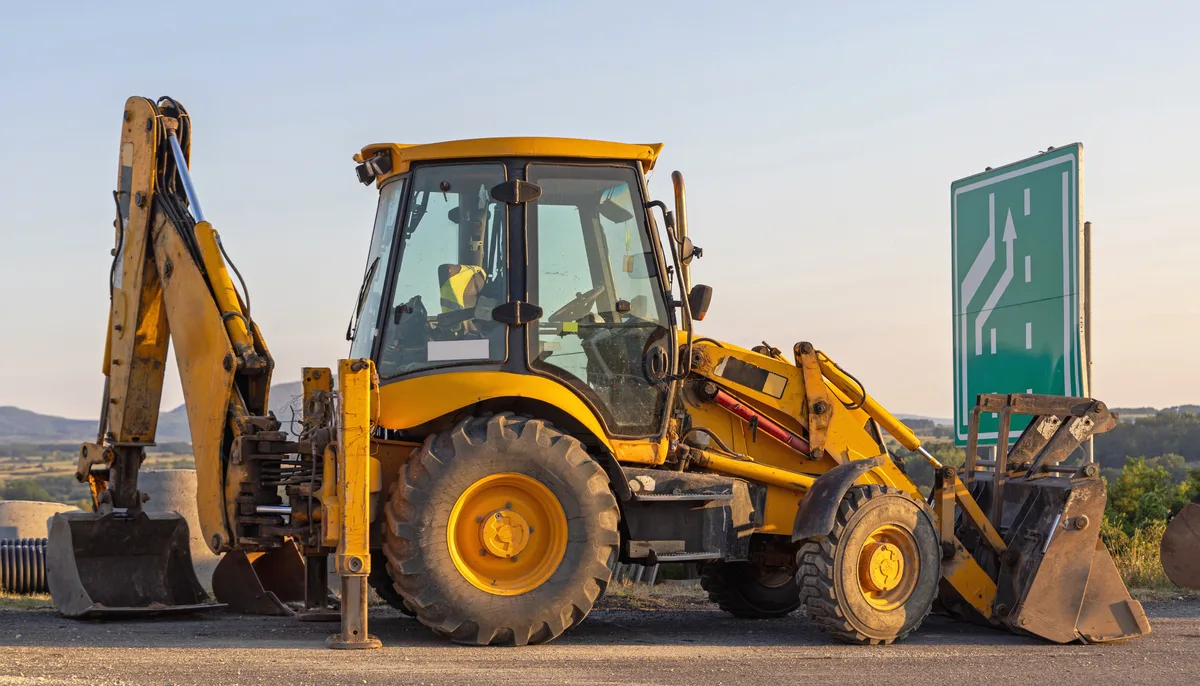
Corrosion is the quiet leader here. Salt, slush and repeated freeze-thaw take pins, bushings, rod and the underside of the loader arms apart over seasons rather than in an event, and the argument about whether a failure was sudden or long-arriving is the one that decides the claim. Around that sits the working environment: older industrial and residential streets with narrow lanes, occupied structures close to the swing, and buried services under surfacing whose records are incomplete. And the road itself — short moves through real traffic, taken often enough that the exposure never goes quiet.
Common Ohio backhoe claims we see
- Corrosion-driven component failure argued as sudden loss. The most contested Ohio claim on this class, and the one worth settling in the wording rather than the adjustment.
- Collision or struck-object on a short street move. Real traffic, a slow machine, and a definitional exclusion that decides nothing about fault.
- Stabilizer through thaw-softened or frost-heaved ground. Winter changes what a surface will carry, and the pad finds out first.
- Boom or counterweight contact behind the operator. Swing arc against a wall, a fence line or a vehicle parked since the machine was set.
- Damage to old surfacing and curbing while repositioning. Small, frequent, and almost always a third-party claim rather than a repair to the machine.
Why Ohio backhoe owners choose Equipment Guard Insurance
Equipment-only placement fits how Ohio contractors are organized. With no statewide credential doing the talking, an owner’s liability and workers compensation are already carrying weight and there is no reason to move them so that one machine can be scheduled at a defensible value — so we do not suggest it. We ask the valuation question properly in a climate that ages iron quickly, we underwrite street-level road use rather than assuming a site-only machine, and we place through markets — named on our homepage — that will read an Ohio equipment schedule on its own merits.
Major Ohio backhoe markets
- Columbus. The state’s fastest-growing site market, with heavy suburban build-out and constant short road moves between adjacent jobs.
- Cleveland. Older industrial and utility fabric under lake-effect winters, where corrosion and thaw-softened ground arrive in the same season.
- Toledo. Port, rail and industrial work near Lake Erie, with soft ground close to the water and long exposure to road salt.
- Akron. Reconstruction and utility replacement on steeper grades, hard on undercarriage and unforgiving of an uneven stabilizer set.
- Dayton. Institutional, aerospace-adjacent and municipal work that keeps the machine in the public right of way most weeks of the year.
Related
- Backhoe insurance — the machine physics that hold in every state.
- Skid Steer insurance in Ohio — the machine whose Ohio question is a filing office rather than a definition.
- All equipment insurance in Ohio — the state hub.
- Equipment floater · Rented & leased equipment
Primary sources
- Section 4501.01 — Ohio Revised Code — Ohio Laws and Administrative Rules (road use and registration)
- Section 4740.01 - Ohio Revised Code | Ohio Laws (Construction industry licensing board definitions) — No statewide general contractor license; the Ohio Construction Industry Licensing Board (OCILB), within the Ohio Department of Commerce, licenses five commercial trades (contractor licensing)
Ohio backhoe insurance FAQs
How does Ohio treat a backhoe on a public road?
By exclusion rather than by classification. Ohio Rev. Code § 4501.01 keeps construction equipment — road rollers, power shovels, ditch-digging machinery and similar equipment not designed for or used in general highway transportation — outside the definition of motor vehicle entirely. The practical result is familiar: no ordinary registration. The route the statute takes to get there is not, and it is worth knowing that the exclusion is drawn around the equipment rather than around a special travel permission.
If it is not a motor vehicle, is road damage still my problem?
Yes, entirely. A definitional exclusion decides what forms the machine appears on and nothing about who pays for harm. A backhoe moving under its own power along a city street is in traffic with everyone else, and if it strikes a vehicle, a pole or a parked trailer, that is a liability claim. The equipment floater rebuilds the backhoe and stops there. The two coverages answer different questions and neither substitutes for the other.
Does Ohio license the contractor operating the machine?
Only in part, and the part it covers is probably not yours. There is no statewide general-contractor license here; the state board licenses five commercial trades — electrical, plumbing, heating and cooling, hydronics and refrigeration — while general contracting is regulated by cities and counties. So a site contractor can be running a serious machine on a job where its mechanical subcontractors hold state credentials and it holds a local one, or none at all.
How does that affect an equipment submission?
It shifts the burden onto your own records. With no single state credential for an underwriter to look up, the schedule itself becomes the evidence: accurate serial numbers, honest hours, a realistic valuation basis and a clear statement of where the machine works and sleeps. Contractors here who keep that current get read faster than those who assume a license lookup will speak for them, because in this state it will not.
What does an Ohio winter actually do to this machine?
It attacks from two directions in the same season. Road salt and repeated wetting drive corrosion into pins, bushings, cylinder rod and the underside of the loader arms far faster than a dry cold does. Freeze-thaw then breaks up the surfaces the machine works on and works from, so ground that carried a stabilizer in November is not the same ground in March. Neither is an insured peril by itself, and both decide the condition an adjuster inspects.
Can you write the backhoe on its own here?
Yes — Equipment Guard Insurance places equipment monoline in Ohio. The machine can be scheduled and valued correctly without disturbing the liability and workers compensation you already carry, which matters in a state where those documents are doing more of the work than a license number is.