
Ohio runs a compact loader through an unusually wide range of work in a single year: warehouse and distribution pads along the freight routes, utility and street repair in older city fabric, farm and township jobs on gravel, and commercial snow contracts once the season turns. It is the machine that makes a small crew viable in all four, and the machine that leaves on somebody else’s trailer.
Two things about this state genuinely shape the account. Ohio licenses a short list of commercial trades and leaves general contracting to local registration, so your paperwork obligations change as you cross jurisdictions while the rules reaching the machine do not; and the state sits at a crossing point of national freight routes rather than at the end of them. For the machine physics that hold everywhere — attachment mechanics, skid steering, the forward-tip pattern — see the skid steer insurance pillar.
What skid steer insurance costs in Ohio
No premium is published here, because an honest figure comes out of your machine list, your storage and your record rather than a table. In Ohio the levers that move it most are the overnight location, the number of jurisdictions your work spans, and winter: a loader that spends its nights behind one gate in one metro is a different submission from one following work between four of them. Then come attachment values and how many are named, the valuation basis, whether telematics are fitted, the deductible, the volume of rented-in machines, and your own loss history. Two identical loaders — one wintered inside, one wintered in an open yard — do not price alike.
Ohio skid steer regulations: title, lien and ownership
A skid steer is untitled construction equipment, and a security interest is perfected by filing a UCC-1 financing statement with the Ohio Secretary of State, the central UCC filing office.
The consequences are procedural, and they matter because there is no title to fall back on. The financing statement and the serial number together are the ownership record; a lender on a financed loader is named on the policy as loss payee against the scheduled unit so any settlement is issued jointly, and the two records have to keep describing the same machine. A lienholder still listed against iron you paid off or traded away is the clearest sign a schedule has not been reviewed in a while. Where Ohio adds something of its own is the layer above the loader: with no statewide general-contractor license to hold, the credential a client can check is a local registration, and the entity named on that registration, on your certificate of insurance and on the contract needs to be one entity. Since the registration is local, that check happens again in every jurisdiction you enter.
Common skid steer risks in Ohio
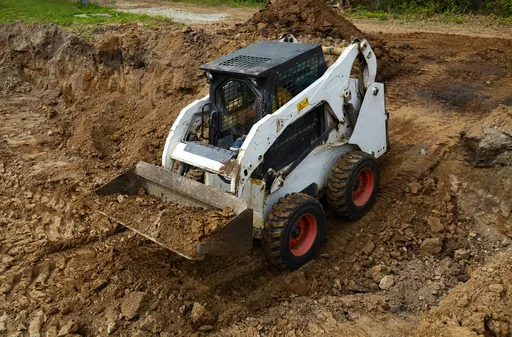
Theft is the exposure that defines this class in Ohio, and connectivity is why. Freight routes cross the state in both directions, several large markets sit close enough together that crews work more than one of them, and a state line is within easy reach of most jobsites — so a compact loader on a trailer has left the jurisdiction that would investigate it well before anyone reports it missing. Winter is the second exposure and it is the freeze-and-thaw kind rather than the deep-cold kind: repeated cycles on hoses, seals, glass and cylinders, snow accumulation on cabs and racked attachments in the north, and road salt working on fittings and electrics through the season. What remains is the machine itself — the forward tip with the arms raised and loaded, and the damage a loader collects being loaded and unloaded day after day.
Common Ohio skid steer claims we see
- Overnight theft from a site in another metro. The characteristic Ohio loss: the crew was working away from base, so the machine stayed out, and the trailer frequently went with it.
- Attachment taken from a yard rack. A breaker or planer removed while the loader was left in place, then found to be carried under a blanket per-item ceiling rather than scheduled by name.
- Freeze-and-thaw damage on iron kept outdoors. Split hoses, weeping cylinders and cracked glass accumulated over a winter rather than lost in a single event.
- Snow-work damage and corrosion. Salt on fittings, electrics and pin bores from commercial snow contracts, on machines that were never scheduled with their winter attachments.
- Local registration not matching the certificate. Not an insured loss, but the routine paperwork failure here — and one that repeats in each new jurisdiction.
Why Ohio skid steer owners choose Equipment Guard Insurance
Equipment-only writing removes a specific Ohio obstacle. Crews here often hold liability arranged around a set of local registrations and a list of general contractors, built up jurisdiction by jurisdiction, and being told the whole program has to move so the loader can be scheduled properly is not a serious proposal. We do not make it. The iron goes on its own schedule, attachments are named individually with their own values as routine, and the machines you rent in during a busy quarter are accounted for. The markets we place through — named on our homepage — read an Ohio equipment schedule as a risk in its own right.
Major Ohio skid steer markets
- Columbus. The state’s fastest-growing jobsite market, with distribution and institutional construction running at once and loaders staying on developments for months.
- Cleveland. Older-fabric rehabilitation and industrial redevelopment on constrained sites, plus lake-driven winter that decides where a machine can be left.
- Toledo. Industrial and terminal-adjacent work at the northern edge, where freight infrastructure makes trailered iron entirely ordinary traffic.
- Akron. Polymer and heavy-industry site work on legacy ground, with dispersed jobs and a good deal of trailer time between them.
- Dayton. Aerospace-adjacent and logistics construction on long federal and institutional programs, meaning long stretches with iron staged and idle on site.
Related
- Skid steer insurance — the machine physics that hold in every state.
- Excavator insurance in Ohio — the machine the locate ticket and its response window are written for.
- All equipment insurance in Ohio — the state hub.
- Equipment floater · Rented & leased equipment
Primary sources
- Section 4740.01 - Ohio Revised Code | Ohio Laws (Construction industry licensing board definitions) — No statewide general contractor license; the Ohio Construction Industry Licensing Board (OCILB), within the Ohio Department of Commerce, licenses five commercial trades (contractor licensing)
We do not link an Ohio filing document here. The ownership and lien rules described above follow Article 9 as Ohio has adopted it; where a state publishes a document that states the rule directly, this page links it.
Ohio skid steer insurance FAQs
Is a skid steer titled or plated in Ohio?
No. It stays outside the vehicle system as untitled construction equipment, so nothing is issued for it at a title office and nothing is surrendered when it sells. The serial number on the frame does the identifying, with the invoice and any financing filing behind it, and that is the whole reason a schedule listing loaders by size class rather than by serial is the weakest document in an Ohio claim file.
Do I need an Ohio license to run equipment on a job?
Not a general one, and this is the state’s defining quirk. The Construction Industry Licensing Board, inside the Department of Commerce, licenses five commercial trades — electrical, plumbing, HVAC, hydronics and refrigeration — and issues nothing for general contracting, which cities and counties register locally instead. A crew taking work in several metros in one quarter therefore deals with several different registration counters and several different sets of local paperwork, while every rule that touches the loader itself is the same everywhere in the state.
Why is Ohio a hard state to lose a machine in?
Because it is a crossing point rather than a destination. Several large metros sit within a few hours of one another and the national freight routes that connect them run east to west and north to south through the middle of the state, with lake terminals at the northern edge. A trailered loader on any of those roads is unremarkable, it can be in another state before the crew notices it is gone, and once it is, the serial record and any telematics fitted are the only things still working on your behalf.
What happens to attachments that were never named?
They fall back on a blanket limit with a per-item ceiling, and the tools worth real money sit above that ceiling. Breakers, augers, planers, grapples and snow pushers are also the items most often taken alone, lifted off a yard rack while the loader itself is untouched. If replacing it would stop work for a week, it belongs on the schedule with its own line and its own value.
Does the Ohio winter reach the machine?
It reaches the standing machine more than the working one. The freeze-and-thaw cycle here is relentless — it is what wrecks the pavement, and it works the same way on hoses, seals, glass and cylinders — and lake-driven snow builds on cabs and racked attachments along the northern edge of the state. Salt from snow work corrodes fittings and electrics over successive seasons. Where a loader spends the winter months is a bigger underwriting question here than where it spends a working day.
Can I insure the loader by itself?
Yes. Equipment Guard Insurance writes equipment as its own account, with owned loaders, attachments and rented-in units on one schedule, and no need to move the liability or workers’ compensation your local registrations already rest on.