
The backhoe is the machine a Pennsylvania crew reaches for when the job is too small for a spread and too real for a mini. It trenches, lifts, loads and backfills, and it walks itself across the site to wherever the next hole is. In this state, how far that walk goes has a legal answer.
What follows is about that answer and its consequences: a registration exemption with conditions attached, a contracting regime built on registration rather than competency, and terrain that makes the transit half of the account heavier than owners expect. The machine behavior that does not vary by state — swing radius, stabilizer loading, the loader end — is on the backhoe insurance pillar.
What backhoe insurance costs in Pennsylvania
A price for this machine cannot be produced from a page, and a number offered here would be theater. The Pennsylvania inputs that actually matter are how the machine travels between jobs and whether that travel keeps it inside the exemption or on a deck, the age and attachment list, whether the yard is secured, how much of the work is in dense older cores versus open ground, the valuation basis and your loss record. Two identical backhoes — one working a single campus contract, one moving weekly across a county — should not carry the same figure, and any process that gives them one has stopped looking.
Pennsylvania backhoe regulations: road operation
A self-propelled backhoe is ‘special mobile equipment’ under the Vehicle Code, and such equipment engaged in construction within one mile of an active construction site is exempt from registration (though tracked vehicles are excluded and lighting requirements still apply).
That rule reads differently from the equivalent in most states, and the difference is worth using. Under Title 75, the Pennsylvania Vehicle Code, the exemption is not a permanent property of the machine — it attaches to equipment engaged in construction within a mile of an active construction site, it does not extend to tracked vehicles, and it leaves the lighting requirements alone. So an owner who reads the exemption as permission to drive anywhere has misread a rule that says on its face where it stops. And even inside the exemption, nothing about liability has been settled: registration governs plating and fees, while what happens when a machine strikes a vehicle, a curb line or a utility cabinet is answered by liability coverage rather than by the floater that repairs the backhoe. The layer above is unusual in the other direction. Pennsylvania issues no statewide competency license for contractors at all; the only statewide filing is the Attorney General’s home-improvement registration for residential work above a statutory annual threshold, administered by the Bureau of Consumer Protection. Registration is not a test, so the burden of proving what a crew is falls almost entirely on its paperwork.
Common backhoe risks in Pennsylvania
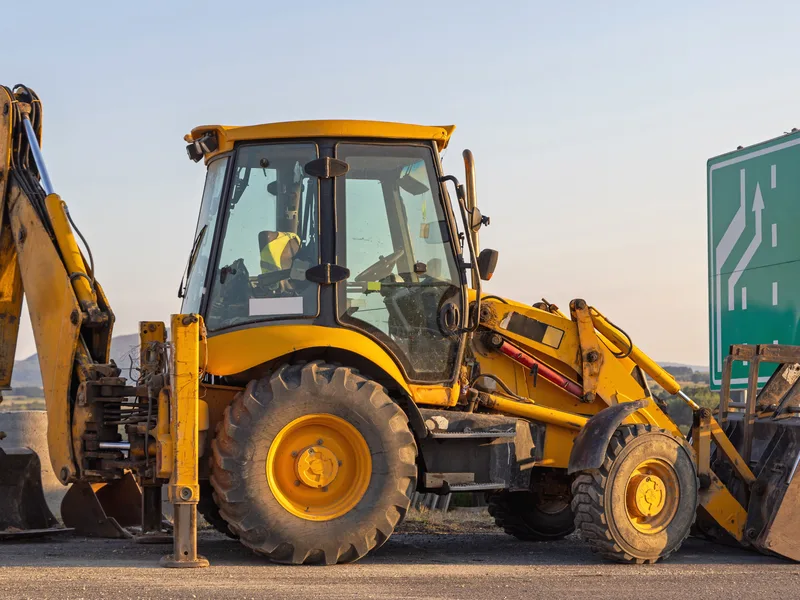
Pennsylvania splits this class between two very different working environments and gets losses from both. In the older urban cores the problem is proximity: narrow streets, party walls, street furniture and buried services of uncertain age all sit inside the swing radius of a machine designed for open ground. Outside them the problem is movement — grades, freeze-thaw pavement and long trailer legs through the ridges, where restraint failures and load shift do their damage. Between the two sits the distinctly local exposure: a machine driven beyond the conditions the exemption was written for, in traffic that is not expecting it.
Common Pennsylvania backhoe claims we see
- Struck-object or collision damage on a road move beyond the exempt working radius. The claim that follows a rule read as broader than it is.
- Boom contact against a party wall or street furniture. The signature loss on constrained rowhouse and older-core streets.
- Stabilizer subsidence into an old service trench or fill. Ground disturbed a century ago rarely behaves like the ground around it.
- Load shift or restraint failure on a graded haul. Concentrated on the ridge and valley routes where the trailer is working hardest.
- Night or low-visibility incident during a permitted move. Lighting obligations survive the registration exemption, and an incident tests that quickly.
Why Pennsylvania backhoe owners choose Equipment Guard Insurance
Monoline equipment placement suits a state that verifies contractors through filings rather than examinations. When the credential says only that you registered, the insurance file is what an owner or a general contractor can actually read about you — so the schedule should be exact, current and defensible on its own, not a byproduct of whatever package renewed last. We ask how the machine moves before we describe its road use, we put the trailer and the machine in the same conversation, and we place through markets — named on our homepage — willing to underwrite a Pennsylvania equipment schedule without requiring the rest of the account.
Major Pennsylvania backhoe markets
- Philadelphia. The densest work in the state, where a machine operates within inches of finished surfaces and buried services nobody has a reliable record of.
- Pittsburgh. River valleys, steep approaches and heavy reconstruction — the hardest terrain in the state for both the machine and the trailer.
- Allentown. Warehouse and distribution build-out at scale, with large open sites and long internal moves that stay inside the working radius.
- Harrisburg. State, municipal and utility work that keeps the machine in the public right of way for much of a normal week.
- Scranton. Reconstruction over legacy industrial ground, where what is under the surface is frequently not what the drawing shows.
- Erie. Lakeshore and industrial site work with a short season and a hard winter shoulder at both ends of it.
Related
- Backhoe insurance — the machine physics that hold in every state.
- Skid Steer insurance in Pennsylvania — the compact machine that never argues about a mile, because it rides everywhere.
- All equipment insurance in Pennsylvania — the state hub.
- Equipment floater · Rented & leased equipment
Primary sources
- Title 75 (Vehicles), Chapter 13 — Pennsylvania General Assembly (road use and registration)
- Home Improvement Contractor Registration - PA Office of Attorney General — No statewide contractor license; the Pennsylvania Office of Attorney General administers home-improvement contractor registration under the Home Improvement Consumer Protection Act (contractor licensing)
Pennsylvania backhoe insurance FAQs
Is a Pennsylvania backhoe exempt from registration, or only sometimes?
Sometimes, and the qualifier is the point. The Vehicle Code treats a self-propelled backhoe as special mobile equipment, and equipment engaged in construction within one mile of an active construction site is exempt from registration. Move outside that condition and the basis for the exemption goes with you. Tracked vehicles are excluded from the exemption entirely, and lighting requirements continue to apply regardless.
What happens if the machine drives further than that?
The honest answer is that the exemption was written for short working movement, not for using the highway as a route between contracts. Owners routinely treat a registration exemption as blanket permission to drive the machine anywhere, and Pennsylvania is a state where that reading is visibly wrong on the face of the rule. If the next job is well beyond the site, the machine belongs on a trailer, and the trailer belongs on the schedule.
Does Pennsylvania license general contractors?
No. There is no statewide competency license for general contractors here. What exists is a registration: home-improvement contractors performing residential work above a statutory annual threshold register with the Attorney General’s Bureau of Consumer Protection under the Home Improvement Consumer Protection Act. That is a consumer-protection filing, not a demonstration of skill, and nobody sits an examination for it.
If the state does not test competency, what does an owner actually check?
Your certificates, in practice. Where a state issues no competency credential, the insurance file becomes the main verifiable statement a contractor makes about itself — which is an argument for the equipment schedule being accurate and legible rather than approximately right. A schedule listing a machine by class instead of by serial number is the kind of thing that becomes a problem exactly once.
Does the terrain change the exposure on this machine?
It changes the transit half of it. Grades through the ridges and the western hills load a trailer and its restraints differently than flat mileage does, and freeze-thaw on those same roads produces the broken pavement a slow, heavy machine handles worst. On the site side, the state’s older urban cores mean tight streets, party walls and buried services of uncertain vintage within the swing radius.
Can you schedule the backhoe by itself?
Yes — Equipment Guard Insurance places equipment monoline in Pennsylvania. The machine can be written on its own without disturbing the liability and workers compensation you already hold, which matters in a state where the contractor’s credential is a registration and the insurance documents are doing most of the work of proving who you are.