
Pennsylvania asks a compact loader to do a wide range of jobs: rowhouse rehabilitation on a street with no parking, farm and township work on gravel, slope grading, and site preparation for warehouses along the freight routes. One machine covers all of it because it fits, and because the attachment it needs next is a pin away. The same portability is why it is the unit most likely to be missing on a Monday.
Two things about this state actually shape the account, and neither is about Article 9. Pennsylvania does not license contractor competency — it registers residential contractors and leaves competence to the market — and the state is long enough, with terrain awkward enough, that machines spend real time away from any yard you control. For the machine physics that hold everywhere, including skid steering and the forward-tip pattern, see the skid steer insurance pillar.
What skid steer insurance costs in Pennsylvania
We publish no premium, because a number worth quoting comes out of your own machine list and your own storage habits. In Pennsylvania the levers that move it hardest are the overnight pattern and the season: a loader that finishes every day behind a fence in one market rates differently from one following work across the state and sleeping wherever the job ends. Then come attachment values and how many of them are named, the valuation basis you select, whether a tracking unit is fitted, the deductible you accept, and your own claim history. Winter storage matters here in its own right — a machine wintered outdoors is underwritten as a machine wintered outdoors.
Pennsylvania skid steer regulations: title, lien and ownership
A skid steer is untitled construction equipment, and a security interest is perfected by filing a UCC-1 financing statement with the Pennsylvania Department of State, the central UCC filing office.
The consequence is administrative rather than exotic. With no certificate of title in existence, the financing statement and the serial number are jointly the ownership record, and a lender on a financed loader is added to the policy as loss payee against that scheduled unit so any settlement is issued jointly. Those two records have to stay aligned: a lienholder still named against iron you paid off or traded is the plainest evidence a schedule has not been reviewed lately. Where Pennsylvania adds something of its own is the layer above the machine. Because the state issues a registration instead of a competency license, the only contractor credential most clients can check is that registration — so the name on it, the name on your certificate of insurance and the name on the contract need to be the same legal entity, and a mismatch surfaces at the moment somebody decides whether the loader comes on site.
Common skid steer risks in Pennsylvania
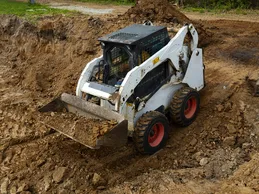
Theft is the exposure that defines this class in Pennsylvania, and geography sets the terms. The state has two large construction economies separated by hours of ridge-and-valley driving, so machines are on trailers often and parked away from base often, which is the condition under which compact loaders disappear. Season is the second exposure and it is genuinely severe here: snow load and lake-driven accumulation in the northwest, freeze-and-thaw on hydraulics and seals statewide, and ice on sloped ground where machines are staged. After those two the remainder is the machine itself — a forward tip with the arms up and loaded, and the dents, glass and cylinder damage that come from loading and unloading a trailer twice a day.
Common Pennsylvania skid steer claims we see
- Overnight loss from a job the crew is not local to. The characteristic Pennsylvania theft: the machine was hours from its own yard, so it stayed on the site, and the trailer often went with it.
- Attachment gone from a rack. A breaker or planer lifted while the loader sat untouched, then found to be riding a blanket per-item ceiling instead of a named schedule line.
- Snow and ice damage to iron wintered outdoors. Collapsed accumulation on a cab, cracked glass, split hoses and seized cylinders on a machine that never came inside.
- Roll or slide on a graded slope. Not always a tip — sometimes a machine simply moved on ice on ground that was fine in October.
- Registration and certificate naming different entities. Uninsured but expensive: a day lost at the gate while the paperwork is corrected.
Why Pennsylvania skid steer owners choose Equipment Guard Insurance
Equipment-only is the whole point for a Pennsylvania crew. Most operators here have assembled liability and workers’ compensation around a registration and a set of client relationships, and being told the loader can only be scheduled properly by moving all of it is not a serious answer. We schedule the iron on its own, name attachments individually as a matter of routine, and account for the machines you rent in during a busy stretch. The markets we place through — named on our homepage — read a Pennsylvania equipment schedule as its own submission.
Major Pennsylvania skid steer markets
- Philadelphia. Rowhouse and infill rehabilitation on streets with no staging room at all, where the loader works from the pavement and sleeps where it worked.
- Pittsburgh. Slope and hillside site work with retaining and drainage structures, so machines operate and park on grade more often than they do anywhere else in the state.
- Allentown and the Lehigh corridor. Large-footprint distribution construction with deep rental supply, which puts rented-in loaders and the certificates rental houses demand on most accounts.
- Harrisburg. Public-sector and institutional work on long programs, meaning long stretches where iron is on site but nothing is happening on it.
- Scranton. Reclamation and older-industrial redevelopment on legacy ground, where machines work dispersed sites well away from a secure yard.
- Erie. Lake-driven winter is the underwriting fact here: the season closes hard, and where a loader spends those months is the whole conversation.
Related
- Skid steer insurance — the machine physics that hold in every state.
- Backhoe insurance in Pennsylvania — the machine the special-mobile-equipment registration exemption is written around.
- All equipment insurance in Pennsylvania — the state hub.
- Equipment floater · Rented & leased equipment
Primary sources
- Home Improvement Contractor Registration - PA Office of Attorney General — No statewide contractor license; the Pennsylvania Office of Attorney General administers home-improvement contractor registration under the Home Improvement Consumer Protection Act (contractor licensing)
We do not link a Pennsylvania filing document here. The ownership and lien rules described above follow Article 9 as Pennsylvania has adopted it; where a state publishes a document that states the rule directly, this page links it.
Pennsylvania skid steer insurance FAQs
Is a skid steer a titled vehicle in Pennsylvania?
No. There is no certificate for it at the transportation department, because it is not a highway vehicle, so ownership is evidenced by the invoice, the serial plate and whatever financing record exists. That has one blunt consequence: after a theft the adjuster and the police work from the serial number, and a schedule that identifies the loader only by size class gives them nothing to work from.
Do I need a Pennsylvania contractor license before I run equipment?
There is no competency license in this state to obtain. Residential contractors above a statutory annual volume of home-improvement work must register with the Attorney General’s consumer-protection bureau, and that is a filing rather than a qualification — no examination, no trade classification, no proof of experience. Read that as a warning about what the registration proves rather than about what it costs you: general contractors treat it as a gate anyway, so the registration and the certificate of insurance must name the same legal entity or the crew waits at the gate.
Why does the distance between the two ends of Pennsylvania matter to my schedule?
Because it turns trailer time into a permanent feature of the account. There is no straight run between the eastern and western markets — the ridges route you around rather than through — so a crew chasing work in both economies keeps a loader on the road, overnighting at truck stops, contractor yards and unfamiliar sites rather than behind its own fence. Machines away from base are where this class loses iron, and an underwriter will ask about the pattern before it asks about the value.
How should attachments be listed?
Individually, once they are worth more than a bucket. A blanket attachment limit carries a per-item ceiling, and the tools that ceiling was never built for — hydraulic breakers, cold planers, augers, mulching heads — are precisely the ones a thief can carry off a rack without touching the loader. Anything you would need replaced within the week is worth a named line and its own value.
Does the Pennsylvania winter change how this machine is underwritten?
It changes the non-theft half of the file, and it does so unevenly across the state. The northwest corner takes lake-driven snow that buries a machine left in the open, while the rest of the state runs a freeze-and-thaw cycle that works on cab seals, glass, hoses and cylinders all winter. Slope adds to it: much of this terrain is not flat, and a loader parked on a grade in ice is a different proposition from one on a level pad.
Will you write the loader without touching my liability?
Yes — that is how Equipment Guard Insurance prefers to write it. Equipment goes on a monoline schedule of its own, owned units and rented-in units together, and any general liability or workers’ compensation you already hold stays exactly where it is.