
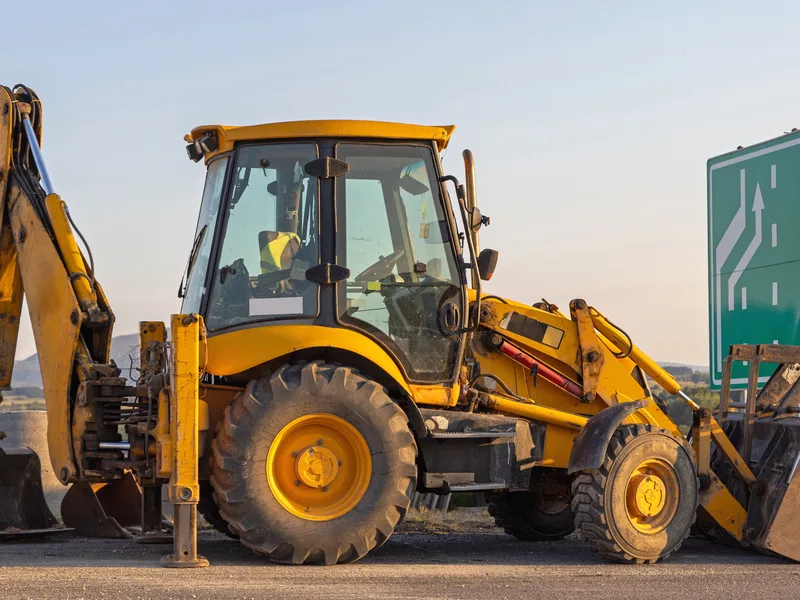
A backhoe is the machine a South Carolina site crew keeps when it is thinning the fleet. Loader at one end, excavating boom at the other, and no need for a truck to move it a few hundred yards down the road to the next section of the same job.
That last ability is what this page is about, because South Carolina has written down exactly what the machine is once it is out there, and the answer shapes the coverage. Below: the classification and its limits, the license ceiling sitting above it, and the two very different working environments the state contains. The mechanical questions that follow the machine everywhere — reach, swing, hydraulic duty — live on the backhoe insurance pillar instead.
What backhoe insurance costs in South Carolina
No honest figure can be published without your details, and one published anyway would be invention with a decimal point attached. The South Carolina inputs that actually move it are the share of the machine’s year spent on public roads rather than inside a site, whether the work is coastal or upstate — because the ground and the air differ enough to change the loss pattern — where the machine sits overnight, whether it is exposed during named-storm season, the valuation basis you select, and your own record. Two identical machines in different halves of this state are not the same risk.
South Carolina backhoe regulations: road operation
A self-propelled backhoe is ‘special mobile equipment’ — a vehicle not designed or used primarily to transport persons or property and only incidentally operated or moved over the highways — and is not registered as an ordinary vehicle.
That definition is worth reading for what it does not do. Because the machine is special mobile equipment under the South Carolina motor-vehicle code, it stays outside ordinary registration — but registration and responsibility are separate subjects, and only one of them has been settled. A backhoe legally traveling a state route is in traffic with everything else on it, and the damage it can do there is answered by liability coverage, never by the floater that puts the machine back together. Above that sits the license. South Carolina grades general and mechanical contractors by classification and sets a per-job ceiling from the financial group the license falls into, so the state has already recorded a view of what your business can carry. An equipment schedule that contradicts it is a question waiting to be asked.
Common backhoe risks in South Carolina
Ground behavior is the organizing risk in this state, and it changes as you move inland. Near the coast, sand and made ground let a stabilizer keep going after it should have stopped, and the resulting subsidence takes the surface and whatever is under it. Inland, clay loads the boom and the loader arms harder than the operator registers. Running through both is the road exposure the classification creates rather than removes, plus the machine’s two permanent habits — the boom finding something behind the operator, and a leg set on ground nobody tested. Storm season then compresses a year of urgency into days.
Common South Carolina backhoe claims we see
- Struck-object or collision damage on a highway move. The exposure the special-mobile-equipment classification is most often misread as having disposed of.
- Stabilizer subsidence into sand or made ground. The coastal signature: the leg keeps going, and the surface, the level and sometimes a buried service go with it.
- Boom contact behind the operator. Swing arc against a wall, a fence line or a vehicle that arrived after the machine was set.
- Storm-window overwork presented as sudden failure. Restoration weeks run machines hard, and the wear-versus-peril line decides the claim.
- Loading and tie-down damage between coastal and upstate jobs. Concentrated on the long legs, where a crew is moving iron across the whole state rather than across a site.
Why South Carolina backhoe owners choose Equipment Guard Insurance
Writing equipment on its own is the point of how we are set up, and in South Carolina it solves a specific problem. A licensed contractor here has liability and workers compensation arranged around a classification and a financial group, and being told to move the whole program so one machine can be scheduled correctly is not a serious answer. We do not give it. We underwrite the road exposure on what the machine actually does rather than assuming it never leaves a site, we ask coastal and upstate questions separately because the answers differ, and we place through markets — named on our homepage — that will read the schedule on its own terms.
Major South Carolina backhoe markets
- Charleston. Port, waterfront and infill work on saturated ground, where the stabilizer question is live on almost every set.
- Columbia. State, institutional and utility work that keeps the machine in the public right of way for a large part of the week.
- Greenville. The upstate industrial and distribution build-out, with clay grades and frequent road moves between adjacent sites.
- Myrtle Beach. Resort and residential development on sand, plus the seasonal surge that leaves no gap in the schedule for service.
- Spartanburg. Industrial pads and access work along the northern corridor, hard on undercarriage and tires alike.
- Rock Hill. Fast suburban growth on the northern edge, where finished surfaces sit close to open ground and the swing arc has no margin.
Related
- Backhoe insurance — the machine physics that hold in every state.
- Skid Steer insurance in South Carolina — the machine whose state question is a filing office rather than a highway.
- All equipment insurance in South Carolina — the state hub.
- Equipment floater · Rented & leased equipment
Primary sources
- Code of Laws Title 56, Chapter 3 — Motor Vehicles — South Carolina Legislature (road use and registration)
- Contractor’s Licensing Board — South Carolina Department of Labor, Licensing and Regulation (contractor licensing)
South Carolina backhoe insurance FAQs
What is a backhoe under South Carolina vehicle law?
It is special mobile equipment. The code reaches vehicles that were not designed or used primarily to move people or property and that only incidentally travel the highways, which describes a backhoe repositioning itself between ends of a job precisely. That classification is why the machine carries no ordinary registration — and why an underwriter treats it as scheduled equipment rather than as a unit on a fleet auto policy.
Does the classification mean road damage is somebody else’s problem?
No, and reading it that way is how owners end up uninsured for the loss they were most likely to have. The definition governs registration. It has nothing to say about who answers when a machine legally on the highway strikes a vehicle, a mailbox or a sign. The floater repairs the backhoe; liability responds for what the backhoe hits, and both need to be present before the first road move of the season.
How does the license classification affect an equipment account here?
More directly than in most states. South Carolina licenses general and mechanical contractors statewide, with two-letter classifications and a per-job ceiling set by the financial group the license sits in. The ceiling is therefore a public statement about your capacity, and an equipment schedule that looks far smaller than the work the license permits invites the obvious question. Keeping the two consistent is a cheap way to avoid a slow submission.
What does coastal work do to a backhoe that upstate work does not?
It changes the ground and the air at once. Saturated sand and made ground near the coast will accept a stabilizer pad and then keep accepting it, so subsidence claims cluster there; salt-laden air shortens the life of rams, pins and exposed rod; and storm season concentrates emergency and restoration work into short, intense windows when every available machine is running hard with no time for service.
And in the upstate, what changes?
Clay and grade. Piedmont clay grips a bucket when wet and sets hard when dry, so cycle loads on the boom and the loader arms run higher than the operator notices, and slopes put the machine into positions where a stabilizer set is doing more work than it looks like. The industrial and distribution build-out along the northern corridor also means more road moves between sites in a working week than a single-site coastal job generates.
Will you write the machine on its own?
Yes — Equipment Guard Insurance places equipment monoline in South Carolina. A licensed contractor whose liability and workers compensation are already arranged around a classification and a financial group has every reason not to reopen them, and scheduling the backhoe properly does not require it.