
A skid steer is the machine that lets a South Carolina crew self-perform instead of subcontracting — it clears, loads, grades, breaks and lifts, gets through a residential gate, and rides to the next lot on a trailer behind the truck already in the yard. It also has the shortest distance between parked and gone of anything a contractor owns.
What follows is specific to South Carolina: a statewide license whose classification and financial group cap the size of job you may hold, a coastline that produces both sudden storm losses and slow corrosion losses, and a port-and-corridor geography that gives stolen iron somewhere to go. For the parts of this machine that behave identically in every state — coupler systems, skid steering, tipping forward under load — read the skid steer insurance pillar.
What skid steer insurance costs in South Carolina
No figure is posted here, because a truthful one gets assembled from the iron you own and the conditions it works in. In South Carolina the levers that move it most are storage, proximity to the coast, and the attachment mix: a loader kept behind a gate inland is a different proposition from one that spends the season on open residential ground within reach of storm wind. After that come the number and value of attachments on the schedule — land-clearing heads move this needle more than most owners expect — the valuation basis you choose, whether a tracking unit is fitted, and your own loss history. What your license classification lets you bid also shapes the schedule, because it decides which work you self-perform.
South Carolina skid steer regulations: title, lien and ownership
A skid steer is untitled construction equipment, not a certificate-of-title vehicle, and a security interest is perfected by filing a UCC-1 financing statement centrally with the South Carolina Secretary of State.
Because there is no title in the chain, the financing statement and the serial number are the ownership record. A lender on a financed loader is added to the policy as a loss payee against the scheduled unit, so a loss payment is issued jointly and the policy and the filing have to describe the same machine. What South Carolina layers on top is not about the machine at all: the statewide license carries a classification for the kind of work and a group that limits the value of a single job, so the licensed entity, the entity named on the certificate of insurance and the entity signing the contract have to be one and the same. Growing across a group boundary is a financial review rather than a form, which is why owners here think about how the iron is financed and scheduled earlier than owners in states with no statewide license at all.
Common skid steer risks in South Carolina
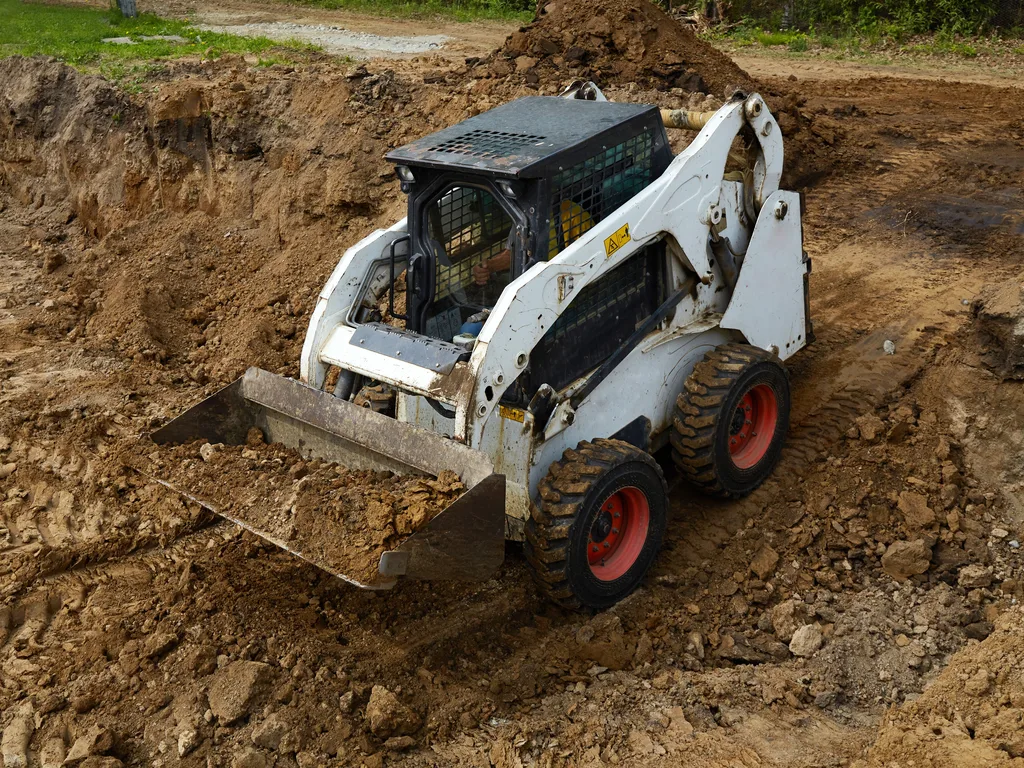
Theft leads the class, and in this state it is a function of growth. New residential and commercial ground on the fringes of Charleston, Columbia, Greenville and Myrtle Beach means open sites, irregular staffing and a compact machine that one person can load out. Wind and water are the second exposure and they behave differently from inland weather: a named storm gives some warning and rewards a plan for moving machines inland, while surge and standing water reach low-lying sites that were dry when the crew left. The slow coastal exposure sits underneath both — salt air on cylinders, connectors and cab electronics. Beyond that, land clearing supplies its own damage pattern, from struck stumps and debris punctures to the forward tip with the arms raised.
Common South Carolina skid steer claims we see
- Theft from an open residential development at night. The defining claim in a growth state, settled against the serial number.
- Named-storm wind damage to a machine left on site. Glass, doors and cab damage where the loader was not moved inland in time — plus the argument about whether it could have been.
- Corrosion and electrical failure on a coastal machine. Gradual rather than sudden, which puts the maintenance record at the center of the loss.
- Land-clearing head damaged or stolen. A mulching head or rake that sits above the blanket per-item sublimit rather than being scheduled by name.
- Forward tip while placing a load at height. Usually on ground softer than it looked, on a machine that carries its load out ahead of the axles.
Why South Carolina skid steer owners choose Equipment Guard Insurance
We write equipment monoline, which fits a state where the general liability program is often built to satisfy a license classification and a general contractor’s requirements at once. Nobody wants to unpick that arrangement to get a loader scheduled properly, and we do not ask anyone to. We schedule attachments by name as a matter of course — the land-clearing heads especially, because they are the items most often quietly under-limited — and we place through markets named on our homepage that will read a South Carolina equipment schedule on its own merits.
Major South Carolina skid steer markets
- Charleston. Port-adjacent industrial work alongside peninsula infill, the sharpest combination of storm exposure and corridor access here, and the deepest coastal rental market.
- Columbia. Institutional and government site work at the center of the state, where schedules are steadier and secured yard storage is genuinely available.
- Greenville. Industrial and plant-adjacent build-out on the interstate corridor, with heavy machine hours and long hauls between sites.
- Spartanburg. Distribution ground work on the same corridor, where loaders spend nights on site and reach an out-of-state metro as easily as an in-state one.
- Myrtle Beach. Resort and residential build-out on a compressed season, with open sites and the most exposed coastal storage in the state.
- Rock Hill. Growth work pulled by a larger metro across the state line — where a stolen loader leaves the jurisdiction inside an hour.
Related
- Skid steer insurance — the machine physics that hold in every state.
- Forklift insurance in South Carolina — the machine whose operator training runs through this state’s own OSHA program.
- All equipment insurance in South Carolina — the state hub.
- Equipment floater · Rented & leased equipment
Primary sources
- Contractor’s Licensing Board — South Carolina Department of Labor, Licensing and Regulation (contractor licensing)
We do not link a South Carolina filing document here. The ownership and lien rules described above follow Article 9 as South Carolina has adopted it; where a state publishes a document that states the rule directly, this page links it.
South Carolina skid steer insurance FAQs
How does my license classification affect what I do with the loader?
It sets the ceiling the machine has to earn under. The Contractor’s Licensing Board, inside the Department of Labor, Licensing and Regulation, licenses general and mechanical contractors statewide using two-letter classifications for the kind of work and a financial group that caps the value of any single job. Two consequences follow for equipment. First, the classification decides which trades you may self-perform, and therefore which attachments actually pay for themselves. Second, moving up a group to bid larger work is a financial review, so how the iron is owned, financed and insured stops being purely an operational question.
Is a skid steer titled or registered in South Carolina?
No. It is untitled construction equipment rather than a certificate-of-title vehicle, so no title is issued, none changes hands at a sale, and none exists to produce after a loss. The serial number, the bill of sale and the central financing record identify the machine instead.
Does the coast change how a compact loader is underwritten here?
Substantially, and in two directions. Named-storm wind and surge reach machines held anywhere from the Charleston peninsula through the Grand Strand, and a loader is both easy to move inland ahead of a storm and easy to forget to move. Then there is the slower exposure: salt air and brackish standing water on machines that live near the water year round, which shows up as corrosion, electrical faults and seal failure rather than as one datable event. An underwriter will ask where the loader goes when a storm is named.
What makes theft the leading exposure on this machine here?
Access and pace. Compact loaders are taken far more often than large tracked machines because a single person can trailer one away, and this is a state where fast-growing residential fringes sit within an hour of a major container port and of the interstate corridor running up to a larger out-of-state metro. Growth also means sites that are open, unfenced and staffed irregularly — so both the serial record and a tracking unit belong on the schedule before anything goes wrong.
Are attachments covered on a South Carolina skid steer policy?
Only where they are scheduled by name. Blanket attachment limits carry a per-item sublimit; buckets, forks and a light grapple usually sit inside it, while breakers, augers, mulching heads and land-clearing rakes usually do not. Land-clearing heads matter here in particular, because clearing scrub and pine on new residential ground is steady work in this state and the head doing it is often the most valuable single item in the yard. Attachments also disappear separately from the loader, lifted off a rack while the machine stays where it was parked.
Can I insure the loader by itself, without a package policy?
Yes. Equipment Guard Insurance writes equipment monoline in South Carolina, so the loader and its attachments sit on their own schedule. If your general liability is already arranged the way your license classification and your general contractors require, we leave it there and write the equipment alongside it.