
Ask a Tennessee site contractor which machine earns its keep and the answer is usually the one with a bucket at each end. The backhoe trenches, loads, backfills and sets pipe, and then it takes itself down the road to the next address without anybody hooking up a trailer.
That last habit is the whole subject here. This page is about what Tennessee law does with the machine the moment it leaves private ground, what the state asks of the business operating it, and how a state shaped like a long corridor rearranges the risk. Boom geometry, bucket selection and the loader end behave the same in every state — those belong to the backhoe insurance pillar, not to this one.
What backhoe insurance costs in Tennessee
We will not print a rate, because a rate produced without your details is fiction with a decimal point in it. The inputs that genuinely move a Tennessee backhoe premium are road exposure and geography: how many hours a week the machine is under its own power on public pavement, how far apart your jobs sit, whether the work is plateau grade or river-bottom flat, where the machine sleeps when the crew goes home, the valuation basis on the schedule, and your own claim history. Two identical machines, one on a single Nashville subdivision and one splitting its year between divisions, are not the same risk and will not price alike.
Tennessee backhoe regulations: road operation
A self-propelled backhoe is ‘special mobile equipment’ — a vehicle not designed or used primarily to transport persons or property and only incidentally moved over highways, including road construction and ditch-digging machinery — and is not registered as an ordinary motor vehicle.
The section carrying that treatment is Tenn. Code Ann. § 55-1-109. We name it and stop there. The copy we have on record is served by a host that turns away automated clients, which means nobody here has opened it, and a citation offered on faith is a claim wearing a section number. What the classification does and does not reach is the part worth being exact about. It answers a registration question and nothing else. A backhoe rolling between two ends of a job is still a heavy object sharing pavement with traffic, and the cost of what it strikes out there is a liability question the floater was never drafted to settle. Tennessee then layers its licensing regime on top: the state license is required before you bid rather than merely before you build, and it is issued by classification, so what you may pursue is a matter of record ahead of the award. Keeping the equipment schedule consistent with that classification saves an awkward conversation later.
Common backhoe risks in Tennessee
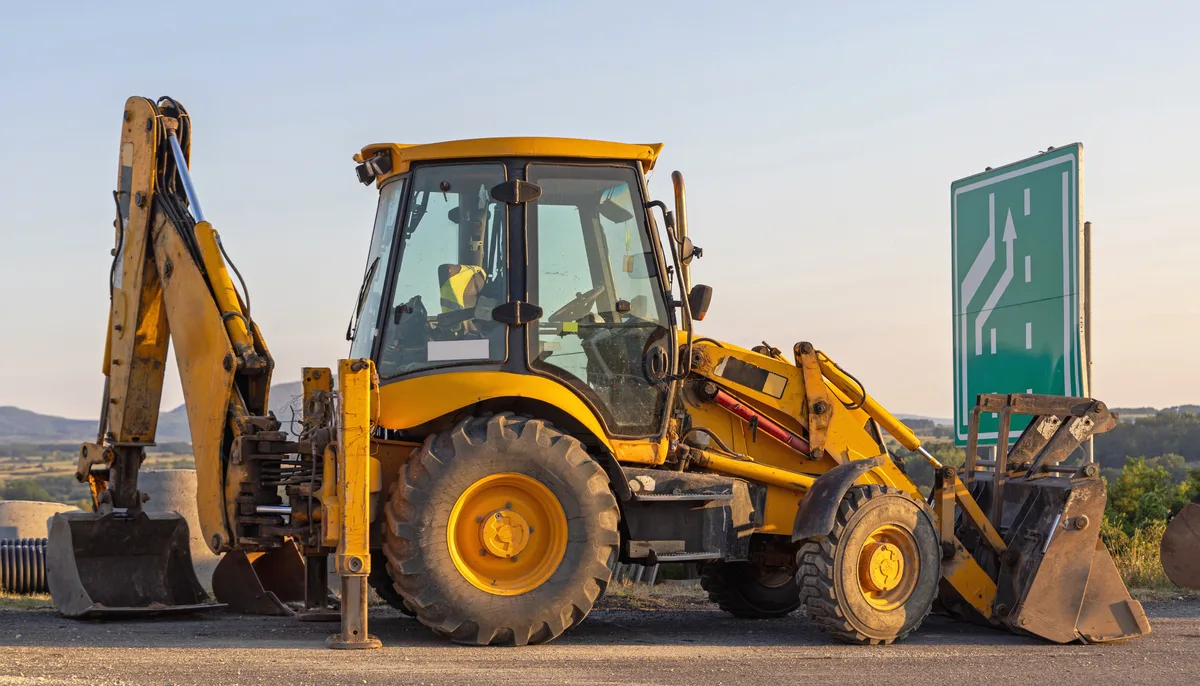
Two Tennessees produce two loss profiles. In the east the ground tilts, and a tilted jobsite is where a backhoe gets hurt during the boring parts of the day — repositioning, walking off a pad, coming down a ramp with a bucket still loaded. In the west the ground is flat and soft, and the failure is vertical: a stabilizer foot sinking into fill or saturated bottomland while the operator is concentrating on the trench. Between the two sits the corridor itself, which is where the machine spends its transit hours and where this class books its most expensive single events. Add the swing-radius problem that follows every backhoe onto every lot, and the underwriting picture is complete.
Common Tennessee backhoe claims we see
- Contact damage during a self-propelled road move. Mailbox, parked vehicle, low canopy, mirror — small objects, and none of them yours.
- Downgrade incidents on eastern jobsites. Loading, unloading or repositioning on slope, where momentum arrives before anybody expects it.
- Stabilizer penetration in western fill and bottomland. The leg goes down, the surface goes with it, and sometimes a buried service goes too.
- Tie-down and ramp losses on long-corridor hauls. Concentrated on the legs between divisions, where most of the state’s equipment mileage sits.
- Swing contact with finished work. The counterweight arc against a wall, a fence line or a newly poured curb on a tight urban lot.
Why Tennessee backhoe owners choose Equipment Guard Insurance
Equipment written on its own is the entire premise of this agency, and in Tennessee it removes a specific obstacle. A licensed contractor here has liability and workers compensation arranged around a classification that took effort to obtain, and being told the whole program must move so one machine can be scheduled correctly is not a serious answer. We do not give it. We ask about road hours and haul legs before quoting rather than assuming a machine that never leaves a fence, we ask which side of the plateau the work sits on, and we place through markets — named on our homepage — that will read a Tennessee equipment schedule on its own terms.
Major Tennessee backhoe markets
- Nashville. The densest and fastest-moving jobsite market in the state, where short road moves between constrained lots put the machine on public pavement most working days.
- Memphis. Distribution, industrial pad and utility work on flat alluvial ground — the state’s clearest concentration of subsidence-type losses.
- Knoxville. Valley and ridge work where jobs sit on grade and machines are repositioned more often than they are trenched with.
- Chattanooga. Riverfront redevelopment and industrial reconstruction hard against finished surfaces, which is where swing-radius claims live.
- Clarksville. Sustained residential and institutional build-out with long daily approaches from contractor yards further south.
- Murfreesboro. Middle-Tennessee greenfield development, where a single crew may hold several open sites and the machine road-moves between them.
Related
- Backhoe insurance — the machine physics that hold in every state.
- Skid Steer insurance in Tennessee — the machine a Tennessee thief can put on a deck in under a minute.
- All equipment insurance in Tennessee — the state hub.
- Equipment floater · Rented & leased equipment
Primary sources
- Contractor (Tennessee Board for Licensing Contractors, Dept. of Commerce & Insurance) - raw <title> is 'Contractor' — Tennessee Board for Licensing Contractors, Department of Commerce and Insurance (contractor licensing)
We do not link a Tennessee vehicle-code section here. The road-use treatment described above follows how Tennessee classifies self-propelled construction equipment; where the state publishes a section that states it directly, this page links it.
Tennessee backhoe insurance FAQs
Does Tennessee make me register a backhoe the way I register a truck?
No, and the reason is a definition rather than a favor. The vehicle code puts self-propelled work machinery in its own category — built to dig rather than to haul, and on the pavement only incidentally — which keeps it outside ordinary vehicle registration. Owners then tend to file the whole road question as settled, which is the mistake this page exists to head off.
Why does this page name a Tennessee code section without linking it?
Because we only publish links to documents somebody here has actually opened. The recorded copy of that section is served by a host that turns away automated requests, so it has not been fetched and read to the standard our other citations meet. The section number is recorded in our own state file and we are willing to name it; the document stays unlinked until it can be read.
How does the Tennessee contractor license affect an equipment schedule?
It sets expectations before the job exists. The license has to be in hand at bid time rather than at groundbreaking, and it is issued by classification, so the type and scale of work you are entitled to pursue is on the record ahead of the award. An underwriter reading a schedule that looks thin against the classification you bid under will ask about it, and the answer is easier to give in advance than during a claim.
What does Tennessee terrain do to a backhoe specifically?
It works the machine in two very different ways. East of the plateau the jobs sit on grade, and grade is what turns routine loading, unloading and repositioning into the moments where machines get damaged and people get hurt. West toward the river bottoms the problem inverts: flat, fine, saturated ground that gives way under a stabilizer foot without warning. One state, two failure modes, and a schedule that should know which one it is buying.
We work jobs in more than one part of the state. Does that change anything?
It changes what the policy is mostly protecting against. A machine that stays inside one metro is exposed to jobsite contact and short road moves. A machine that runs the length of Tennessee spends real hours as cargo, and loading, tie-down, ramp and highway incidents are where this class concentrates its worst losses. We would rather size the transit picture honestly than write the machine as though it never left the yard.
Can you write the backhoe by itself?
Yes. Equipment Guard Insurance places equipment as a standalone line in Tennessee, so the machine can be scheduled properly without reopening the liability or workers compensation program you already have in force under your license classification.