

In a state of small crews and small sites, the backhoe is often the only serious piece of iron an outfit owns. It digs the trench, feeds the truck, sets the pipe and then takes itself up the road to the next address without anyone hooking up a trailer — which is precisely the habit that makes it awkward to insure well.
This page is about the Vermont side of that awkwardness: how the state treats the machine once it is on a public road, which contractors the state actually credentials, and how a land-use permit can decide when the digging starts at all. The parts of the machine that behave the same in every state — boom geometry, stabilizer loads, the loader end — belong to the backhoe insurance pillar.
What backhoe insurance costs in Vermont
We will not print a rate here. A figure produced without your machine, your work and your record would be decoration rather than information. What genuinely moves a Vermont backhoe premium is the number of road moves in a normal week, the age and attachment list of the machine, whether it winters indoors or on an open site, the valuation basis you choose, and how the last several years have gone. Two identical machines — one working a single Chittenden County subdivision all season, one moving between four town contracts a month — do not deserve the same number, and quoting them the same is how an account ends up mispriced in both directions.
Vermont backhoe regulations: road operation
Self-propelled construction equipment such as a backhoe is generally treated as special mobile equipment not registered as an ordinary motor vehicle and only incidentally operated on public roads.
We state that treatment and cite nothing, deliberately. Vermont’s road-use rule for construction equipment is not one this build has traced to a section it has fetched and read, and naming a number we have not opened would be worse than naming none. What matters commercially survives the missing citation anyway: an exemption from ordinary registration is a paperwork outcome, not a liability outcome. The machine is still a heavy, slow, wide object sharing a public road with everything else on it, and damage it does out there is answered by liability coverage rather than by the floater that repairs the backhoe. The credential layer above it is unusual enough to be worth stating plainly. Vermont registers residential contractors through the Office of Professional Regulation — an office inside the Secretary of State, not a building department — and that registration reaches residential contracting above a statutory contract-value threshold and no further. Commercial site work has no statewide equivalent. Act 250 then adds a second timing layer on larger earth-disturbing projects, so on some jobs the question is not whether you may dig but when the review lets you.
Common backhoe risks in Vermont
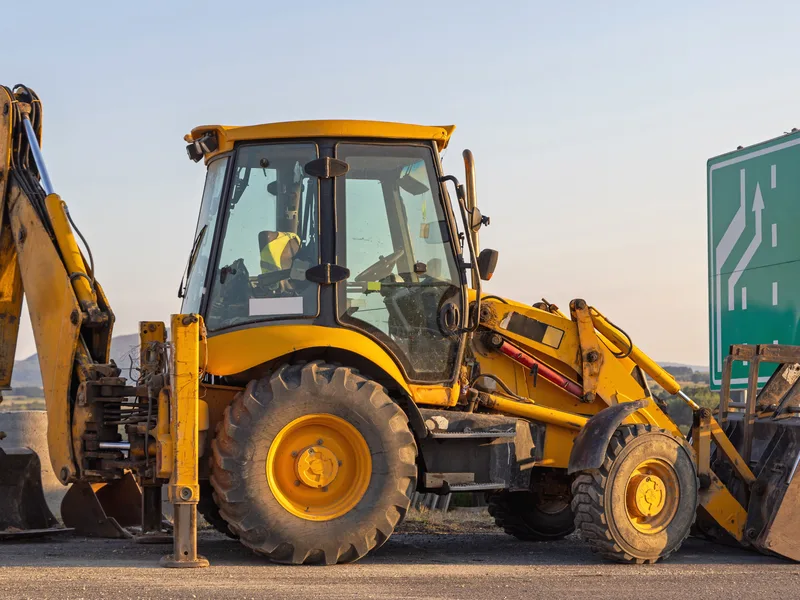
The Vermont pattern is short moves and soft ground rather than distance. A backhoe here crosses public pavement often, usually briefly, frequently on a town highway with no shoulder and a stone wall or a ditch line within a foot of the tire — so contact claims come from clearance, not from speed. Underneath that sits the seasonal problem: ground that is rock-hard in February and structureless in April punishes the boom in one season and drops the stabilizers in the next. Add the permitted job that has not opened yet, with a machine sitting on it unattended for weeks, and you have the three ways Vermont owners actually lose money on this class.
Common Vermont backhoe claims we see
- Clearance contact on a town road move. A wall, a guardrail, a mailbox run or a parked vehicle on a road with nowhere to move over to.
- Stabilizer breakthrough in the spring thaw. A foot that held all winter goes through softened fill, taking the surface and sometimes a shallow service with it.
- Boom or bucket damage in frozen ground. Frost resists the bucket and the operator forces it; the loss shows up in the structure rather than at the tooth.
- Undiscovered loss on a site waiting for permit clearance. Weeks of nobody checking turns a small event into an expensive one.
- Damage while trailered over a gap-town gradient. The short haul over a pass is where tie-down and load-shift claims concentrate here.
Why Vermont backhoe owners choose Equipment Guard Insurance
Equipment-only placement fits how Vermont contractors are actually put together. Most outfits running a backhoe here are small enough that their liability and work comp are settled arrangements they have no appetite to reopen, and a market that will only look at the iron as part of a package is not offering them anything. We do not work that way. We ask about road moves rather than assuming a machine that never leaves the site, we ask where it sits between contracts, and we place through markets — named on our homepage — that will read a single-machine Vermont schedule on its own.
Major Vermont backhoe markets
- Burlington. The densest build-out in the state, where downtown and lakeside lots put finished surfaces within a boom radius of the machine.
- South Burlington. Commercial and institutional site work with the steadiest pipeline in the region, and the most repeat road moves between adjacent jobs.
- Rutland. Older infrastructure and utility replacement in the south, where what is buried is rarely exactly where the record says it is.
- Barre. Stone country, with heavy approach roads and abrasive ground that shortens the life of pins, bushings and cutting edges.
- Montpelier. Small-scale municipal and riverfront work that keeps the machine in the public right of way more days than not.
- Essex Junction. Residential and light-industrial build-out — the corner of the market where the state’s residential registration actually bites.
Related
- Backhoe insurance — the machine physics that hold in every state.
- Skid Steer insurance in Vermont — the compact machine whose Vermont question is a filing office, not a road.
- All equipment insurance in Vermont — the state hub.
- Equipment floater · Rented & leased equipment
Primary sources
- Residential Contractors — Vermont Secretary of State, Office of Professional Regulation (contractor licensing)
We do not link a Vermont vehicle-code section here. The road-use treatment described above follows how Vermont classifies self-propelled construction equipment; where the state publishes a section that states it directly, this page links it.
Vermont backhoe insurance FAQs
Is a Vermont backhoe plated and registered like a work truck?
It is not. The state puts self-propelled construction machinery in the class of equipment that is worked rather than driven, and equipment in that class stays outside the ordinary registration system as long as its highway use is incidental to the job. We describe that treatment in words rather than by section number, because the section behind it has not been fetched and read to the standard our citations have to meet.
Does Vermont license the contractor who runs the machine?
Only on the residential side. Registration runs through the Office of Professional Regulation, which sits inside the Secretary of State rather than in a construction agency, and it applies to residential contracting above a statutory contract-value threshold. There is no statewide commercial general-contractor credential to go with it, so an outfit doing site work for a commercial owner is proving itself with references and certificates rather than with a state card.
Does Act 250 change anything about how the backhoe is insured?
It changes the calendar, and the calendar changes the exposure. Land-use review can decide when a larger earth-disturbing project is permitted to start, which means a machine is sometimes bought or brought in ahead of a permit and then waits. An idle backhoe parked on an unopened site is a different risk from a working one — nobody is on it daily, nobody notices damage quickly — and the application should say where it waits.
What does the freeze and thaw cycle do to this machine here?
It attacks the two ends of it. Frozen ground resists a bucket and loads the boom harder than the operator intends; then the thaw softens shoulders and fill so a stabilizer foot that held all winter drops through in April. Vermont crews lose more surface and more buried service to that seasonal swing than to anything dramatic, and the pattern is worth describing on an application rather than explaining after a claim.
Vermont roads are narrow. Does that change the road exposure?
It changes its shape rather than its size. There is not much long-haul mileage here, so the machine rarely spends hours in traffic; instead it makes short, frequent moves along town highways, gravel roads and older bridges with no shoulder to give way onto. Frequency plus tight clearance is its own exposure — a wide machine passing a stone wall, a mailbox line or a parked car has very little room to be wrong in.
Can the machine be scheduled on its own?
Yes. Equipment Guard Insurance places equipment monoline in Vermont, so the backhoe can be scheduled without disturbing whatever liability and workers compensation you already have. That matters here because the state credential does not carry an insurance requirement for most of the work a backhoe actually does, which leaves the structure of your program entirely up to you.