
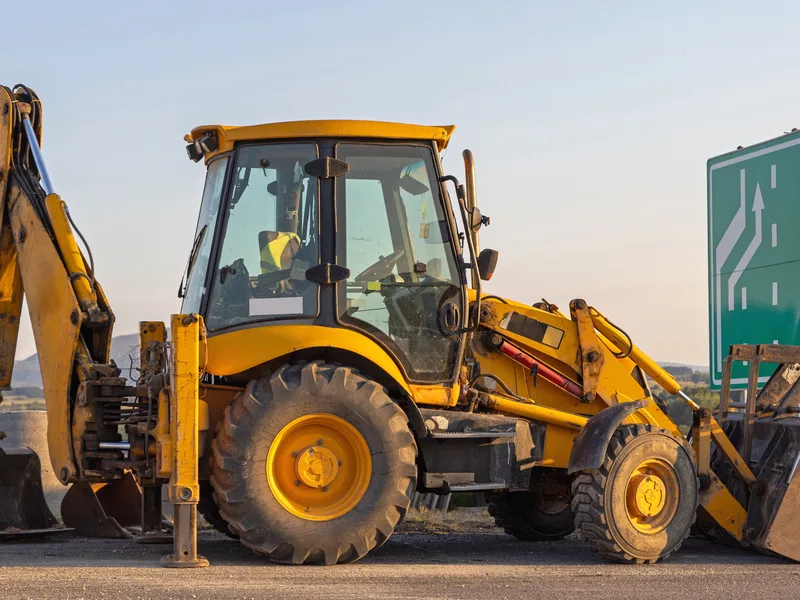
A backhoe stays on the roster of a Washington crew long after newer machines have been traded, because it is the one unit that can dig, lift, load, backfill and then reposition itself without a truck being pulled off another job to fetch it.
This page covers what Washington does with that machine and with the business running it — a classification the state has actually written down, a contractor regime in which the insurance filing is part of the credential rather than a footnote to it, and a geography that operates as two different markets with a mountain range in between. The machine facts that are the same everywhere sit on the backhoe insurance pillar.
What backhoe insurance costs in Washington
No price is published here and none would survive contact with your actual schedule. The Washington inputs that carry weight are which side of the crest the machine works, how much of its movement is driven against hauled, how wet the ground it habitually sets up on is, whether it stands behind a gate or on the job overnight in a metro with a persistent equipment-theft problem, the valuation basis, and your record. A machine on tight urban service work in the sound corridor and one covering dispersed jobs out of the eastern plateau are answered by different questions long before they are answered by different numbers.
Washington backhoe regulations: road operation
A self-propelled backhoe is classed as ‘special mobile equipment’ — a vehicle not designed or used primarily for transporting persons or property and only incidentally operated over a highway.
That definition sits at RCW 46.04.552, which we have read and are content to point you at. What it fixes is the machine’s status; what it leaves entirely open is everybody else on the road. A backhoe moving under its own power is wide, slow and blind behind, and the harm it can do to a passing vehicle or a piece of streetside property is a liability question that the form repairing your machine was never written to answer. The more distinctive Washington layer sits above the vehicle code. Contractors here do not sit an examination — they register with Labor and Industries as general or specialty contractors, and a surety bond and liability insurance are conditions of holding that registration. The consequence is worth stating plainly: in this state a lapse in coverage is not only an uncovered loss waiting to happen, it weakens the document your customers rely on to hire you. Continuity is therefore part of the credential, which is why we treat it as a first question on an account here rather than a renewal-time detail.
Common backhoe risks in Washington
Water organizes the risk on the western side of this state. Months of rain hold soils near saturation, so excavations dewater into themselves, trench faces need watching through the day rather than at the start of it, and a stabilizer pad that was solid in a dry August is on entirely different ground in February. Around the sound the same water makes the glacial slopes unpredictable, so a cut that behaved yesterday can behave differently today. Add congestion — short frequent moves through corridors that are busy at every hour — and the western pattern is a machine working wet ground in tight company.
East of the mountains the pressures invert. Distances are long, the climate is drier and colder, the jobs are dispersed, and both the road legs and the time to get help stretch out. The route between the two halves crosses passes where weather is a genuine variable rather than a nuisance. The machine’s own two habits then travel with it wherever it goes: the boom swinging into something behind the operator, and a stabilizer leg finding out what is actually under the surface it was set on.
Common Washington backhoe claims we see
- Stabilizer footing lost in saturated ground. The signature wet-season loss here — the pad was placed properly, and the ground stopped cooperating.
- Trench or cut-face failure on a wet slope. Concentrated on the glacial ground around the sound, where water changes a face overnight.
- Contact with a road user during a short urban move. Congested corridors, poor rearward sightlines, and a machine moving several times a week.
- Overnight theft or stripping from an urban job. Attachments and anything unbolted, on sites where secure ground is expensive and rare.
- Transit damage on a pass crossing. Grade, weather and a long run between safe places to stop, on the one route that joins the state’s two markets.
Why Washington backhoe owners choose Equipment Guard Insurance
Placing equipment by itself is what we do, and Washington gives the approach an unusually concrete justification. Your ability to work rests on filings that already exist and already satisfy the state; pulling those apart to get one backhoe scheduled correctly would be trading something solid for something cosmetic. So the machine goes on its own schedule instead. We ask which side of the mountains it works, how wet the ground under it habitually is, and where it stands at night — then we place through markets — named on our homepage — prepared to read a Washington equipment schedule on its own merits.
Major Washington backhoe markets
- Seattle. The densest utility and redevelopment work in the state, on constrained sites where the swing arc is never entirely clear.
- Tacoma. Port-adjacent industrial and infrastructure work, with heavy ground, heavy traffic and salt in the air.
- Spokane. The eastern hub, a drier and colder operating climate, and the base for jobs spread across long approaches.
- Vancouver. Fast southwestern growth and river-corridor site work, where high water tables meet new residential build-out.
- Everett. Industrial and municipal work north of the metro, with wet glacial ground and slope work close to finished property.
- Kent. Valley logistics and distribution site development, low-lying and drainage-driven, with constant repositioning between adjacent jobs.
Related
- Backhoe insurance — the machine physics that hold in every state.
- Skid Steer insurance in Washington — the machine that fits where a wet Puget Sound lot leaves no room for this one.
- All equipment insurance in Washington — the state hub.
- Equipment floater · Rented & leased equipment
Primary sources
- RCW 46.04.552 — Washington State Legislature (road use and registration)
- Register as a Contractor — Washington State Department of Labor and Industries (contractor licensing)
Washington backhoe insurance FAQs
How does Washington classify a backhoe on a public road?
As special mobile equipment: a vehicle neither designed nor used primarily to carry people or property, operated over a highway only incidentally. That is a definitional home rather than a permission, and it is the reason the machine is not registered and plated the way a service truck is. It settles what the machine is. It settles nothing about what happens when the machine, under its own power, meets something that belongs to somebody else.
Does Washington license contractors, or register them?
Register, and the distinction has teeth here. There is no competency license and no state trade examination for general contracting. Instead every construction contractor registers with Labor and Industries as either a general or a specialty contractor, and holding that registration requires filing a surety bond and liability insurance. So the paperwork that proves you are covered is not evidence submitted alongside your credential — a substantial part of it is the credential.
What happens to my standing if coverage lapses?
It becomes a registration problem as well as an insurance problem, which is not how it works in most states. Because the bond and the liability filing are conditions of holding the registration rather than courtesies extended to it, a gap does not just leave a claim unpaid — it undermines the document a general contractor or an owner relies on when they hire you. That is the practical reason we treat continuity on a Washington account as a first-order concern rather than an administrative one.
Is a backhoe exposed differently west and east of the Cascades?
Substantially, and it is worth saying so on the application. West of the crest the work is dense, wet and close together, so the machine makes short frequent moves through congested corridors on ground that rarely dries out. East of it the market is spread across long distances in a drier, colder, more continental climate, and both the road legs and the recovery times stretch accordingly. One state, two operating patterns, and a route between them that crosses passes in weather that can change on the way.
What does a long wet season do to this machine and its set-up?
It attacks the ground rather than the machine. Months of rain keep soils near saturation, so an excavation dewaters into itself, trench walls need attention all day, and a stabilizer pad placed on ground that carried it fine in August can lose its footing in February. On the glacial slopes around the sound the same water is what makes a cut face unpredictable. The machine itself mostly suffers slowly — corrosion at pins and rams, and electrical faults that arrive months after the water did.
Can the machine be written on its own here?
Yes — Equipment Guard Insurance writes equipment monoline in Washington, and in this state that matters more than usual. Your registration leans on liability and bond arrangements that already work; the last thing anyone should do to insure one machine correctly is disturb the filings the right to work rests on. The backhoe goes on its own schedule and those stay exactly where they are.