
Almost nothing in West Virginia is built on flat ground, and a backhoe here spends its life cutting benches, trimming slopes, opening trenches on a grade and then driving itself along a road that was laid out to follow a creek. It is the most useful machine on a small crew precisely because it does all of that without waiting for a lowboy.
This page deals with the state-specific half of insuring it: how the vehicle code classifies the machine once it is on a public road, what a genuine statewide contractor license adds to the file, and what working across a slope does to a machine designed to sit level. The mechanical questions that travel with a backhoe everywhere belong to the backhoe insurance pillar.
What backhoe insurance costs in West Virginia
No figure appears here, and the reason is not coyness. Rating this machine needs the serial-numbered machine and attachment list, the valuation basis, the addresses it works from, how much of its week is spent on public roads, and your own claims record. In West Virginia the terrain adds a question most states do not ask — how much of the work is on grade — and that answer moves a premium as much as mileage does. A backhoe on valley-floor utility work and one benching a hillside all season are different risks wearing the same paint.
West Virginia backhoe regulations: road operation
A self-propelled backhoe is ‘special mobile equipment’ — a self-propelled vehicle not designed or used primarily to transport persons or property and incidentally moved over highways, expressly including road construction machinery, ditch-digging apparatus, power shovels and earth-moving equipment.
That definition is unusually direct, which is worth knowing when somebody tries to argue about it. Rather than describing a residual category and hoping a backhoe fits, West Virginia Code § 17A-1-1 reaches the machine through a list naming road construction machinery, ditch-digging apparatus, power shovels and earth-moving equipment. A backhoe is not being squeezed into that class; it is the kind of thing the class was drafted around. What the classification does not do is remove the machine from the road. It stays a slow vehicle on a public route, and on West Virginia routes — two lanes, no shoulder, curves that arrive without warning — the risk it presents to traffic behind it is a liability exposure that no equipment floater was written to answer. The second thing that marks this state out is the license. Contractor licensing here runs statewide through the Contractor Licensing Board under the Division of Labor, across general and specialty classifications, which puts West Virginia in the minority of states where an outside body has already assessed the business operating the machine. Both documents are linked below, and both were read before they were cited.
Common backhoe risks in West Virginia
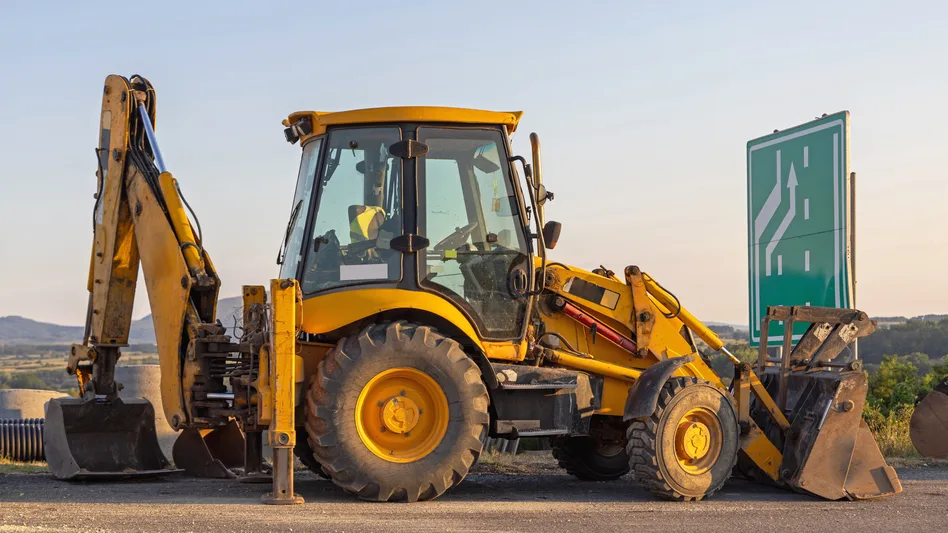
Slope is the organizing risk. A backhoe is a level-ground machine asked here to work on ground that is rarely level, and a stabilizer set downhill is carrying load in a direction the geometry does not favor — which is why slip, tip and subsidence losses show up more often on West Virginia schedules than on flat-state ones. The road half of the exposure is shaped by the same geography: narrow two-lane routes, blind curves and long approaches mean a machine traveling under its own power is a hazard to other traffic as much as it is at risk from it. In the older river-valley towns, reconstruction adds repeatedly backfilled ground and buried services that predate accurate records. Winter then closes routes, delays recovery, and turns a breakdown on a remote job into a week rather than a day.
Common West Virginia backhoe claims we see
- Stabilizer slip or machine movement on a benched slope. The most West Virginia loss on this class, and the one flat-state pricing misses.
- Third-party collision behind a slow machine on a two-lane route. Liability rather than floater, and usually the largest number in the file.
- Subsidence into previously opened and backfilled valley-town ground. Takes the surface, the level, and sometimes what was buried under it.
- Boom contact on a constrained hillside site. Where there is no room to swing without something being behind the machine.
- Extended downtime after a loss on a remote job. Recovery over mountain routes is measured in days, and the standing costs run the whole time.
Why West Virginia backhoe owners choose Equipment Guard Insurance
A licensed West Virginia contractor has a program built around that license, and unpicking it to get one machine covered properly is a poor trade. We write equipment on its own, so the backhoe is scheduled correctly and nothing else has to move. We also price sloped-ground work as sloped-ground work rather than assuming a level site, we ask what the road moves actually look like on the routes you use, and we place through markets named on our homepage that will read an Appalachian equipment schedule without flinching at it.
Major West Virginia backhoe markets
- Charleston. The largest market in the state, with capital, chemical and municipal work concentrated on constrained valley-floor ground.
- Huntington. River, rail and industrial reconstruction, where old services and older backfill sit under most of the work.
- Morgantown. University-driven growth pushing new construction onto slopes that were left alone for good reason.
- Parkersburg. Industrial and utility work along the Ohio valley, with long road moves out to the jobs around it.
- Wheeling. The northern panhandle, where narrow street patterns and old infrastructure keep the machine in the right of way.
- Martinsburg. Eastern Panhandle build-out feeding the Washington commuter belt — the fastest work in the state and the flattest ground.
Related
- Backhoe insurance — the machine physics that hold in every state.
- Skid Steer insurance in West Virginia — the compact machine that works the same slopes but answers to a filing office, not a highway.
- All equipment insurance in West Virginia — the state hub.
- Equipment floater · Rented & leased equipment
Primary sources
- West Virginia Code § 17A-1-1 — West Virginia Legislature (road use and registration)
- West Virginia Code §21-11 — West Virginia Legislature (contractor licensing)
West Virginia backhoe insurance FAQs
What is a backhoe classed as on a West Virginia road?
Special mobile equipment, and the definition is more explicit here than in most states. Rather than describing a residual category and leaving a backhoe to fall into it, the code reaches the machine through a list that expressly includes road construction machinery, ditch-digging apparatus, power shovels and earth-moving equipment. The section is linked on this page, because we read it.
Does the statewide contractor license change how the machine is underwritten?
It changes what an underwriter can see. West Virginia is one of the minority of states operating a real statewide license through the Contractor Licensing Board under the Division of Labor, across general and specialty classifications. That means a file arriving from here already carries an outside assessment of the business behind the machine — which is more than a broker can say about an outfit in a registration-only state, and it tends to shorten the conversation.
How do the grades change the exposure on this machine?
Working across a slope is the defining West Virginia difference. Benching, cut-and-fill and slope stabilization put a backhoe on ground that is not level under it, and a stabilizer set on the downhill side is carrying a load the machine was not designed to place there. Tip and slip losses are correspondingly more common here than on flat-state schedules, and they are worth naming on the application rather than discovering in a claim file.
What is a road move actually like in this state?
Slow, narrow and blind. Much of the state is reached by two-lane routes with no shoulder to pull onto and curves that hide an overtaking driver until it is late. A machine legally entitled to be there is still a slow obstacle on that road, and the road-move claims we see in West Virginia are less about the machine hitting a fixed object than about what happens behind it. That is a liability question, and it belongs in the conversation early.
Does older infrastructure change what goes wrong?
It does, particularly in the river valleys where the towns are oldest. Utility replacement in Charleston, Huntington or Wheeling means working around services installed long before anybody drew them accurately, on ground that has been opened and backfilled repeatedly. Backfilled ground is exactly what swallows a stabilizer leg, and it is also where the surface you damage is somebody else’s new pavement.
Will you write the machine on its own?
Yes. Equipment Guard Insurance places equipment as a standalone policy, so a licensed West Virginia contractor can get the backhoe scheduled correctly without reopening the liability and workers compensation that sit behind the license.