
In West Virginia a compact loader is often not the convenient choice but the only one. Access roads are narrow, benches are cut into grade, and a machine that can turn inside its own width and climb with a bucket forward gets work that a larger unit simply cannot reach. The same qualities make it the easiest thing on the job to put on a trailer and drive away.
This page is about the state, not the machine. Two things distinguish it: a real statewide contractor license, which is rarer than most operators assume, and terrain that puts earth-moving and slope work at the center of nearly every job. Whatever is true of the loader regardless of where it works — the tip geometry, the coupler ecosystem, the hydraulics behind the attachments — belongs on the skid steer insurance pillar.
What skid steer insurance costs in West Virginia
We will not print a rate here. What drives the number in West Virginia is the ground and the storage: machines working cut slopes and saturated benches carry a different physical-damage picture from machines working level pads, and a loader that has to stay at the bottom of a hollow all week rates unlike one that comes home to a shop yard in Charleston every night. The rest of the levers are the ones you would expect — total scheduled value, how many attachments and what they are, the valuation basis, whether a tracker is fitted, the trailer, and your claim record. Winter matters too: cold starts, ice and mud season all show up in the loss history of machines that are never put away.
West Virginia skid steer regulations: title, lien and ownership
A skid steer is untitled construction equipment, and a security interest is perfected by filing a UCC-1 financing statement with the West Virginia Secretary of State, the central UCC filing office.
The follow-on is procedural, and worth stating plainly: because no certificate exists, the financing statement and the serial plate are the record of who owns the machine. A lender on a financed loader goes onto the policy as loss payee against that scheduled unit, so a loss payment is issued jointly, and the two records need to stay in step — a lienholder still named against a machine you sold last spring is the signal that a schedule needs a fresh look. Where West Virginia genuinely differs is one level up. Most states in this position hand general-contractor licensing to cities and counties; this one does not. The Contractor Licensing Board under the Division of Labor issues a statewide license across general and specialty classifications, so the credential you hold is good across the state, and the entity named on it should be the same entity named on your certificate of insurance and on your equipment schedule. A general contractor checking paperwork before a machine comes on site will compare exactly those three.
Common skid steer risks in West Virginia
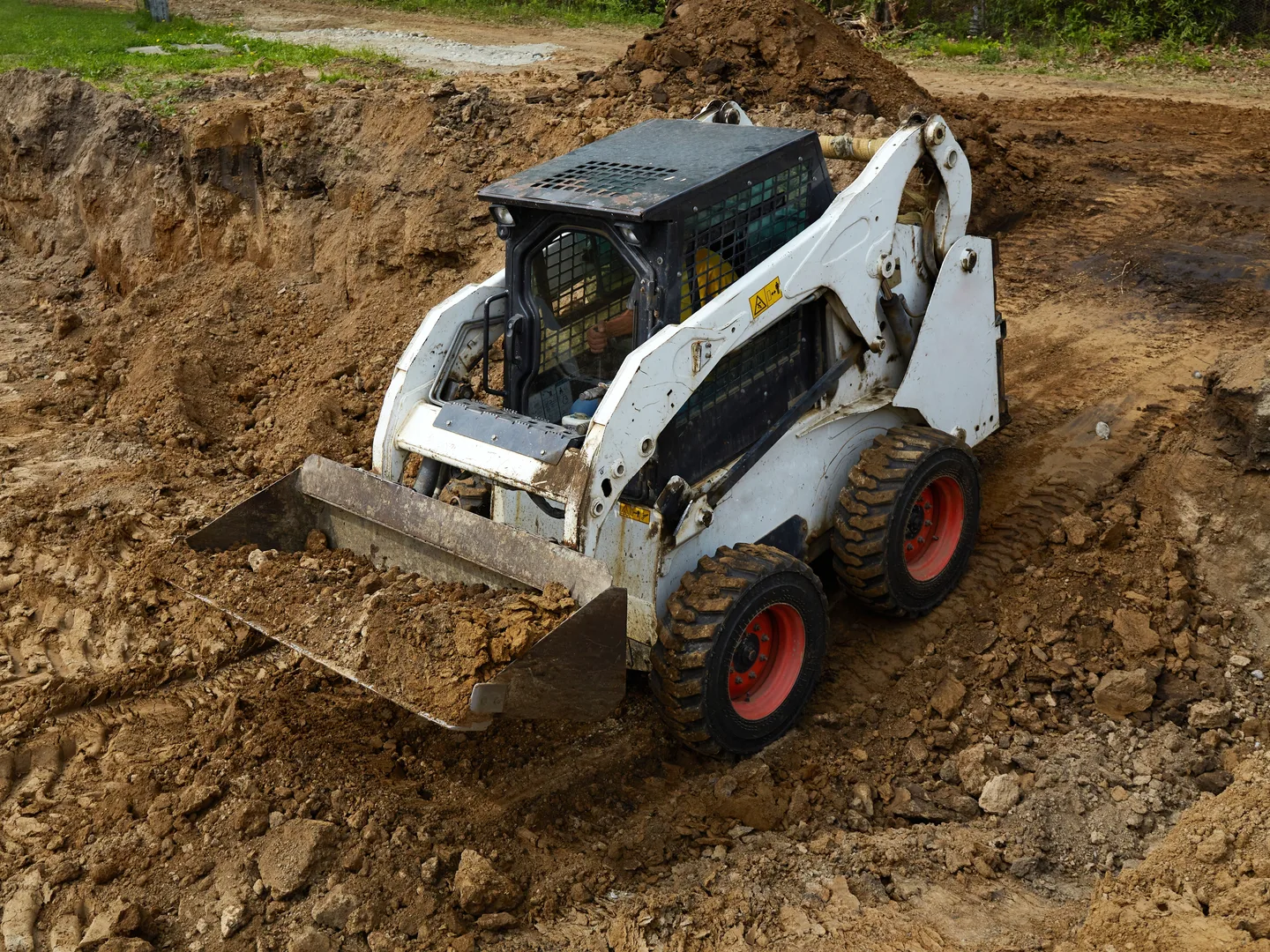
Two exposures dominate, and terrain shapes both. The first is theft, and geography works against you in a particular way here: West Virginia touches Ohio, Pennsylvania, Maryland, Virginia and Kentucky, and the northern and eastern panhandles put a great deal of jobsite activity closer to another state’s metro than to the state capital. A loader taken from a Martinsburg or Wheeling site can be over a state line the same evening, which is why the serial record and a tracking unit are worth more here than a padlock. The second is the ground itself. Side-slope rollover, undercarriage and track damage on rock, and machines working saturated fill after rain account for a large share of the physical-damage claims, and none of it is theoretical on a bench cut into a hillside. Hauling is the third: getting iron up a single-lane grade on a trailer produces shifted-load and strap-failure losses that flatter states rarely see.
Common West Virginia skid steer claims we see
- Side-slope rollover on a cut bench. The characteristic loss on steep ground — usually with a full bucket, usually on fill that had taken rain the night before.
- Overnight theft from a remote site. Machines left at the end of an access road because retrieving them costs a working day, and recovered — when they are recovered — on the strength of the serial record alone.
- Undercarriage and track damage working rock. Rails, rollers and tracks on a compact machine used as an earth-mover in ground it was never bought for.
- Trailer and transit loss on a graded road. A shifted load or a failed strap on a switchback climb, with damage to the loader, the trailer or both.
- Attachment taken separately from the loader. A breaker or mulching head lifted off the rack while the machine stays where it is, then found to be riding a per-item cap rather than a scheduled line.
Why West Virginia skid steer owners choose Equipment Guard Insurance
We write equipment monoline, and on this class in this state that solves a specific problem. A West Virginia contractor holding a statewide license usually has a liability program built around it and no appetite for unwinding the whole arrangement to get one loader and a trailer scheduled the way they should be. We do not require it. Attachments and trailers go on the schedule by name, because that is where value hides on a compact machine, and we place through markets — named on our homepage — that will look at steep-ground equipment on its merits instead of declining it on a class code.
Major West Virginia skid steer markets
- Charleston and the Kanawha valley. The largest concentration of commercial and industrial site work in the state, and the market where shop yards with real overnight security actually exist.
- Huntington. River-adjacent industrial and municipal work with a tri-state labor pool, so crews and machines routinely finish the week in a different state from where they started it.
- Morgantown. University and institutional expansion on constrained hillside parcels, where confined-site loading and finished-surface damage drive the non-theft claims.
- Parkersburg. Chemical and industrial plant work along the Ohio valley, where rented-in machines and the certificates plant owners demand are a routine part of an account.
- Wheeling. The northern panhandle, a narrow strip of jobsite market with interstate access in both directions and the shortest run to an out-of-state yard anywhere in the state.
- Martinsburg and the eastern panhandle. The fastest-growing residential and distribution build-out in West Virginia, closer to the Maryland and Virginia lines than to Charleston, with the theft exposure that goes with it.
Related
- Skid steer insurance — the machine physics that hold in every state.
- Dozer insurance in West Virginia — the machine that moves the slope rather than works on it.
- All equipment insurance in West Virginia — the state hub.
- Equipment floater · Rented & leased equipment
Primary sources
- West Virginia Code §21-11 — West Virginia Legislature (contractor licensing)
We do not link a West Virginia filing document here. The ownership and lien rules described above follow Article 9 as West Virginia has adopted it; where a state publishes a document that states the rule directly, this page links it.
West Virginia skid steer insurance FAQs
Is a skid steer titled in West Virginia?
No. It is untitled construction equipment, not a motor vehicle with a certificate, so there is no title to sign over on a sale and none to produce when a machine goes missing. Identity rests on the serial plate, the bill of sale and the filing record. A schedule that says nothing more than the size class and the color is the document that costs you money in a claim.
Do I need a state contractor license to run a loader in West Virginia?
Very likely, and this is where the state parts company with most of its neighbors. West Virginia runs a genuine statewide contractor license through the Contractor Licensing Board under the Division of Labor, covering general and specialty classifications alike, so the credential travels with you instead of being reissued at every city limit. One license answers for work in Charleston, Morgantown and Martinsburg, rather than three registrations answering for one job each. Confirm your classification with the Board directly, and keep the entity named on the license identical to the entity named on your certificate of insurance — that pairing is what a general contractor checks before a machine comes through the gate.
Does working on steep ground change how the loader is underwritten?
It changes what the underwriter asks about. Benching, cut-and-fill and slope stabilization put a compact machine sideways on a grade far more often than flat-country work does, and rollover on a side slope is a real loss here rather than a theoretical one. Expect questions about the kind of ground you work, whether the machine is tracked or wheeled, and how it gets up and down the access road. Rollover damage is an insured cause of loss on an equipment floater, but a saturated bench and a full bucket are a combination worth thinking about before it becomes a claim.
What if the machine has to stay on site overnight because getting it out costs a day?
Say so on the application. Plenty of West Virginia work sits at the bottom of a hollow or at the end of a switchback where hauling the loader home each evening is not realistic, and pretending otherwise produces a policy written for a risk you do not have. Overnight location is the single biggest rating input on this class, and an underwriter would far rather price a machine that stays on site with the keys pulled, a tracking unit fitted and the serial number on the schedule than discover the arrangement after a loss.
Is the loader covered while it is on the trailer?
On a properly written equipment floater, yes — transit is part of what an inland marine form is for, and in this state it matters more than most. Getting a machine up a graded single-lane road means chains, straps and a grade the trailer was never designed for, and shifted-load damage during hauling is a claim we see. Make sure the trailer itself is on the schedule too; owners think of it as an accessory and insurers do not.
Can the loader be insured by itself?
Yes — that is the way Equipment Guard Insurance prefers to write it. Equipment monoline means the loader, the attachments and the trailer go on one schedule of their own, and any liability policy you already hold is left untouched.