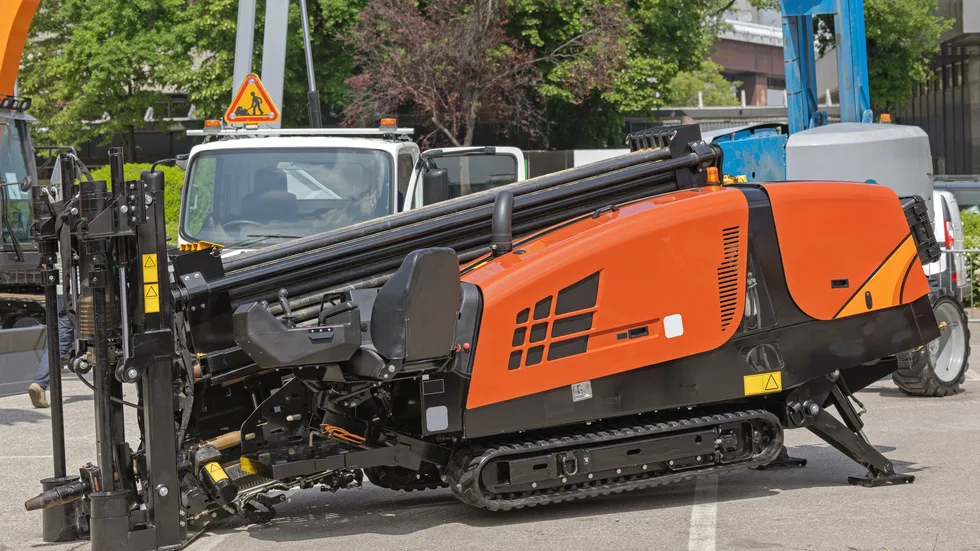

Horizontal directional drilling installs services underground without opening a trench. A rig pushes a steerable head along a planned path, a locator above ground tracks it, and the bore is then reamed out and the product pulled back through. Roads, rivers, driveways and mature landscaping stay intact.
It is a superior method for most congested settings and it carries a risk profile unlike anything else on this site, because the entire working length of the machine is somewhere nobody can see.
Get a Free Quote Call 317-942-0549
Working blind on purpose
A trencher or an excavator exposes what it passes. Something unexpected becomes visible, and a crew can stop. A bore does none of that. It travels a long distance through undisturbed ground, guided by a signal from a transmitter in the head and the operator’s reading of it.
That makes the strike exposure the defining feature of the class. Where a mark is wrong, a service is unrecorded, or the bore drifts off the planned line, nothing warns anyone until the damage is done. Cross-bores — passing a new line straight through an existing one, most seriously through a sewer that nobody notices until it is cleared later — are the exposure that concentrates minds in this industry, because the consequences can arrive long after the crew has gone.
The controls are locating discipline, potholing to physically confirm crossings, and accurate as-built records. Underwriters ask about all three directly on this class.
Frac-out: the exposure with no equipment damage
Drilling fluid does the work of carrying cuttings out, stabilizing the bore and cooling the head. It circulates under pressure, and it is supposed to return along the annulus to the entry pit.
When it finds an easier path — a fissure, a granular seam, an old service trench — it surfaces somewhere it should not. Fluid welling up in a carriageway, a garden, a basement or a watercourse is a frac-out, and it is a clean-up and third-party matter rather than equipment damage. Near water it escalates rapidly into an environmental exposure with regulatory attention attached.
Because this is a liability event with no damage to your own machine, it is the exposure most likely to be under-appreciated by someone thinking about a drill purely as an asset on a schedule. It belongs squarely on the liability conversation.
Rods, tooling and what is left in the ground
A drill string is a consumable inventory rather than a fixed part of the machine. Rods, bits, reamers, swivels and transmitters are bought, consumed, damaged and periodically lost.
Ground conditions drive consumption enormously — rock and cobble destroy tooling that would last a season in sand. And rods do get abandoned: a string stuck in a collapsing bore, or twisted off, may simply stay underground. That is a genuine loss of a genuine asset, and it is exactly the kind of item that sits under-scheduled in a blanket tools limit that was never sized for it.
The locating equipment deserves separate mention. Transmitters and receivers are valuable, portable, easy to remove, and frequently the most-stolen item on this kind of job.
Rig sizes and two different accounts
Compact rigs installing utility drops and fiber are trailer-mounted, self-contained and operated by small crews. They are portable enough to be a theft target on the same terms as a compact loader, and they work in residential streets surrounded by shallow services.
Maxi rigs making long crossings under rivers, highways and rail are a different proposition: large spreads with fluid recycling plant, substantial site setups, and crossings where a failure is a major incident rather than an inconvenience. Between the two sits a broad midi range doing most day-to-day utility work.
Telling us which end of that range you operate matters more than the machine list, because the exposures barely overlap.
Site setup, entry pits and the surface footprint
Although the method avoids trenching, it is not surface-free. Entry and exit pits, fluid handling and containment, spoil management, rod stacks and the rig itself all occupy space, usually in a street or a verge because that is where the services run.
That produces the ordinary set of public-facing exposures: open pits, traffic management, material and fluid on the carriageway, and access to properties interrupted. None of these are dramatic and all of them generate claims, particularly on residential work where driveways and gardens are involved.
Who runs one
Utility contractors installing communications, power, gas and water; fiber-network builders; pipeline contractors making crossings; and municipal and rural cooperatives. The common thread is installing linear services where opening the surface is either prohibited, prohibitively expensive, or simply not worth the reinstatement.
What directional drill insurance costs
No published figure would be honest. The inputs on this class are unusually liability-weighted: rig size and value; whether work is in congested urban ground or open country; whether bores cross watercourses, highways or rail; tooling and locating inventory values; locating and potholing practice; and loss history, with strikes, cross-bores and frac-outs weighted far more heavily than damage to the machine itself.
Ground conditions decide the day
Directional drilling is more sensitive to what it is boring through than almost any other method. Sand and soft clay are workable and predictable. Cobble and boulder ground pushes the head off line and destroys tooling. Solid rock needs different equipment entirely, with mud motors and rock bits rather than a conventional steering head.
The exposure that follows is that a bore begun on one set of assumptions can meet another halfway along. Steering becomes unreliable, progress stops, and the choice is between pushing on with damaged tooling or abandoning the bore. Both cost money, and only some of it is ever an insured loss.
Ground investigation before a crossing is the control, and for significant bores it is standard practice. Its absence on a difficult crossing tells an underwriter something about how the work is planned.
Pullback: the moment with the most at stake
The bore itself is only half the job. Once the path is complete and reamed, the product — pipe, conduit or duct bundle — is pulled back through it, and that is the operation where the value is highest and the options are fewest.
A pullback that stalls is a serious event. The product may be damaged in the ground, the bore may collapse around it, and recovering a partially installed string is difficult and sometimes impossible. On a long crossing the product being pulled can be worth more than the rig pulling it, and it usually belongs to somebody else.
That is worth naming because it puts third-party property at risk in a way that is not obvious from a machine schedule. It is one of the clearer cases on this site for reading the contract alongside the policy.
Fluid handling and what leaves the site
Drilling fluid is a working consumable that has to be mixed, circulated, recovered and eventually disposed of, along with the cuttings it carries out. On larger spreads that means recycling plant on site; on smaller jobs it means tanks and a vacuum truck.
Disposal is a regulated activity, and where fluid or cuttings end up somewhere they should not — a storm drain, a watercourse, a neighboring property — the consequences arrive as a liability and environmental matter rather than as anything to do with the machine. It is the same category as a frac-out, arriving by a more mundane route.
Coverage breakdown
- Equipment floater — rig, tooling, rod inventory and locating equipment.
- General liability — strikes, cross-bores, frac-outs and surface damage.
- Workers compensation — crews at entry pits and around rod handling.
- Rented and leased equipment — larger rigs are frequently hired per crossing.
- Transit and trailer transport — moving rigs and support plant.
- Umbrella and excess — where a serious cross-bore or environmental claim goes.
Why Equipment Guard Insurance
Boring is the one machine class here where the equipment is the smaller half of the risk, and a submission that leads with machine values misses the point. We ask about locating practice and crossings first. Equipment-only placement means none of that requires moving your liability. The panel is named on our homepage.
Related
- Trencher insurance — the open-cut alternative.
- Excavator insurance — what digs the entry and exit pits.
- General liability — where this account actually lives.
- All equipment we cover
Primary sources
Frequently asked questions about directional drill insurance
Why is the strike exposure worse on directional drilling?
Because the whole bore is unseen. Open-cut work exposes what it passes and lets the crew react; a bore travels tens or hundreds of feet through ground nobody can see, guided by a locating signal. When the path crosses something that was mismarked or unmarked, nothing visible warns anyone until it is already through.
What is a frac-out?
Drilling fluid under pressure finding a path to the surface instead of returning through the bore. It appears as fluid welling up in a road, a lawn, a basement or a watercourse. It is a clean-up and third-party liability event rather than equipment damage, and near water it becomes an environmental matter quickly.
Are drill rods and tooling covered?
Rods, bits, reamers and swivels should be on the schedule as items in their own right. They are valuable, they are consumed at a rate that varies enormously with ground conditions, and rods are regularly lost in the ground. A rod string abandoned in a failed bore is a real loss that a blanket tools limit will not carry.
Do the small rigs get stolen?
Yes. Compact drills are trailer-mounted, self-contained and in constant demand, which puts them in the same theft category as a compact loader. The locating equipment is a separate target — it is portable, expensive and often left in a truck overnight.
What happens when a bore has to be abandoned?
Re-boring on a new line is generally a contractual cost rather than an insured loss. Where abandonment follows an obstruction that also damaged tooling, or where the abandoned bore caused surface damage, parts of the event may be covered while the re-work is not.
How much does directional drill insurance cost?
No honest figure can be published. What moves it is rig size and value, whether work is in congested urban ground or open country, whether bores are made under watercourses or roads, tooling values, locating practice, and loss history — with strikes and frac-outs weighed more heavily than machine damage.