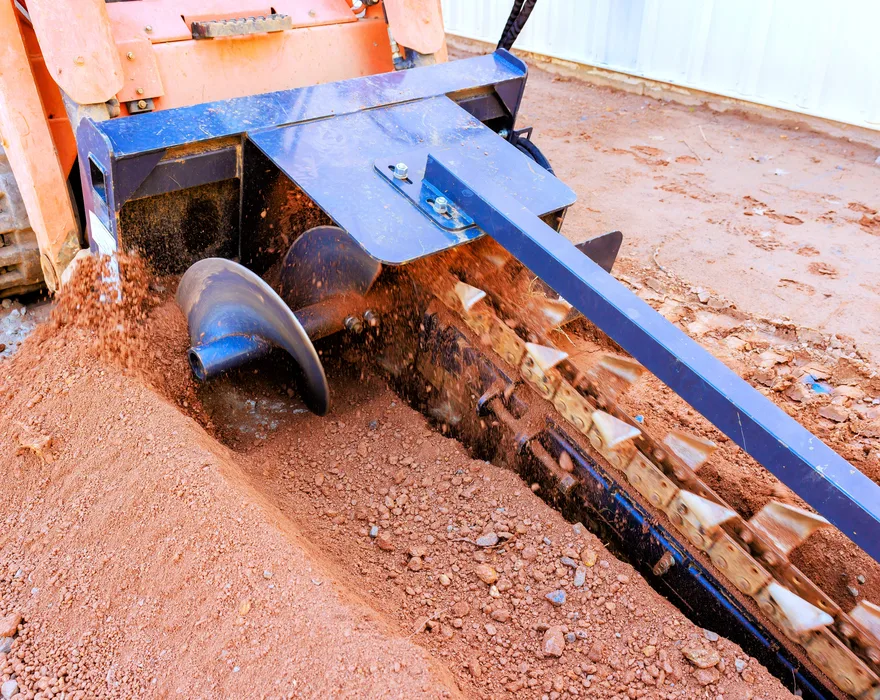

A trencher digs by drawing a toothed chain or a rotating wheel through the ground and throwing the spoil to one side. It exists because an excavator digging a long narrow trench is slow and wasteful, and because most buried services need exactly that shape.
The class runs from walk-behind units a single operator wheels off a trailer to ride-on machines that cut deep and wide enough for main services. Both ends of that range are on this page, because they present opposite problems.
Get a Free Quote Call 317-942-0549
A continuous cut is a different kind of strike risk
When a bucket digs, the operator takes discrete bites and can stop between them. A trencher does not work that way. The chain runs continuously and the machine advances steadily, which means that when it meets something unexpected it can travel a considerable distance through it before anyone reacts.
That changes the shape of a utility strike. Rather than a single point of damage, a trencher can open a long section of a cable or a run of pipe, and it can take out multiple services in one pass where they run parallel. The restoration cost is set by the utility, not by you, and the consequential losses of everyone the outage reaches sit on the liability side.
Because damage-prevention practice matters so much here, the marking process and the distance the machine works from marked services are things an underwriter will ask about directly rather than in general terms.
Spoil, reinstatement and the open trench
A trencher produces a windrow of spoil alongside the cut and leaves an open trench behind it. Both are exposures until the job closes.
An open trench is a hazard to pedestrians, vehicles and other trades, and responsibility for guarding it generally follows whoever opened it. Plating, barriers and lighting are obligations rather than courtesies, and skipping them is the ordinary route to a liability claim that has nothing to do with the machine. Spoil left across a footway or a driveway creates the same class of problem in a lower key.
Reinstatement is the other half. Surfaces cut and backfilled badly settle, and settlement shows up months later as a claim against the contractor who was long gone. Where the work is in a public surface, the reinstatement standard is set by whoever owns the road.
Two machines, two problems
Small walk-behind and stand-on units are inexpensive, extremely portable, and among the most commonly stolen items in this whole equipment family. They are also the machines most often missing from a schedule, because they read as tools rather than as equipment. If it has an engine and a serial number, it belongs on the list.
Large ride-on trenchers invert that. They are conspicuous and hard to move casually, so theft recedes and the exposure concentrates in what they cut through. They also cut deeper, which puts them into the zone where main services run rather than the shallow zone where irrigation and lighting sit.
Wear, chains and what the floater will not pay
Chain, teeth, sprockets and the digging boom are consumables on this machine, and abrasive ground consumes them quickly. All of it is wear, and wear is excluded on every equipment floater.
Sudden damage is a different matter. A chain broken by an unmarked concrete obstruction or a boom bent by an unexpected rock is a loss rather than maintenance. The distinction turns on suddenness and accident, and on this machine the line gets tested more often than most.
Who runs one
Utility contractors installing water, sewer, gas, power and communications, irrigation and landscape contractors, fencing crews, drainage installers, electrical contractors running site services, and rental fleets. Much of that work is in established ground with existing services already in it, which is exactly why the strike exposure dominates.
Chain, wheel and micro-trenching
The cutting method changes what the machine suits and what goes wrong with it. A chain trencher — a toothed chain around a boom — is the general-purpose choice, flexible on depth and width and workable in most soils. A rockwheel or wheel trencher cuts with a toothed disc and is the answer in rock and hard material, where a chain would be consumed quickly.
Micro-trenching sits at the other extreme: a narrow, shallow slot cut into an existing surface, mostly for communications work. It is fast and disruptive to pavement rather than to the ground beneath it, which shifts the exposure toward surface reinstatement and away from deep-service strikes.
Each of those is a different job with a different failure mode, and the machine list alone does not tell an underwriter which one you do. Describing the work is more useful than describing the fleet.
Ground conditions and the obstruction nobody marked
Trenchers are unforgiving of what they cannot see. Rock, old foundations, buried concrete, abandoned services and reinforced slabs are all capable of stopping a chain abruptly or bending a boom, and none of them appear on a locate drawing because none of them are live services.
That produces a category of loss that is neither a strike nor wear: sudden mechanical damage from an obstruction. It is the clearest case for having the machine properly scheduled and valued, because the repair is immediate and the machine is out of service while the job waits.
Wet ground creates the opposite problem. A trench cut in saturated material can collapse as fast as it is opened, which is a safety exposure for anyone working in or near it and a productivity problem that leads crews into shortcuts.
Working near the road
A great deal of trenching happens in verges, footways and carriageways, because that is where services run. That puts crews and machines alongside live traffic for extended periods.
Traffic management becomes part of the job rather than an add-on: signage, coning, plating over open cuts, and reinstatement to whatever standard the road authority sets. Incidents here tend to involve third parties rather than the machine, which is why this kind of work prices differently from the same footage cut across an open field.
Coverage breakdown
- Equipment floater — every machine, including the small ones.
- General liability — strikes, open trenches and reinstatement failures.
- Rented and leased equipment — trenchers are heavily rented for single jobs.
- Workers compensation — trench and ground-crew exposure.
- Transit and trailer transport — moving between jobs.
- Umbrella and excess — where a multi-service strike claim goes.
What trencher insurance costs
We do not publish a premium, because the figure comes out of your specific fleet and the work it does. What moves it here is the number and value of machines, including the small units people forget; how securely the portable machines are stored; whether the work is in established ground with live services or in open ground; whether any of it happens in or beside a public road; the depth you routinely cut to; and loss history, with strike claims weighing more heavily than machine damage.
One point specific to this class: a clean record on strikes is worth more in an underwriter’s eyes than a clean record on machine damage, because the strike claim is the one with no natural ceiling. Documenting the locate process you follow is the cheapest credibility available on this account.
Why Equipment Guard Insurance
We schedule the small machines that other submissions leave off, and we treat the strike question as the center of the account rather than a footnote. Equipment-only placement means none of that requires moving your liability. The panel is named on our homepage.
Related
- Excavator insurance — the other way to open ground.
- Directional drill insurance — installing services without opening a trench at all.
- General liability — the strike exposure in detail.
- All equipment we cover
Primary sources
Frequently asked questions about trencher insurance
Is a small walk-behind trencher worth insuring separately?
It belongs on the schedule, yes. Small units are inexpensive relative to a loader but they are extremely portable, which makes them a theft item, and they are frequently the machine nobody wrote down. A schedule that lists the big machines and omits three walk-behinds is a schedule that will disappoint somebody.
What is the main liability exposure when trenching?
Striking something already in the ground. A trencher makes a continuous cut at speed, which means it can travel a long way through a buried service before anyone reacts. The damage to the line and the losses of everyone downstream of an outage are liability questions rather than equipment ones.
Does the trench itself create an exposure?
It does. An open trench is a hazard to people and vehicles until it is backfilled and reinstated, and responsibility for it usually sits with whoever opened it. Barriers, plating and reinstatement are practical obligations that turn into liability claims when they are skipped.
Are the chain and teeth covered when they wear out?
No. Chain, teeth and sprockets are wear items, and every floater excludes wear and gradual deterioration. Sudden damage — a chain broken by an unexpected obstruction — is a different matter, and is the kind of event the policy exists for.
Do I need commercial auto for a trencher?
Usually not, because most trenchers are trailered rather than driven on roads. Larger ride-on units occasionally travel short distances under their own power, which raises the same road-use question a backhoe does. If that happens routinely, tell us.
How much does trencher insurance cost?
There is no honest published figure. What moves it is the size and value of the machines, whether small portable units are stored securely, the kind of work and how close it runs to existing services, and loss history — with strike claims read separately from damage claims.