
Alabama is a state where the dirt has opinions. Red clay holds a slope beautifully and then turns to grease in a downpour; the sandy coastal plain carries a machine all day and washes out overnight. A dozer working here spends its life on material that behaves one way dry and a completely different way wet, which is the whole reason the state watches what happens after the blade has gone.
What follows is the Alabama side of that: who runs the permit, who has to write the plan behind it, and where the money actually goes wrong once ground is open. For the machine — blade and ripper work, undercarriage economics, hauling a tracked machine between jobs — see the dozer insurance pillar, which does not change at a state line.
What dozer insurance costs in Alabama
There is no honest way to publish a premium for this class on a web page, and on a dozer the machine is rarely the decisive figure anyway. An Alabama account moves on the acreage you open and how long it stays open, whether you are clearing timber or shaping a finished subdivision grade, the haul distances between a Huntsville job and a Mobile one, the age and undercarriage condition of the iron, whether the work sits inside larger developments, and your own claim history. A land-clearing crew and a fine-grading crew can run identical machines and still be priced as different animals.
Alabama dozer regulations: stormwater and land disturbance
Alabama took delegation of the national program and runs it through NPDES Construction General Permit ALR100000, administered by Alabama Department of Environmental Management (ADEM). It reaches a land disturbance of one acre or more (or under one acre within a common plan of development totaling one acre or more).
The Alabama wrinkle is who writes the plan. The construction plan that supports the permit has to be prepared by a qualified credentialed professional, which is not the ordinary arrangement across the states we serve, and it produces a division that matters commercially. The document describing how the site will be held together while it is open is a credentialed professional’s work; the site itself, every hour the machine is on it, is yours. When those two drift apart — the plan assumes a staging sequence the schedule will not allow, or a control that nobody can maintain through a wet week — the exposure lands on the contractor, not the author. And the exposure is worth naming precisely, because two very different things get called the same word. A penalty, a notice, a suspended permit: those are regulatory outcomes, and an equipment policy has nothing to say about them. What can become a claim is the physical event — soil off an opened site onto a neighboring property, into a road, or into a creek. That is third-party damage arising out of your work, it answers under liability and pollution coverage rather than the floater, and on this machine it routinely dwarfs the value of the machine itself.
Common dozer risks in Alabama
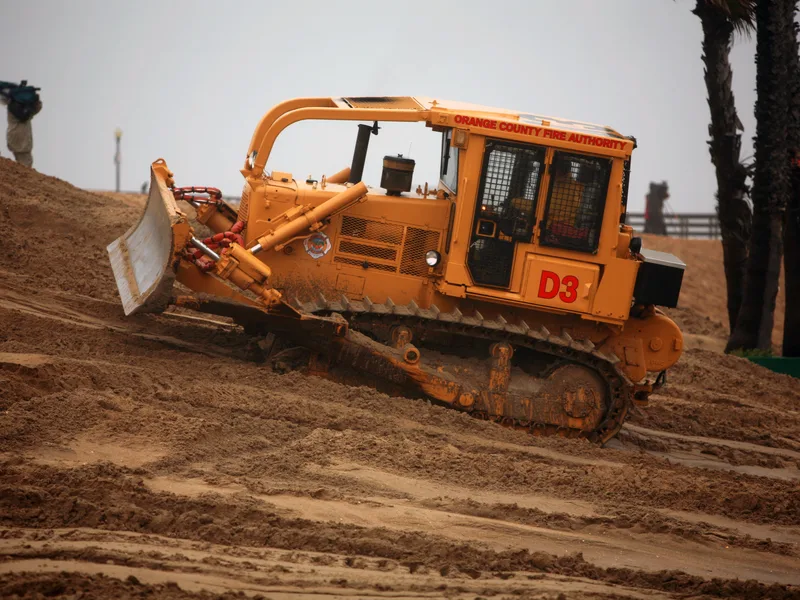
The dozer’s own losses come in a short list, and most of them are not exciting. Undercarriage life in abrasive sandy material is a running cost the floater will never pay. Clay packs the rollers and idlers and turns a routine day into a machine that has to be dug out. Overturn on a cut slope or a spoil edge is the serious physical risk, and it happens on ground that looked fine an hour earlier. Land clearing adds fire: dry vegetation packed against hot surfaces on a machine miles from anything that could put it out. Behind all of it sits the land-disturbance exposure, which does not come from a mistake at all — it comes from doing exactly the job you were hired to do, and it grows every day the ground stays bare.
Common Alabama dozer claims we see
- Soil leaving a cleared site during a heavy rainfall event. The signature Alabama exposure, and a third-party question rather than a floater one.
- Machine fire during land clearing. Debris against a hot engine on a machine working in dry material, with a second exposure if the fire does not stay on the machine.
- Overturn on a red-clay slope after rain. Traction changes faster on this material than an operator expects.
- Loading and transport damage. Long hauls across a tall state concentrate loss on the ramp, the deck and the tie-downs.
- Undercarriage wear presented as sudden damage. Worth separating early, because it is the most common reason a dozer claim goes sour.
Why Alabama dozer owners choose Equipment Guard Insurance
A dozer is easy to insure badly: schedule the iron, quote the number, move on. We would rather say the uncomfortable part out loud, which is that on this machine the iron is the cheap half and the ground it relocated is the expensive one. Writing equipment monoline lets us value and schedule the machine properly without reopening a program built around your Alabama work, and it leaves room to talk about who wrote your plan, who has to live with it, and which policy would actually respond if the soil ends up somewhere it was not supposed to be. We place through markets — named on our homepage — that treat earthmoving as a class of its own.
Major Alabama dozer markets
- Birmingham. Steep, rocky cut-and-fill on the ridges, the most demanding routine grading in the state.
- Huntsville. Sustained industrial and residential pad work, most of it inside larger phased developments.
- Mobile. Coastal site preparation in sand with storm exposure on freshly opened ground and a high water table.
- Montgomery. Black-belt soils that shrink, swell and hold water, so a finished grade does not stay finished.
- Tuscaloosa. River-adjacent work where the receiving watercourse is close enough to make the erosion plan a live document.
- Hoover. Suburban subdivision phases on hillside lots, where slope work and erosion control run together.
Related
- Dozer insurance — the machine physics that hold in every state.
- Skid Steer insurance in Alabama — the machine that finishes what the blade roughed in, and the one thieves can actually move.
- All equipment insurance in Alabama — the state hub.
- Equipment floater · Rented & leased equipment
Primary sources
- Construction General Permit — Alabama Department of Environmental Management (stormwater and land disturbance)
- About – Alabama Licensing Board for General Contractors — Alabama Licensing Board for General Contractors (nonresidential) and Alabama Home Builders Licensure Board (residential) (contractor licensing)
Alabama dozer insurance FAQs
Which agency issues the construction stormwater permit in Alabama?
Alabama Department of Environmental Management (ADEM) — the state took delegation of the national program, so the permit, the inspector and the enforcement all sit inside one state body rather than a federal region office. That body is also the state’s general environmental agency, which means the people looking at your disturbed acre are the same people who look at everything else with an environmental dimension on the job.
Who is allowed to write the erosion-control plan for my site?
Not you, in the general case. Alabama requires the construction plan supporting the permit to be prepared by a qualified credentialed professional, which is unusual among the states we serve. It is a real quality control and it is also a commercial fact worth understanding: the plan is a professional’s document, the compliance is yours, and if the two drift apart on a live site the person holding the machine is the one standing in the mud.
What is the trigger, and does a small pad escape it?
The requirement reaches a land disturbance of one acre or more (or under one acre within a common plan of development totaling one acre or more). That parenthesis is the part crews misjudge — an individually modest lot inside a bigger scheme is not automatically outside the permit, and dozer work is very often exactly that: one phase of something larger, opened and closed on its own schedule.
Would insurance respond to an enforcement action?
A penalty is a regulatory outcome, not property damage, and no equipment policy contemplates paying it. Insurance becomes relevant one step downstream, when the physical consequence lands on somebody else — sediment across a neighboring parcel, mud tracked onto a public road that causes a wreck, material reaching a creek. Those are third-party matters arising from the work, and they belong to liability and pollution coverage.
What does Alabama ground and weather do to a dozer?
Two different jobs in one state. The northern and central red clay is heavy, sticky and slow to drain, so it loads the machine, clogs the undercarriage and holds water on a site long after the rain stops. The southern coastal plain is sand that lets a machine move freely and then travels the moment it is open. Over both sits a rainfall pattern that arrives in intense bursts, including tropical systems, which is the worst possible timing for freshly graded ground.
Do I have to buy a package to get the dozer written?
No. Equipment Guard Insurance writes equipment monoline in Alabama, so the machine can be scheduled on its own with its transport pattern and attachments described properly. We then treat the land-disturbance side as its own subject rather than letting it disappear into an assumption about what the floater covers.