
Arizona earthmoving happens on ground that gives up its shape easily and takes a long time to get any of it back. Vegetation is sparse, the crust that holds fines together is thin, and once a blade has removed both, the surface it leaves behind will stay exactly as loose as the day it was cut until something moves it.
This page covers the Arizona half of that: which agency administers the permit attaching to a disturbed acre, why an arid climate concentrates rather than removes the runoff exposure, and where the risk actually lands once the machine has done its job well. Blade and ripper behavior, undercarriage economics and transport hold everywhere and live on the dozer insurance pillar.
What dozer insurance costs in Arizona
No published premium would survive contact with an actual submission, and on a dozer the iron is rarely the biggest input anyway. What moves an Arizona number is the machine — size, hours, undercarriage condition — together with the abrasiveness of the ground you take, how much area you open at one time and whether it sits inside a phased development, how far the iron travels between widely separated jobs, how much of the year it runs in extreme heat, and your own record. A solar-site crew stripping large open acreage and a custom-lot crew shaping single pads are not the same account.
Arizona dozer regulations: stormwater and land disturbance
Arizona administers the national discharge program itself. Construction stormwater is handled by the Arizona Department of Environmental Quality (ADEQ) under a state general permit rather than by a federal regional office, and the obligation attaches at a land disturbance of one acre or more (or smaller if part of a common plan disturbing one acre or more).
The part worth dwelling on is what a desert does to that obligation, because the intuition runs backwards. Rain is infrequent here, so it is tempting to treat runoff controls as paperwork about an event that never comes. What actually happens is that a season’s worth of energy is delivered in a small number of hours, onto ground that has had months to dry into something with no cohesion, and into channels — washes, arroyos, engineered drainage — that already run straight off the property. The interval between the first drop and the first cubic yard of your site arriving somewhere else can be very short. That is where the commercial boundary sits, and it deserves plain language. A penalty over an inadequate control measure is a regulatory event and not something the equipment policy was built to answer. Material leaving your ground and reaching a neighbor’s property, a public roadway or a watercourse is third-party damage arising out of your work, answered in liability and pollution wording rather than by the floater. The permit does not create that risk; it marks the line where the state thinks it starts.
Common dozer risks in Arizona
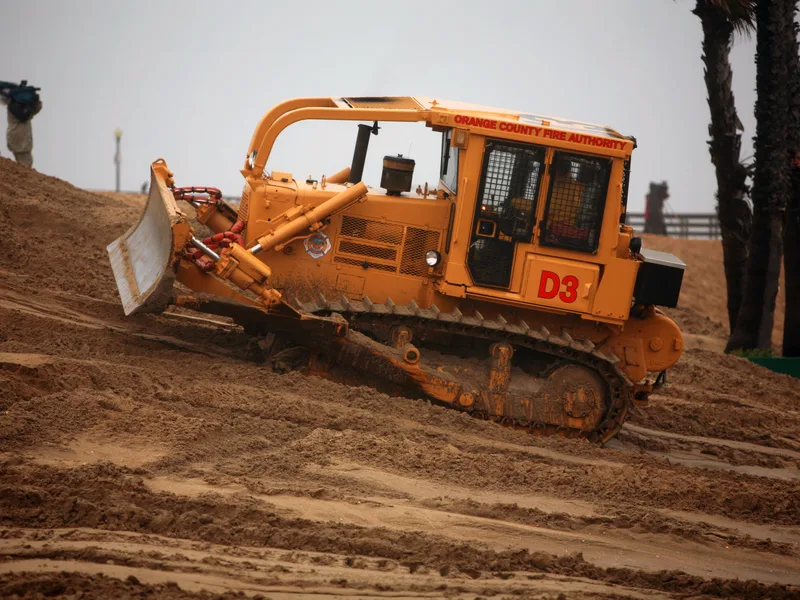
The machine’s own exposures here are led by abrasion and heat. Caliche and decomposed granite grind through undercarriage components at a rate that surprises owners arriving from softer states, and the resulting bills are maintenance rather than claims. Sustained summer temperatures push cooling systems, hydraulics and drivelines toward their limits, and a dust-blinded cooling pack is a common precursor to an expensive stop. Fire in the engine bay is a live concern on a machine pushing dry brush. Transport matters more than average simply because Arizona jobs can be a long way apart. Wrapped around all of it is the land-disturbance exposure, which exists because the work was done, not because anything failed.
Common Arizona dozer claims we see
- Site material carried into a wash or a street during a monsoon storm. The defining third-party exposure here, compressed into a handful of hours a year.
- Wind-blown material reaching adjoining property. The arid-state variant of the same problem, and the one that generates complaints fastest.
- Heat-related driveline or hydraulic failure. Frequently the end of a long argument about maintenance rather than a covered sudden event.
- Engine-bay fire pushing dry brush. Debris against hot surfaces, on a site with nothing nearby to stop it.
- Loading and haul damage on long inter-site moves. Ramps, decks and tie-downs take the loss when the machine covers real distance between jobs.
Why Arizona dozer owners choose Equipment Guard Insurance
Most placements look at a dozer, see a large insured value and stop there. The useful conversation is the other one: the iron is replaceable and the acre you opened is not, and those two facts are carried by different policies. Writing the equipment monoline lets us schedule the machine on its own without disturbing arrangements already built around Arizona work, and it lets us be straight about where the land-disturbance exposure actually lands. We place through markets — named on our homepage — that will read a desert grading account rather than reach for a generic contractors template.
Major Arizona dozer markets
- Phoenix. Continuous phased development on flat, caliche-heavy ground, where the common-plan half of the trigger reaches sites that look far too small to be caught.
- Mesa and Gilbert. The east-valley residential and commercial build-out, with converted farmland, irrigation legacies and short distances to engineered drainage.
- Scottsdale. Hillside and desert-lot work where slope, protected terrain and close neighbors all constrain the same cut.
- Tucson. Southern-basin grading over rock-strewn ground, with washes crossing sites that spend most of the year looking permanently dry.
- Flagstaff and the high country. Cold-season work at altitude, forested lots and a genuinely short window in which to open ground.
- Chandler. Large single-occupier campus and plant sites, where one client’s pad is bigger than most subdivisions and the earthwork schedule is unforgiving.
Related
- Dozer insurance — the machine physics that hold in every state.
- Excavator insurance in Arizona — the machine that must not break ground until the marks are complete and still valid.
- All equipment insurance in Arizona — the state hub.
- Equipment floater · Rented & leased equipment
Primary sources
- WQD | AZPDES Construction Activity General Permit (CGP) for Stormwater | ADEQ — Arizona Department of Environmental Quality (ADEQ) (stormwater and land disturbance)
- Arizona Revised Statutes §32-1122 — Qualifications for license — Arizona Registrar of Contractors (ROC) (contractor licensing)
Arizona dozer insurance FAQs
Why does a stormwater permit apply to a site that is dry most of the year?
Because the permit is about what happens during the rain, not about how often it rains. Ground that has been stripped and left loose through a long dry stretch has nothing holding it together when a storm finally arrives, and the storms that arrive here tend not to be gentle. Aridity concentrates the exposure into a few hours a year rather than removing it.
Who administers the program in Arizona?
The state does. The Arizona Department of Environmental Quality (ADEQ) runs the construction stormwater program under state authority rather than leaving it to a federal office, so the permit, the plan review and the inspection all belong to the same state agency. For a contractor that means one relationship rather than two, and it means this obligation sits inside your Arizona compliance picture instead of beside it.
Does the trigger really reach a site smaller than an acre?
It can, and the second clause is the one that catches crews out. The threshold recorded for Arizona is one acre or more (or smaller if part of a common plan disturbing one acre or more) — so a modest pad is not automatically outside the requirement when it is one piece of a larger scheme. On a state building subdivisions and campuses in phases, that is not a rare edge case; it is a normal Tuesday.
What about dust rather than water?
It is the same problem with a different carrier medium, and in this state it is the more visible one. Material lifted off an open pad by wind lands on someone else’s ground, cars, or a road, and complaints follow far faster than any storm does. Treat it as a third-party matter arising from the work rather than as a housekeeping annoyance, because that is how it will be presented to you.
What does Arizona ground and heat do to the machine itself?
Caliche and decomposed granite are abrasive in a way that ordinary soil is not, so undercarriage life is consumed faster here than the hour meter suggests. Sustained heat is the other half: cooling packs load up with fine dust, hydraulic and driveline temperatures run high through the summer, and a machine that is merely neglected in a mild climate becomes a machine that stops in this one.
Will you write the dozer by itself?
Yes. Equipment Guard Insurance places equipment monoline in Arizona, so the iron goes on its own schedule with nothing else needing to move. What we will not do is let you assume the floater has quietly absorbed the land-disturbance exposure — it has not, and the machine is usually the cheaper of the two problems.