
Everywhere else, the dig rule is a countdown. You place a call, days pass, and at the end of them the law stops objecting. Arizona reverses the logic: nothing about the calendar entitles you to start, and the machine waits until the ground has been written on.
That single difference reaches further into an excavating operation than it sounds like it should — into how you sequence a job, how you price a long alignment, and what happens when a crew is three weeks into a trench. This page follows it through, along with the ground itself, which in much of this state is a good deal less forgiving than the plan suggests. For the physics that belong to the machine wherever it works — reach, tail swing, the undercarriage, the attachment ecosystem — see the excavator insurance pillar.
What excavator insurance costs in Arizona
No honest page prints a figure for this machine, and on an Arizona excavator the reason is unusually plain: the same unit is a different risk depending on whether it spends the year opening street in a built-out corridor or shaping a pad on raw desert. Underwriters look at the depth you work, how close the alignment runs to live services, whether gas and fiber corridors are part of your normal week, the size and value of the units, the breakers and thumbs riding with them, where the fleet sits between jobs, and what your loss record says about all of it. Rock work moves the machine side; congestion moves the liability side; the two rarely move together.
Arizona excavator regulations: dig notice and the one-call duty
Positive-response regime — marks are valid for 15 working days, and the excavator must renotify at least two working days before that validity period expires to keep digging.
The duty runs through the excavation section of the Arizona Revised Statutes, and it is worth reading as a permission rather than a warning. There is no fixed advance-notice day count on the excavator at all: the operators are given two working days to get their marking down, and until that marking is complete the ground is closed to you. Once it is down, it has a shelf life — fifteen working days — and a renotification at least two working days before that lapses is what keeps a long dig lawful. Two things follow for a contractor. First, your start is exposed to somebody else’s response time, which belongs in the schedule rather than in the excuses. Second, an open trench can outlive its own authorization, and nobody on site is likely to notice the day it happens. What the marking never does is move the risk: it discharges an obligation on the operators, and it leaves you holding both the duty to dig carefully around the paint and everything the record never captured.
Common excavator risks in Arizona
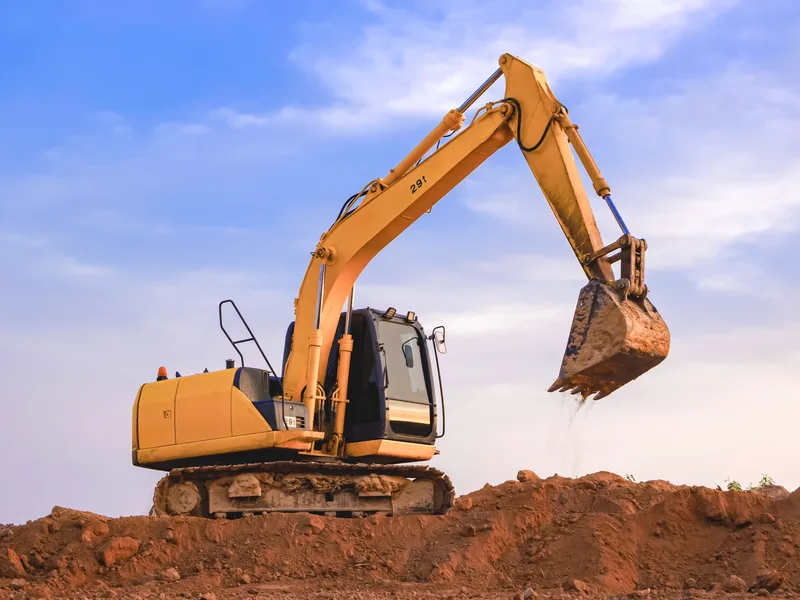
The strike is the loss that reorders an account, and its signature here is a machine that is barely scratched sitting beside a claim nobody can absorb. Fiber trunks and gas transmission run along the same growth corridors the trenching work follows, so the exposure concentrates exactly where the volume is, and a cut trunk brings restoration, service interruption and a stopped site rather than a repair bill. Underneath that sit two habits of the machine that travel anywhere: the slide at a trench edge or on a spoil-loaded slope, and the tail swing meeting something the operator cannot see.
Arizona then adds conditions that are its own. Caliche and desert rock make the bucket fight for depth and rob the operator of the feedback that would otherwise register a surprise. Summer heat is a real underwriting fact on hydraulics, cooling packages and the people running them. The monsoon turns a dry wash into moving water fast enough that where a machine is parked overnight in July is a question worth asking. And on long linear alignments — canal work, corridor trenching, anything strung out across open ground — the fleet is exposed at the far end of the job where nobody is watching it after dark.
Common Arizona excavator claims we see
- Fiber or gas strike on a growth corridor. The account-changing file: restoration plus interruption, on a machine that needed a wash and a grease.
- Dig continued past an expired marking. Not a claim by itself — but it changes the complexion of every strike claim behind it.
- Trench-edge collapse under a tracked machine. Undercut hardpan and spoil stacked too near the lip on ground that looked solid.
- Tail-swing contact on a constrained infill lot. Counterweight into a wall, a vehicle or shoring inside the swing circle.
- Flash-flood loss on a parked unit. A monsoon cell over a wash where the machine was left between shifts.
- Overnight theft from an open alignment. Attachments first, then the mini — the far end of a linear job is nobody’s yard.
Why Arizona excavator owners choose Equipment Guard Insurance
An excavator account is really two accounts wearing one policy number, and most placements only take the easy half seriously. We would rather start with the work: how deep, how close to live services, how much of the year is spent in street versus open desert, and whether the ROC class you hold matches the schedule in front of us. Then we place the iron on its own — monoline, so nothing else in your program has to move — and treat the underground question as an underwriting subject in its own right, through markets named on our homepage that will read excavation work on its merits.
Major Arizona excavator markets
- Phoenix. The heaviest trenching volume in the state and the densest congestion of live services beneath it, so the strike exposure and the schedule pressure peak in the same place.
- Tucson. An older core with utility replacement work running through it, plus mining-adjacent earthwork on the fringes where the machines are larger and the ground is harder.
- Mesa and Chandler. Industrial and semiconductor build-out on live campuses, where a strike stops a facility rather than a street and the consequential side is what underwriters ask about.
- Scottsdale. Infill and resort work on tight lots, which is where the tail swing and the property damage claims come from rather than the trench.
- Gilbert and the East Valley. Irrigation and canal infrastructure threaded through new development, so the buried record and the buried reality are of different ages.
- Flagstaff and the high country. Elevation, volcanic rock, a genuine winter and long approaches to dispersed work — a different machine problem entirely from the Valley.
Related
- Excavator insurance — the machine physics that hold in every state.
- Skid Steer insurance in Arizona — the compact machine whose Arizona question is a filing office and an unfenced desert lot after dark.
- All equipment insurance in Arizona — the state hub.
- Equipment floater · Rented & leased equipment
Primary sources
- 40-360.22 - Excavations — Arizona 811 (dig notice and one-call)
- Arizona Revised Statutes §32-1122 — Qualifications for license — Arizona Registrar of Contractors (ROC) (contractor licensing)
Arizona excavator insurance FAQs
Arizona does not set a number of days before I dig. So what actually lets me start?
The marking does. The statute puts no fixed advance-notice day count on the excavator; it obliges the facility operators to mark within two working days of the request, and it forbids breaking ground until that marking is complete. The practical effect is that your start date is not something you calculate — it is something you are granted, and a slow response on one facility holds up the whole dig even when every other operator has already been out.
The marks are down and the job runs for weeks. Do they stay good the whole time?
No, and this is the Arizona detail crews get caught by. Marking carries a validity period of fifteen working days, and to keep digging past it you have to renotify at least two working days before that period lapses. On a long alignment that means the paperwork has a maintenance schedule of its own: somebody has to be watching the expiry while the crew is watching the trench, because a ticket that dies underneath an open excavation leaves you digging without the thing that made the dig lawful.
Arizona 811 marked it and my bucket still found something. Whose loss is that?
Yours to answer for, in most versions of that story. What the marking buys you is an obligation discharged by the operators — it is not a warranty that every facility is on the plan, that the paint sits over the pipe rather than beside it, or that nothing was abandoned in place by somebody who never joined the notification system. How the crew excavated around the paint is the question that decides the file, which is why the third-party side of this machine is placed on purpose instead of assumed.
Does caliche change the exposure or just the productivity?
Both, and the second one feeds the first. Cemented hardpan takes a breaker or a heavy bucket to open, and a machine working that hard transmits far less feedback up the stick — the operator loses the small hesitation that would otherwise say "that is not rock". Sustained rock work also loads the undercarriage, the boom pins and the hydraulics, so the wear conversation and the strike conversation are the same conversation on an Arizona site.
Does my Registrar of Contractors classification matter to the insurance?
It matters to who is reading your documents. Arizona licenses through the ROC in commercial, residential and dual building classifications alongside the engineering and specialty classes, each with its own experience and examination requirement, so a general contractor here can see at a glance what scope you are entitled to take. That makes your certificates a supporting document rather than the whole story — but it also means a schedule that does not match the class you hold is a question you will be asked.
Can I schedule the excavator by itself without unpicking the rest of my program?
You can. Equipment Guard Insurance writes equipment as a standalone line in Arizona, so the machine, its breaker and its buckets go on one schedule and the underground question gets addressed beside them. Nothing about that requires you to move liability or workers compensation that is already arranged around work you have.