

Very little on a jobsite is genuinely irreversible. A trench gets backfilled, a slab gets sawn out, a pole gets reset. Ground that has been stripped and re-graded is the exception — it stays the shape you left it, and so does the route the next rainfall takes across it.
What follows is the Arkansas half of that story: the division whose name goes on the permit, the threshold that pulls a job under it, and the way this state’s geology decides which half of the risk you are carrying in any given week. Blade loads, push-arm geometry and undercarriage life do not change at a state line and live on the dozer insurance pillar.
What dozer insurance costs in Arkansas
No honest number for this class can be published in advance, and on a dozer the machine is not even the dominant term. What actually moves an Arkansas figure is the ground you take on and whether it is rock or river silt, the acreage you have open at any one moment and how close it sits to a ditch or a stream, the machine’s hours and undercarriage condition, how it travels between counties, and your own loss history. A crew benching a hillside above a spring and a crew stripping a flat Delta pad are being asked entirely different questions by an underwriter, even when the iron on the schedule is identical.
Arkansas dozer regulations: stormwater and land disturbance
Arkansas administers the construction stormwater program itself rather than leaving it to the federal agency. The instrument is ARR150000 — NPDES Construction Stormwater General Permit (CGP), issued by Arkansas Department of Energy and Environment, Division of Environmental Quality, and it attaches to a land disturbance of one acre or more.
Two consequences follow, and only one of them is paperwork. The administrative one is straightforward: because the program is delegated, the reviewer, the notice and the inspector are all in-state, and the division handling your construction discharge is the same division you meet on dewatering, borrow and anything else that touches water — one relationship rather than a stack of unrelated ones. The commercial consequence is the part worth reading twice. A penalty for an inadequate control measure is a regulatory event and no equipment policy was ever built to answer for it. What can become a claim is the physical result: silt that leaves your acreage and reaches a neighboring property, a public road or a watercourse. Arkansas makes that unusually short work in both directions — in the east the field ditches run straight into somebody else’s ground, and in the karst uplands what enters a losing stream travels out of sight before anyone can point at it. That is third-party damage arising from your work, it belongs to liability and pollution coverage rather than to the floater, and on this machine it is the exposure most capable of exceeding the value of the iron that caused it.
Common dozer risks in Arkansas
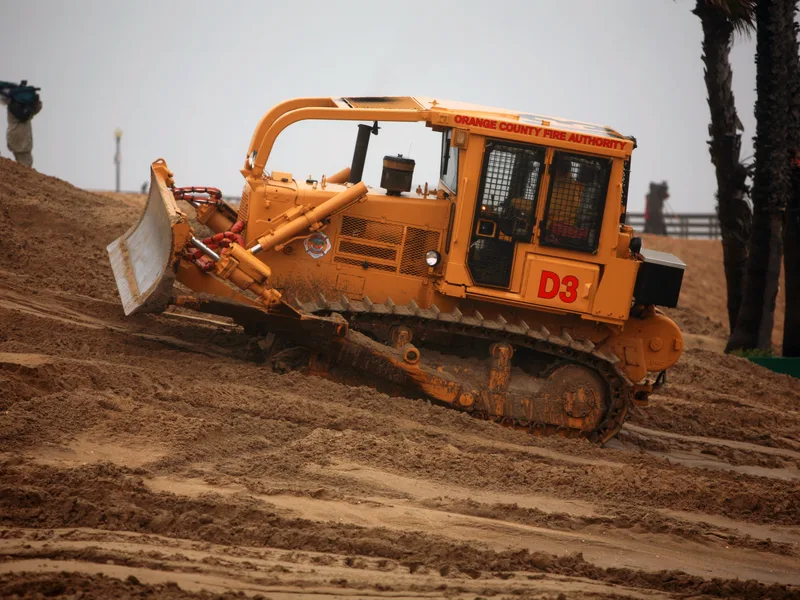
The dozer’s own loss profile in Arkansas divides along the same line the geology does. In the uplands it is abrasion and impact: chert and sandstone in the cut chew rails, rollers and cutting edges, and the wear bill is a maintenance cost rather than an insured one no matter how sudden it feels. In the Delta it is footing and fire — deep saturated silt that will not carry weight after rain, and dry crop residue against hot surfaces in late summer. Overturn sits on top of both, usually on a spoil edge or a fresh cut the operator had already crossed safely that morning. And around all of it sits the land-disturbance exposure, which is created by the job going right rather than by anything going wrong.
Common Arkansas dozer claims we see
- Silt off an open cut into a field ditch or stream. The signature Arkansas exposure on this machine, and a third-party question rather than a floater one.
- Overturn on a spoil edge or a benched hillside. Almost always on ground that behaved earlier in the same shift.
- Engine-bay fire in dry residue. Chaff and stalk packed against hot surfaces, on a machine working where there is no water for miles.
- Damage loading or unloading on a rural approach. Narrow county bridges and soft shoulders concentrate the loss on the ramp and the tie-down.
- Rail and roller wear presented as a sudden failure. Worth separating from a covered peril before a claim rather than in the middle of one.
Why Arkansas dozer owners choose Equipment Guard Insurance
Plenty of placements treat a dozer as an oversized loader and price the serial number. We would rather say plainly that on this class the serial number is the smaller half of the file. Writing equipment on its own means an Arkansas owner can get the machine scheduled and valued correctly without unpicking arrangements built around the rest of the business, and it leaves room to have the land-disturbance conversation honestly instead of letting a floater quietly imply it has been handled. We place through markets — named on our homepage — that read earthmoving as its own class.
Major Arkansas dozer markets
- Little Rock. The central corridor, where interstate, institutional and river-plain work meet and both soil regimes turn up on the same schedule.
- Fayetteville and Springdale. Sustained build-out over karst uplands — sinkhole and spring country, where what leaves a site can be gone before it is seen.
- Bentonville. Campus and retail-led development benched into hillsides, so slope work and erosion control run as one operation.
- Fort Smith. River-valley industrial and rail-served sites on older fill, with cross-border hauling as routine.
- Jonesboro. Delta distribution and agricultural ground: flat, fine, and drained by ditches that lead directly onto someone else’s land.
Related
- Dozer insurance — the machine physics that hold in every state.
- Excavator insurance in Arkansas — the machine whose Arkansas question is what lies under the ground rather than what leaves it.
- All equipment insurance in Arkansas — the state hub.
- Equipment floater · Rented & leased equipment
Primary sources
- General Stormwater Permits — Arkansas Department of Energy and Environment, Division of Environmental Quality (stormwater and land disturbance)
- Apply for Contractors License/Registration » Arkansas Department of Labor and Licensing — Arkansas Contractors Licensing Board, Department of Labor and Licensing (contractor licensing)
Arkansas dozer insurance FAQs
What pulls an Arkansas earthmoving job into the stormwater permit?
The size of the ground you open, not the size of the machine that opens it. Once disturbance reaches the statutory acreage the general permit applies, and small parcels that belong to a bigger scheme are counted against that same threshold rather than treated as separate jobs. Crews get caught by the second half far more often than the first, because a pad that looks modest on its own stops looking modest once it is read as one lot in a subdivision.
Which agency am I actually dealing with in Arkansas?
The Division of Environmental Quality, which sits inside the state Department of Energy and Environment and runs the wider water-permitting slate as well as construction stormwater. That matters in a practical way rather than a ceremonial one: the same division that reviews your notice of intent is the one your discharges, your dewatering and your borrow pits eventually route through, so the relationship is continuous rather than project-shaped.
Does a penalty for a failed control measure go on my insurance?
No, and treating it as an insurance problem is how owners end up with the wrong policy conversation. A fine assessed against you for an inadequate or unmaintained control is a regulatory matter between you and the state. The insurable event is what the failure lets happen next — silt in a ditch that carries it into a neighboring field, mud tracked onto a state highway, material in a stream. That is damage to somebody else arising from your work, and it belongs to liability and pollution coverage.
How differently does the machine work in the Delta and in the Ozarks?
Almost as if they were separate trades. In the eastern alluvial plain the soil is fine, deep and nearly flat, so the blade moves easily and the ground gives up almost nothing in traction or bearing when it is wet — and the same fineness is what lets it travel once it is exposed. In the uplands the argument reverses: shallow soil over chert, sandstone and shale, benching on grade, rock in the cut, and an undercarriage bill that arrives faster than the calendar suggests it should.
Does the equipment floater answer for any of the land-disturbance risk?
It answers for the iron and stops there — fire, theft, overturn, the transport leg, physical damage to the machine itself. It has nothing to say about earth that has been relocated and then relocated again by weather. On a dozer that gap is wider than on anything else we schedule, because a well-maintained machine doing exactly what it was hired to do is precisely what creates the larger exposure.
Do I have to move my whole program to get the dozer written properly?
No. Equipment Guard Insurance writes equipment on its own, so an Arkansas owner can put the machine on a schedule that reflects its real value and hours without reopening anything else. What we will not do is let the floater stand in for the land-disturbance conversation — we would rather map that boundary with you before a wet week does it for us.