

Everything that makes an excavator valuable — the reach, the force, the willingness to keep going into material nobody has seen — is also what makes its worst loss invisible until it has already happened. The boom rarely ends a year. The bucket sometimes does.
This page deals with the Arkansas version of that problem: the working-day band a notice has to land inside, the obligations that band puts on people other than you, and the way soft eastern ground and hard western rock hand the same machine two separate sets of trouble. Everything that stays true of an excavator no matter which state it works in — swing geometry, undercarriage wear, the attachments that ride with it — is on the excavator insurance pillar.
What excavator insurance costs in Arkansas
There is no honest number to print here, and the reason is worth stating rather than apologizing for: the machine is the smaller half of the rating question. What you dig decides far more than what you dig with. Depth, how routinely you work inside congested corridors, whether gas and fiber are part of your normal week or something you avoid, the size and age of the unit, the attachment list, where it sits between jobs and what your record looks like all pull in different directions. An Arkansas crew cutting service trench through a built-up block and a crew opening a farm pond are priced apart because they are apart.
Arkansas excavator regulations: dig notice and the one-call duty
The One Call Center notifies member operators within four working hours of receipt; operators mark within two working days.
Our data records the governing sections as Ark. Code Ann. § 14-271-112 for the notice of intent and § 14-271-110 for the marking duty, and we name them here without linking them, because this site links only documents it has actually opened and read to the standard the rest of these citations meet. The working shape of the regime is not in doubt. Notice belongs inside a band that opens ten full working days ahead and closes two full working days before the machine moves, the center relays it to member operators within hours, and those operators then take working days of their own to mark. Read as a sequence rather than as a single deadline, that tells you the real constraint on an Arkansas job is response time you do not control. And the far end of it is the part crews misjudge: none of that machinery transfers the consequence of a strike. Marks are approximate by definition, the duty to dig carefully around them stays where it always was, and anything the records never captured stays with the person holding the controls.
Common excavator risks in Arkansas
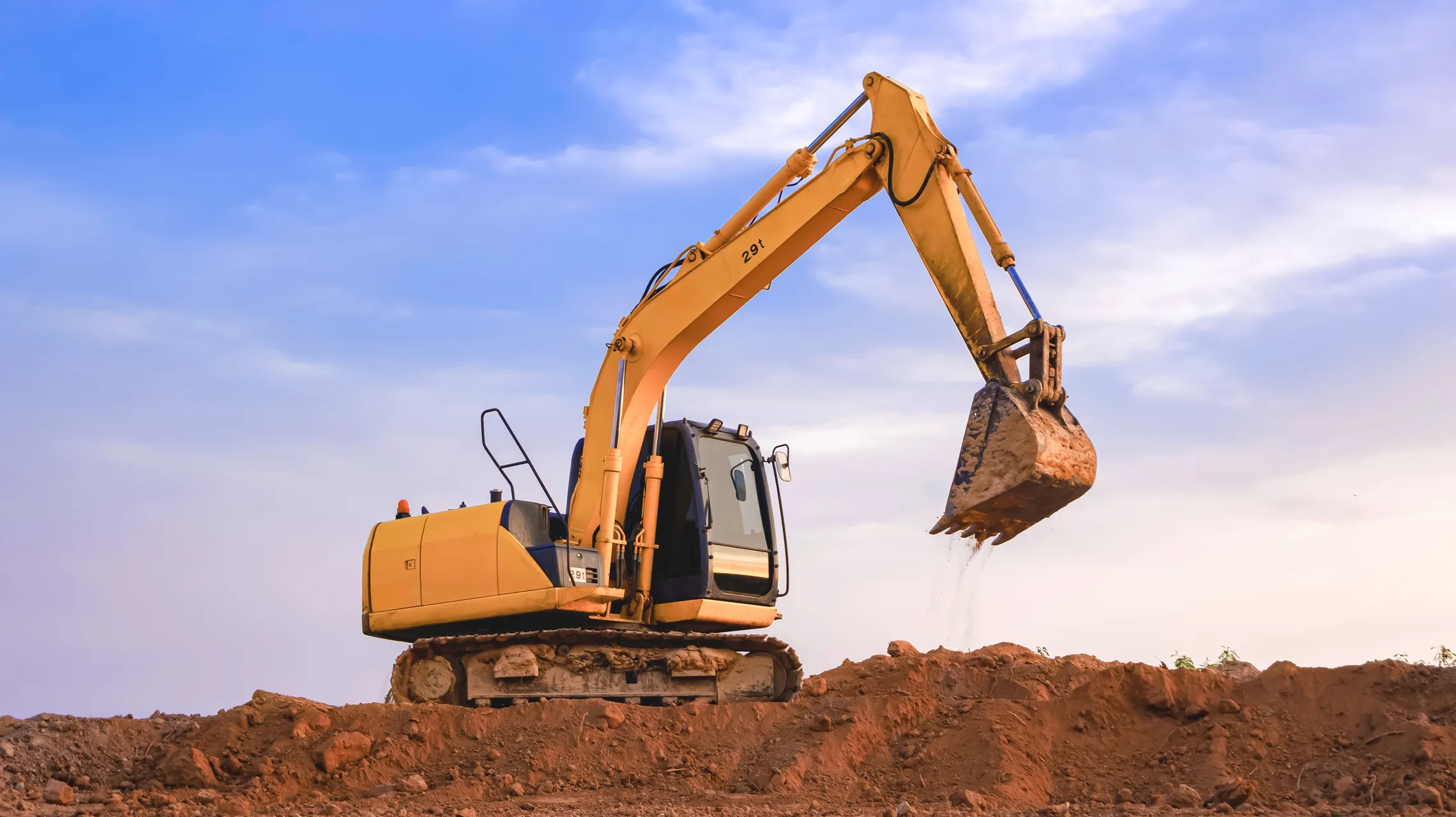
The strike is the loss that reorders everything else, and it does not look like an equipment loss at all: the excavator is usually driveable afterwards while the bill is not. Restoration of the facility, service lost to everyone fed by it, a crew standing down and a site that has to be made safe are the components, and on a pressurized main or a fiber trunk the third-party side runs well past what the machine is worth. Underneath that sit the two things this machine does to itself anywhere: it goes over at a trench lip or on a slope it should not have crossed, and it swings into something the operator could not see. Arkansas then splits the physical problem in two. Saturated Delta soils undermine trench walls and swallow track pressure; upland rock puts hammer shock through the arm, the pins and the undercarriage week after week. Add a wet spring that turns access roads into a recovery problem and the machine is exposed getting to the job as well as on it.
Common Arkansas excavator claims we see
- Line strike with downstream consequence. Physical repair is the small line item; interruption and restoration are the ones that change the account.
- Trench collapse in saturated ground. Eastern Arkansas soils that stand up in the morning and do not by afternoon, taking spoil, shoring and sometimes the machine.
- Hammer and rock damage in the uplands. Cumulative shock through the arm, pins and undercarriage on Ozark and Ouachita work, surfacing as a component failure rather than an accident.
- Swing contact on a confined lot. Counterweight into a wall, a fence line or a parked vehicle where the setup left no room behind the house.
- Loss during float or recovery. Loading, hauling and pulling a stuck machine off soft access — the moments when the excavator is least in its element.
Why Arkansas excavator owners choose Equipment Guard Insurance
Placing the machine on its own is what makes the underground conversation possible at all. Bundled into a package, an excavator is a line of iron with a value beside it and the strike question never gets asked. We would rather start from the work — how deep, how often in a street, how close to live services, how much of your year is utility-adjacent — and put the machine and that exposure in front of markets that read excavation on its merits rather than pricing it as generic contractor equipment. Those markets are named on our homepage. Arkansas licenses you at state level, so your credentials already speak for your competence; the insurance ought to speak for the work.
Major Arkansas excavator markets
- Little Rock. The state’s densest utility congestion and its heaviest replacement workload, where marks are crowded and there is rarely open ground to work in.
- Fort Smith. River-adjacent industrial and rail-served sites, with older service networks and a water table that shapes how deep anyone wants to go.
- Fayetteville. Campus and corridor work on rock, where the day is spent breaking material rather than moving it.
- Springdale and Bentonville. Sustained commercial and distribution build-out on a schedule that rewards speed, which is exactly the pressure that shortens locate discipline.
- Jonesboro. Delta agricultural and municipal work — deep soft soils, drainage and irrigation, long approaches and a spring that decides when anyone starts.
Related
- Excavator insurance — the machine physics that hold in every state.
- Backhoe insurance in Arkansas — the machine whose paperwork problem is the highway rather than the trench.
- All equipment insurance in Arkansas — the state hub.
- Equipment floater · Rented & leased equipment
Primary sources
- Apply for Contractors License/Registration » Arkansas Department of Labor and Licensing — Arkansas Contractors Licensing Board, Department of Labor and Licensing (contractor licensing)
We do not link an Arkansas dig-notice section here. The notice duty described above follows Arkansas’s own one-call statute as our data layer records it; where the state publishes a document that states it directly, this page links it.
Arkansas excavator insurance FAQs
When does the notice have to go in on an Arkansas excavation?
The window opens ten full working days out and closes two full working days before the bucket moves, so there is a band rather than a deadline. Working days are the operative unit, which matters most in the weeks that carry a holiday: a crew counting on the calendar reaches the outer edge of the band sooner than it expects, and a notice given outside the band has to be replaced rather than argued about.
Once I have called, who owes me something back and how quickly?
This is the part Arkansas spells out and most crews never read. The notification center passes your notice to its member operators inside a few working hours of receiving it, and those operators then have working days of their own to get paint and flags on the ground. Your start date therefore sits at the end of somebody else’s queue. Planning a mobilization on the assumption that marks appear the morning after the call is how a week gets lost, and idle crew time is not a loss any equipment policy was built to absorb.
If the marks are there and I hit something anyway, is that on me?
Usually, yes, at least in part. The obligation the notice creates is an obligation to mark approximate locations — not a warranty that every facility was located, that every operator responded, or that nothing unrecorded shares the trench. What decides the claim afterwards is how the excavation proceeded around the marks that were made. That is why the third-party side of this machine is arranged deliberately instead of being folded into the schedule and forgotten.
Does Arkansas license the contractor running the excavator?
It does, and unusually for the region it does so at state level. The Contractors Licensing Board issues commercial licenses above a statutory contract-value threshold, backed by a net-worth showing and a surety bond, with separate residential builder and remodeler classifications underneath. So an owner or general contractor here is checking a real state credential as well as your certificates, and the two are read together.
Does the ground itself change the exposure across the state?
Considerably. In the eastern bottomlands the soil is deep, soft and often saturated, so trench walls behave badly and dewatering is a routine part of the job; the machine sinks, tracks poorly and works close to a water table. Across the Ozark and Ouachita uplands the problem inverts — shallow rock, hammer work, and shock loading through the arm and undercarriage. The same excavator on the same schedule is exposed to two different failure modes depending on which half of the state it is standing in.
Can you place the excavator without touching my other policies?
Yes. Equipment Guard Insurance writes equipment monoline in Arkansas, so the machine, its attachments and the underground question can all be handled on their own terms while the liability and comp you already carry stay exactly where they are.