
A blade in Colorado is usually working against two things at once: a landscape that rises faster than anywhere a machine of this size is comfortable, and a soil that will not agree to stay the size it was when you left it. Both are ordinary here, and neither is obvious from a set of drawings.
This page is about the Colorado side of that work — which agency issues the permit attaching to a disturbed acre, what the ground and the weather do to a machine and to the site it produced, and how the exposure divides between policies afterward. The machine physics that hold in any state live on the dozer insurance pillar.
What dozer insurance costs in Colorado
A number quoted from a page is a guess, and on this class it would be a poor one. What actually shapes a Colorado figure is elevation and season — a high-country crew simply has fewer working months — together with the machine’s size, hours and undercarriage condition, the soils you routinely take on, how much area stands open at once and what lies below it, the distance and frequency of moves between Front Range and mountain jobs, where the iron sleeps and whether it sleeps under anything, and your own record. Two crews with the same dozer and different altitudes are different risks.
Colorado dozer regulations: stormwater and land disturbance
Colorado administers the national discharge program itself, and the construction stormwater general permit is issued through the state health and environment department’s water-quality permits rather than by a federal regional office. The obligation attaches at a land disturbance of one acre or more (or smaller if part of a common plan disturbing one acre or more).
Two things are worth drawing out. The first is how unusual that uniformity is in this particular state. Colorado has no statewide general-contractor license — competency, grading approvals and inspection are the business of counties and municipalities, and they differ meaningfully from one to the next — so a contractor working several jurisdictions is already carrying several rulebooks. The stormwater obligation is the piece that does not vary, which makes it one of the few things you can plan around state-wide. The second is the commercial boundary, and it needs saying without hedging. A penalty assessed over a control measure is a regulatory matter; it is not property damage and no equipment policy was written to answer it. Material that leaves your site and arrives on adjoining property, in a public street or in a drainage way is third-party damage arising out of your work, and it lives in liability and pollution wording. Colorado sharpens this because so much of the annual moisture arrives as short, intense convective storms onto ground that has been dry and loose for weeks — the exposure does not build gradually, it happens in an afternoon.
Common dozer risks in Colorado
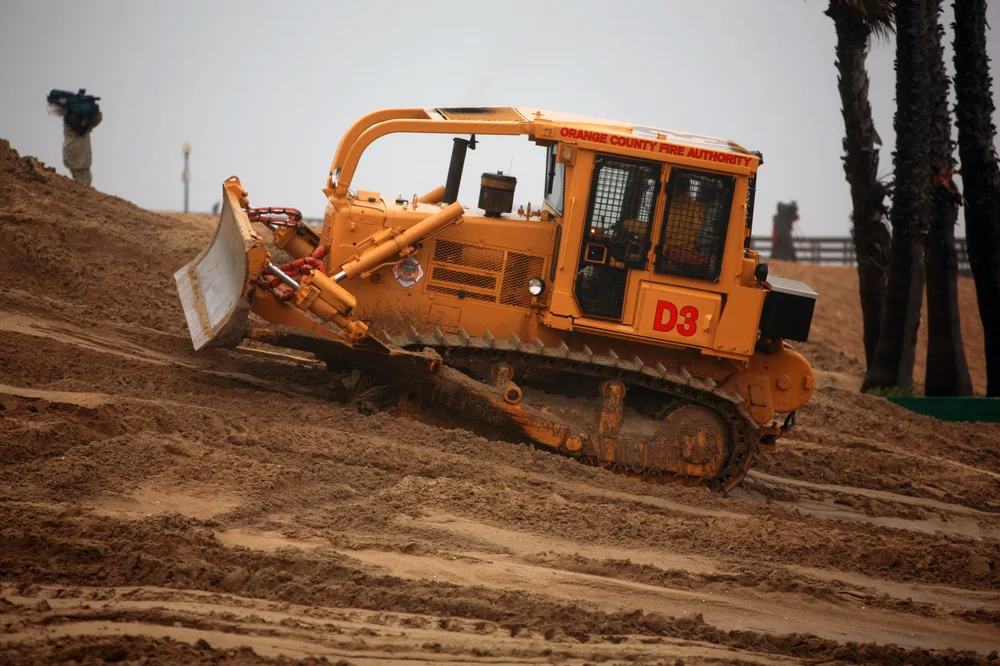
The iron’s own exposures here are led by terrain and by weather. Mountain and foothill work puts a heavy machine on cross-slopes, benches and fill faces, which is the overturn picture; decomposed granite and rocky subsoils grind through undercarriage at a rate that owners tend to underestimate. Hail is the loss Colorado supplies that most states do not, and it finds glass, lights, mirrors and cab fittings on machines that stand outdoors between shifts. Thin air changes how engines and cooling systems behave at altitude, and a long shoulder season means the iron often stands idle in places nobody is watching. Around all of it sits the land-disturbance exposure, created by the job being done rather than by anything failing.
Common Colorado dozer claims we see
- Material carried off an open pad in a convective storm. The defining third-party exposure here, and it typically arrives in one afternoon rather than over a season.
- Hail damage to glass, lights and cab fittings. Ordinary in this state, easy to overlook on a schedule written elsewhere.
- Overturn on a mountain bench or fill face. Terrain-driven, on ground whose outboard edge is brand new.
- Undercarriage wear from decomposed granite and rock. Consumption rather than a peril, and worth separating from a covered loss before a claim exists.
- Theft or vandalism during a long shoulder season. Machines parked at altitude between working windows, often a long way from anybody.
Why Colorado dozer owners choose Equipment Guard Insurance
A dozer account is worth placing on purpose rather than inheriting, because the machine is the smaller half of what it creates and the two halves are carried by different policies. We write the equipment monoline, so a Colorado schedule can be built properly without reopening arrangements already working for you, and we say plainly which exposures the floater carries and which it does not. We place through markets — named on our homepage — that understand a grading contractor is not a general contractor with a big attachment.
Major Colorado dozer markets
- Denver. The heaviest concentration of pad and subdivision grading in the state, on clay that argues with everything built on it.
- Aurora. Large-scale eastern-plains expansion, where wide open acreage stands stripped and exposed for long stretches.
- Colorado Springs. Development pushing onto steeper foothill ground, with slope work and drainage in tension on the same lot.
- Fort Collins and the northern corridor. Mixed institutional, residential and irrigation-legacy earthwork on the plains edge.
- Pueblo and the southern plains. Industrial, energy and infrastructure earthmoving across dry, wind-scoured open country.
- Grand Junction and the western slope. Long distances between jobs, rocky ground, and site work in country that dries hard and washes fast.
Related
- Dozer insurance — the machine physics that hold in every state.
- Backhoe insurance in Colorado — the machine whose Colorado question is registration and road use rather than runoff.
- All equipment insurance in Colorado — the state hub.
- Equipment floater · Rented & leased equipment
Primary sources
- Water Quality - Permits — Colorado Department of Public Health and Environment (stormwater and land disturbance)
Colorado dozer insurance FAQs
Which permit covers a Colorado grading site, and who issues it?
The state issues it. The Colorado Department of Public Health and Environment (CDPHE) administers the construction stormwater general permit under state authority, and the obligation attaches at a land disturbance of one acre or more (or smaller if part of a common plan disturbing one acre or more). That makes it unusual in the Colorado landscape: there is no statewide general-contractor license here, so most of what governs a site is decided by the county or the municipality, while this particular obligation is uniform across the state.
What does expansive clay actually do to work we have already finished?
It moves it. A great deal of Front Range ground swells when it takes on water and shrinks when it dries, so a pad graded true in one season is not necessarily true in another, and fills, subgrades and drainage patterns can all shift after the machine has left. The insurance point is quieter than the engineering one: work that changed shape is a dispute about the job, not a sudden accidental loss to your equipment, and those are two entirely different conversations.
Our machines are registered as special mobile machinery. Does that affect the equipment policy?
Not directly, but it is worth knowing why the question comes up. Colorado treats self-propelled construction machines as a separately registered and taxed class of vehicle rather than simply exempting them, which means a dozer here has a registration identity that the same machine would not have in most states. It does not turn the floater into an auto policy — the machine is still scheduled equipment — but it does mean the paperwork trail underwriters see is a little different.
How does altitude and the weather pattern change the working year?
It shortens and interrupts it. High-country work has a genuinely narrow season, engines and cooling systems behave differently in thin air, and the Front Range gets much of its moisture from short intense storms rather than steady rain — which is exactly the delivery pattern that moves loose material off an open site. Hail is the other Colorado specialty, and it damages glass, lights and cab fittings on iron that lives outdoors.
Is a stormwater problem something the equipment policy pays for?
No, and the distinction is worth holding on to. A regulatory penalty over control measures is not property damage, so it is not an equipment claim in any state. Material leaving your ground and reaching adjoining property, a public street or a drainage way is third-party damage arising from your work, and it is answered by liability and pollution wording. On a dozer that second exposure is frequently larger than the machine that produced it.
Can the dozer be written on its own?
Yes. Equipment Guard Insurance places equipment monoline in Colorado, so the machine goes on its own schedule without the rest of the account being reopened. We would rather set out plainly which policy carries the moved ground than let it be assumed into the floater.