
Delaware is a coastal-plain state, and a dozer feels it immediately. There is little rock to fight, the material moves easily, and the blade does its work without argument — which is exactly why the risk here is not in the pushing. It is in what the moved material does afterward, on flat ground that drains slowly and over a water table that is rarely far down.
This page covers the Delaware regulatory shape — who sets the sediment standard, who actually reviews your plan, and what the acre trigger reaches — and then the commercial boundary that decides which consequences an insurance policy will pay. For the machine, its running gear and how it travels, the dozer insurance pillar carries the detail that does not change from state to state.
What dozer insurance costs in Delaware
No figure belongs on this page. What sets a Delaware number is the machine — size, age, hours, running gear — and then the work: how much ground is open at once, how close the site is to tidal water or a shared drainage channel, whether dewatering is part of the job, whether the sites are one large subdivision phase or a run of small pads, how far the iron travels between them, and your own history. Two contractors with matching equipment can present very different risks once those are answered.
Delaware dozer regulations: stormwater and land disturbance
Delaware administers its own construction stormwater permit through the state natural resources and environmental control department, and it reaches a land disturbance of one acre or more. The sediment and stormwater standard is set at state level, but plan review is delegated — a conservation district is commonly the office that approves the grading plan for a given site.
That delegation is more than an administrative detail, and it is where a first-time contractor here loses time. The rule you are complying with is statewide and the person applying it is local, which means expectations about sequencing, stockpiles and stabilization can be answered face to face rather than guessed at from a document. Use that. The other thing worth being explicit about is the boundary between compliance and coverage, because the two get spoken of as though they were one thing. A penalty for an inadequate control is a regulatory outcome and no equipment form pays it. What becomes an insurance claim is the physical consequence — sediment onto the property next door, across a public road, or into a drainage channel that carries water for many other landowners. That is third-party damage arising out of your operations, and it belongs to liability and pollution wordings. On a dozer that half of the exposure is routinely larger than the machine that created it, which is the opposite of how most equipment accounts are discussed.
Common dozer risks in Delaware
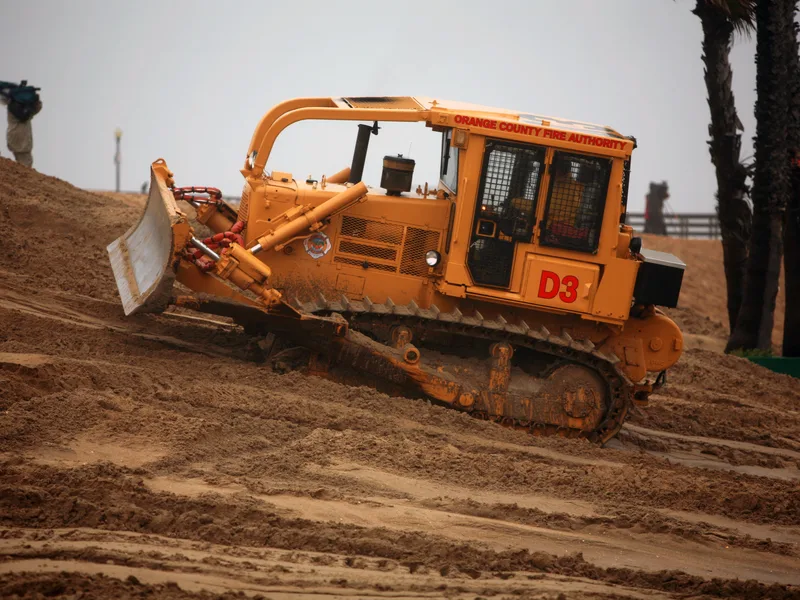
The machine’s own losses here skew toward saturation rather than abrasion. Soft, wet material means a dozer working at the edge of its footing more often than a rocky state would demand — bogging, sudden loss of support at a fill edge, and the slow damage of running in standing water. Fire and transit losses sit where they always do. Around that is the land-disturbance exposure, which on flat ground is deceptive: nothing appears to be running anywhere until a storm fills the site and then all of it moves at once, laterally, into whatever channel is nearest.
Common Delaware dozer claims we see
- Material moving off a saturated site after a storm. The defining Delaware exposure, and a liability question rather than an equipment one.
- Machine bogged or dropped at a soft fill edge. Recovery damage frequently exceeds the damage from the incident itself.
- Dewatering discharge reaching somewhere it should not. Pumped water carries material, and where it is put is a decision with consequences.
- Loading and unloading damage. The concentrated transit event on a tracked machine, and the one most often disputed.
- Component and fluid loss between phases. Open subdivision ground with no traffic on it is where parts leave rather than whole machines.
Why Delaware dozer owners choose Equipment Guard Insurance
We would rather be useful about the split in this state than sell around it. Writing the equipment monoline means the dozer goes on its own schedule without reopening anything else you carry, and it leaves room for the conversation that matters: what your plan requires, who approves it, and which of the things that can go wrong on a wet Delaware site are actually insurable and which are simply the cost of getting the sequencing wrong. The markets we place through are named on our homepage, and they read earthmoving on its own merits.
Major Delaware dozer markets
- Wilmington. Industrial and urban redevelopment on previously built ground, with older drainage systems and immediate neighbors on every side.
- Newark. Corporate, campus and former industrial sites where reuse means grading around what somebody else left behind.
- Middletown. The state’s heaviest run of farmland-to-subdivision conversion, and the largest continuously open disturbances.
- Bear and the northern suburbs. Steady commercial and residential pad work squeezed between existing development, where laydown space is the constraint.
- Dover. Institutional and public work in the center of the state, and the staging point for jobs further south.
- Smyrna and the growth corridor. Small-town expansion onto flat agricultural ground drained by shared channels rather than by gradient.
Related
- Dozer insurance — the machine physics that hold in every state.
- Excavator insurance in Delaware — the machine that reaches the water table first and tells you what the blade is about to be working in.
- All equipment insurance in Delaware — the state hub.
- Equipment floater · Rented & leased equipment
Primary sources
- NPDES General Permit for Stormwater Discharges from Construction Activity — Fact Sheet (DNREC) — Delaware Department of Natural Resources and Environmental Control (DNREC) (stormwater and land disturbance)
- Delaware Code Title 30, Chapter 25 — Contractors' License Requirements and Taxes, §2502 License requirement — Delaware Division of Revenue (contractor licensing)
Delaware dozer insurance FAQs
Who actually approves a Delaware grading plan?
Not necessarily the agency that wrote the rule. Delaware sets its sediment and stormwater standards at state level but delegates plan review, and in practice a conservation district is often the office that reads your plan, asks for changes and signs it off. That is the single most useful thing to know before a first job here: the standard is statewide, the reviewer is local, and the relationship you need is with the reviewer.
Does flat ground make sediment control easier?
It makes it different, and in some ways worse. Steep ground tells you where the water will go; flat ground does not, and a coastal-plain site sheds slowly, ponds, then moves laterally when it finally moves. Sandy material also travels readily once it is saturated. A control layout that would be obvious on a hillside has to be reasoned out here from the drainage rather than read off the contours.
What does a high water table do to the work?
It shortens the distance between the blade and trouble. Cut a little deeper than planned and you are working saturated material that will not compact, will not hold a slope and turns to slurry under tracks. It also means dewatering shows up on jobs that were never planned around it, and water pumped off a site has to go somewhere — which is a discharge question, not a housekeeping one.
Is a sediment violation covered by my equipment policy?
It is not, and no insurance argument makes it so. A penalty for a deficient control is regulatory. The insurable event is what the material does after it leaves — into an adjacent property, across a road, or into one of the drainage channels that carries water for a great many properties at once downstate. Once your material is in a shared channel it is somebody else’s damage, and that is a liability and pollution matter rather than an equipment one.
Is theft a real concern on a Delaware dozer?
Far less than on compact equipment, for the ordinary reason that moving one takes a lowboy and a driver who can load it. What does happen is component and fluid loss on sites that sit open between phases, and Delaware has plenty of those on farmland converting to subdivision. Where the machine sleeps between phases matters more than any alarm you could bolt to it.
Can you place the dozer without the rest of my program?
Yes. Equipment Guard Insurance writes equipment monoline in Delaware, so the machine can go on its own schedule immediately. We would rather use the time to work out where your site drains and who reviews your plan, because those two answers say more about the account than the model number does.