
Every state has a soil. Georgia has one that testifies. Clay-rich saprolite across the Piedmont is fine enough to stay suspended for a long ride, slow to drop out once it is moving, and bright orange the whole way — so when a control measure fails here, the evidence arrives downstream before the paperwork does.
On top of that sits a regulatory arrangement with a wrinkle most states do not have: the state runs the construction stormwater program itself, and it runs it as a set of permits sorted by project type rather than as a single document everybody signs. The machine questions — blade loads, undercarriage life, slope work, transport — belong to the dozer insurance pillar and hold wherever you work.
What dozer insurance costs in Georgia
There is no premium on this page. A dozer number is assembled from the job rather than from the model plate, and the Georgia inputs that move it are the machine’s age, hours and undercarriage state, the acreage you have open at any one moment, whether your projects sit inside larger developments, how the machine travels between a metro yard and a rural phase, the stabilization discipline your crews actually keep, and your own record. It is worth naming the asymmetry directly: the iron is usually the least expensive thing in the file, because a machine repair is bounded and a downstream cleanup is not.
Georgia dozer regulations: stormwater and land disturbance
Georgia administers its own program through the state environmental protection division, and the instrument is not one permit but three: NPDES Construction General Permits GAR100001, GAR100002, GAR100003. Coverage is required at a land disturbance of one acre or more (or tracts under one acre within a common plan of development totaling one acre or more).
The consequence worth paying for is what follows from that split, and then what follows from the clay. Sorting permits by project type means the compliance question on a new job is which document you belong under, and a contractor who works a stand-alone site one month and a phase of a large development the next has answered that question twice — a distinction that is invisible from the seat of the machine and entirely visible to an inspector. Then the soil does the rest. Because Georgia sediment is fine, mobile and vividly colored, a failure here does not stay on the site to be quietly corrected; it presents itself in a creek, and the same photograph starts two entirely different files. One is enforcement, which your company carries alone: a penalty is not property damage and no equipment policy was ever meant to answer for it. The other is a claim, because material off your site and onto a neighboring property, a public road or a watercourse is third-party damage arising out of the work you were hired to do. That one lives in liability and pollution wordings, and on this machine it is routinely the larger number of the two.
Common dozer risks in Georgia
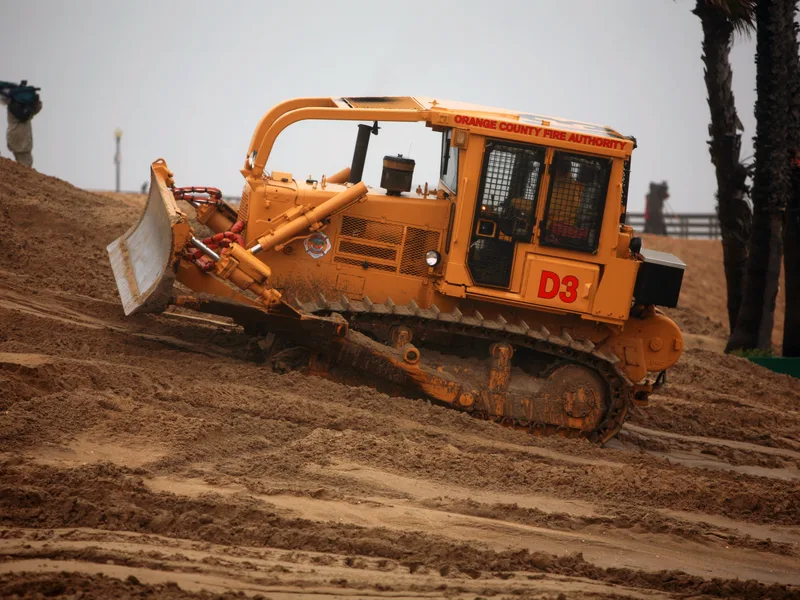
A Georgia dozer works a long year, and length is itself a risk factor: more hours, more transport movements between jobs, and more days on which a site is open when a summer storm cell parks over it. The machine’s own losses run to the familiar set — undercarriage wear accelerated on abrasive weathered rock, overturn while cutting into a slope or working a spoil edge, engine-bay fire in dry vegetation late in the season, and damage in transit, since nothing this size arrives under its own power. Alongside those runs the exposure this state is really about. Clay holds a slope beautifully until it is saturated and then behaves like something else entirely, so the failure mode is not gradual: a cut face that has been stable for weeks lets go in an afternoon, and the material goes wherever the water was already going.
Common Georgia dozer claims we see
- Orange sediment reaching a creek after a summer cell. The defining Georgia loss, and third-party in character rather than a floater matter.
- A saturated cut face letting go. Clay fails suddenly rather than progressively, which is why the warning signs a crew watches for are the wrong ones.
- Working the wrong permit on a development phase. Not itself an insured loss, but the file it opens often runs beside one that is.
- Overturn on a spoil edge or a fresh bench. Usually on ground the operator crossed safely earlier the same day.
- Transport and tie-down damage across long hauls. A tracked machine moving between a metro yard and an outlying phase concentrates loss on the ramp and the deck.
Why Georgia dozer owners choose Equipment Guard Insurance
The reason to place a dozer deliberately is that it is the machine most likely to create an exposure larger than itself, and package underwriting rarely notices. We write equipment as its own line, which means the schedule can be built around your Georgia work rather than squeezed into a program designed for something else, and it means the land-disturbance conversation happens on its own terms instead of being assumed away. We will tell you plainly which parts of this the floater answers for and which parts it does not, and we place through markets — named on our homepage — that understand grading work rather than treating it as an oversized loader risk.
Major Georgia dozer markets
- Atlanta. The continuous metro growth ring, where most work sits inside a larger common plan and the permit question is live on every job.
- Augusta. Institutional, medical and defense-adjacent site work on sandy fall-line ground that behaves differently from Piedmont clay.
- Savannah. Port-driven industrial and warehouse pads on flat, wet coastal ground where drainage is engineered rather than natural.
- Columbus. Mixed military-adjacent and industrial site preparation with long haul distances between phases.
- Macon. Distribution and logistics development at the crossroads of the interstate system, on ground that grades quickly and erodes just as fast.
- Athens. University-driven expansion on rolling clay hills, where short steep grades sit close to established neighborhoods.
Related
- Dozer insurance — the machine physics that hold in every state.
- Skid Steer insurance in Georgia — the machine whose lien paperwork is filed at a county courthouse here rather than with the state.
- All equipment insurance in Georgia — the state hub.
- Equipment floater · Rented & leased equipment
Primary sources
- NPDES Construction Stormwater General Permits — Georgia Environmental Protection Division (stormwater and land disturbance)
- Georgia Rules & Regulations, Chapter 553-1 ORGANIZATION — Rules of State Licensing Board for Residential and General Contractors — State Licensing Board for Residential and General Contractors (SLBRGC), within the Georgia Secretary of State’s Professional Licensing Boards Division (contractor licensing)
Georgia dozer insurance FAQs
Why does Georgia have more than one construction stormwater permit?
Because the state sorts construction by what the project is rather than by what equipment is on it. Stand-alone construction, infrastructure work and building inside a larger common development are handled under separate general permits, each with its own number. The practical effect for an earthmoving contractor is that the paperwork question on a new job is not only whether you need coverage but which of the permits your particular job belongs under, and a crew that assumes it is always the same one will eventually be wrong.
Does the acre threshold work differently on a subdivision phase?
It reaches further than crews expect. A tract smaller than the threshold is still caught when it forms part of a common plan of development that crosses it in total, which is precisely the shape of most Georgia residential and commercial growth. A half-acre pad inside a large development is not outside the requirement simply because your part of it is small, and the machine most likely to be sitting on that half acre is a dozer.
What makes red clay a bigger deal than ordinary dirt?
Two things, one physical and one evidential. Physically, the clay-rich saprolite across the Piedmont is fine enough to stay suspended for a long way and slow to settle out once it is moving, so a failure travels further than sand would. Evidentially, it is bright orange. A stream carrying Georgia clay announces itself from a bridge, which means the discovery of a problem here is rarely quiet and rarely late.
Is a fine from the state an insurance claim?
They are two different events that happen to share a photograph. The enforcement file and the neighbor’s damage claim can both be built from the same picture of an orange creek, but only one of them is an insured loss. The penalty is a regulatory liability your company carries itself. The sediment sitting on someone else’s land, road or water is third-party property damage arising out of your work, and that is what liability and pollution wordings exist for — not the floater, which repairs the machine.
How does a year-round working season change the risk?
It removes the natural pause that colder states get for free. In a state that freezes, exposed ground spends part of the year effectively closed and stabilized; in Georgia it does not, so a site can sit open for months longer while intense summer convective rainfall passes over it. More open days in front of harder rain is the whole story, and it is why sequencing and stabilization discipline earn more here than in most markets.
Can you place the dozer on its own without touching my other lines?
Yes — monoline equipment is how Equipment Guard Insurance was built, and in Georgia it means the machine can be scheduled correctly without anyone reopening a program that already works. The part we insist on saying out loud is that scheduling the dozer well does not settle the land-disturbance question. Those live in different sections of a different policy, and we would rather map that with you before a wet week than explain it after one.