

Ask an Idaho grading contractor where the water goes and you will often get a name rather than a direction. Not a creek — a canal, with a district or a company behind it, a delivery schedule, and farms downstream that have paid for what is in it. Water here is property before it is landscape.
The permitting picture has a second peculiarity worth knowing. Idaho ran for years without its own discharge program and has taken one on comparatively recently, so the office a contractor deals with about a construction site is not the office an older set of project documents assumes. Below is where that stands now, what triggers it, and where the exposure sits afterward; the machine itself is covered in the dozer insurance pillar.
What dozer insurance costs in Idaho
We quote rather than publish, because nothing useful can be said about a dozer rate without the work behind it. The Idaho inputs that move a number are the machine’s hours, age and undercarriage condition, how much of your work is ripping shallow rock rather than moving soil, the area you keep open at once and how close it sits to a canal or a river, seasonal concentration when a valley job and a farm job compete for the same months, transport distance across a long state, and your record. The underlying shape does not change: repairing the iron is a bounded cost, and answering for the ground is not.
Idaho dozer regulations: stormwater and land disturbance
Idaho now administers the program itself. The authority is Idaho Department of Environmental Quality (DEQ), the instrument is the IPDES Construction General Permit No. IDR100000, and it reaches a land disturbance of one acre or more (or smaller if part of a common plan disturbing one acre or more). The state assumed this role from the federal agency comparatively recently, which is why paperwork of any age in this state can point in two different directions.
The consequence that matters is who stands downstream. Over much of the irrigated plain the nearest receiving water is not a natural channel at all but a constructed one, operated by an irrigation district or a canal company under its own rules, carrying water that farms have contracted and paid for. That turns a sediment event into something with a much shorter path to a demand letter than a regulatory file would take: a plugged headgate, a fouled filter, a delivery a grower did not get during the week he needed it. Season matters too — a canal that is dry in the fall looks like a convenient place to work beside, and everything left near it over the winter is mobilized the moment the water comes back in spring. Set against that, the boundary is the usual one and worth stating without hedging. A penalty from the state is a regulatory cost your company carries alone; no equipment policy answers for it. Sediment or debris delivered into somebody else’s canal, field, road or river is third-party property damage arising out of your work, and it belongs to liability and pollution coverage rather than to the schedule the dozer sits on. Here, unusually, the injured party is often easy to name and easy to quantify.
Common dozer risks in Idaho
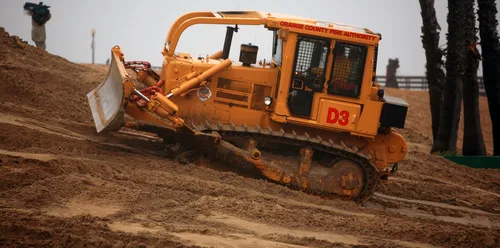
The plain is built on lava, and the mantle of soil over it is thin and uneven, so a machine that was grading cleanly meets rock without notice. Much of the work becomes ripping, which loads the undercarriage, the shanks, the blade edges and the frame far harder than soil work does and puts wear ahead of the hour meter. Thin soil cuts the other way too: there is not much material available to hold anything back when rain does arrive, and it arrives in bursts. Away from the plain the risk changes shape — panhandle and mountain work brings grade, timber, and long approaches, while high-desert sites bring dust, dry vegetation and engine-bay fire risk in late summer. Transport runs through all of it, because a state this long moves its iron a great deal.
Common Idaho dozer claims we see
- Sediment into an operating canal or lateral. The complainant is a district or a company with customers, not only a regulator with a file.
- Spoil stored against a dry channel that later fills. The loss is created in one season and delivered in the next.
- Undercarriage and ripper damage in shallow basalt. Rock work ages a machine faster than its hours suggest, and the wear argument follows.
- Engine-bay fire in late-season dry vegetation. High desert, chaff on hot surfaces, and very little nearby to stop it with.
- Transport damage on long moves between valleys. Grades, passes and repetition rather than a single dramatic event.
Why Idaho dozer owners choose Equipment Guard Insurance
A dozer that spends its life ripping rock and working beside somebody else’s water needs both halves of its risk taken seriously, and package underwriting tends to notice only the first. We write equipment on its own, so the machine is scheduled at a value that reflects what Idaho ground actually does to it, and nothing about placing it requires reopening the rest of your program. Then we separate the second half explicitly — the canal, the district, the grower downstream — because that exposure answers to a different form and is usually the larger one. We place through markets — named on our homepage — that read earthmoving as its own class rather than as farm equipment with tracks.
Major Idaho dozer markets
- Boise. The state’s densest site-development market, where subdivision grading runs right up against the irrigation network the valley was built on.
- Meridian. Continuous residential expansion over former farmland, with laterals and drains still running through the middle of new phases.
- Nampa. Agricultural-industrial and processing site work, where the canal system is production infrastructure rather than a scenic feature.
- Idaho Falls. Eastern plain work on thin soil over lava, the market where ripping is the normal condition of the job.
- Pocatello. Rail, industrial and highway projects on broken ground between basins, with long hauls in and out.
- Coeur d’Alene. Panhandle work on timbered slopes with lakes and rivers close by and a shorter season to fit it into.
Related
- Dozer insurance — the machine physics that hold in every state.
- Backhoe insurance in Idaho — the machine that spends real time on public roads between valley jobs and is classed for it by statute.
- All equipment insurance in Idaho — the state hub.
- Equipment floater · Rented & leased equipment
Primary sources
- IPDES Construction General Permit, Permit No. IDR100000 (issued 01/10/2022; effective 02/10/2022; expires 02/09/2027) — Idaho Department of Environmental Quality (DEQ) (stormwater and land disturbance)
- Idaho Code Title 54, Chapter 52 — Idaho Contractor Registration Act — Idaho Division of Occupational and Professional Licenses (DOPL), Idaho Contractors Board (contractor licensing)
Idaho dozer insurance FAQs
Has the permitting authority in Idaho actually changed?
Yes, and recently enough that it still catches people. For most of the program’s history construction discharges here were permitted by the federal environmental agency, because the state had not taken delegation. Idaho has since assumed the program and now issues its own construction general permit through the state environmental quality department. Older specifications, checklists and habits still point at the federal office, so it is worth confirming which regime a set of project documents was written under.
Why does an irrigation canal matter more than an ordinary ditch?
Because it has an owner and customers. Canals and laterals across the plain are operated by irrigation districts and canal companies with their own rules about what may enter the water and what may be built beside it, and the water in them is delivered to farms that pay for it. Sediment in a canal is therefore not only a permitting problem; it is a plugged headgate, a fouled filter and a delivery someone did not receive. That is an identifiable business with an identifiable loss, which is a very different letter from a notice of violation.
Does it matter what time of year the canal is running?
It changes the failure mode completely. During the season a canal is a live watercourse immediately downstream of your site, and anything that gets in is moving before you know about it. Out of season it is a dry, convenient-looking channel, and material pushed near it or spoil stored against it simply waits. When the water is turned back in the following spring, everything that accumulated over the winter is mobilized at once, which is how a problem created in October becomes a claim in April.
What does basalt do to a dozer?
It changes the job from pushing to breaking. Across the Snake River Plain the soil mantle over lava rock is thin and irregular, so a blade that was cutting cleanly meets rock without warning, and much of the work becomes ripping rather than grading. That is hard on the undercarriage, the ripper shanks, the blade edges and the frame, and it is why wear on an Idaho machine can run well ahead of its hour meter. Thin soil also means there is not much material available to hold sediment on site when it rains.
Would insurance pay a penalty from the state?
No. A penalty is what a regulator does about your controls, and no equipment or liability wording answers for it — that cost stays with your company. What insurance is built for is the damage: silt delivered into a canal that somebody else operates, material onto a neighboring field or a county road, sediment into a river reach. Those are third-party losses arising out of your work and they belong to liability and pollution coverage. In this state that third party may be a district, a canal company and a farm all at once.
Can I put the dozer on its own schedule?
That is precisely what we do. Equipment Guard Insurance writes equipment monoline, so an Idaho dozer is listed and valued on its own without anyone reopening a program that already suits the rest of your business. We are equally clear about the edge of it: the schedule answers for the machine, including the ripping damage this state is good at producing, and it does not answer for what your open ground sent into somebody’s water. Two exposures, two conversations.