

Flat ground is the hardest kind to be careless on. A dozer working an Illinois site is not fighting a mountain; it is making small decisions about grade that determine where water will sit for the next thirty years, on land where a few inches of fall is the difference between a drained field and a pond. Almost nothing about that shows up on the day you do it.
This page deals with the Illinois half of the job: which body issues the permit, what the local layer adds, and what the state’s peculiar drainage history does to a contractor who changes a grade. The machine itself — blade loads, ripper work, undercarriage economics and moving a tracked machine between jobs — belongs to the dozer insurance pillar, which holds everywhere.
What dozer insurance costs in Illinois
We do not print premiums for this class, because the number is driven by things a page cannot see. In Illinois the inputs that move an account are the acreage you have open at any one time, how far the machine travels between the collar counties and downstate, whether your work is greenfield conversion of farmland or infill on ground that has been built on before, the age, hours and undercarriage state of the iron, how the machine is secured when the site is idle over a long winter, and your own record. The dozer, taken alone, is frequently the least interesting item on the schedule.
Illinois dozer regulations: stormwater and land disturbance
Illinois administers the national discharge program itself. Illinois Environmental Protection Agency issues ILR10 — General NPDES Permit for Storm Water Discharges from Construction Site Activities, and the trigger is a land disturbance of one acre or more. We state that from our own verified record rather than from a linkable document — the page we hold for it is a program page, not the permit — and the note under the sources block says so rather than leaving you to assume otherwise.
Two things about Illinois deserve more attention than the acre figure. The first is jurisdictional: the permit is a single state instrument, but the contractor is not regulated at state level at all, because Illinois issues no statewide general contractor license and leaves that to municipalities under home rule. A crew moving between towns therefore carries one permit and a moving set of local requirements for identical work. The second is physical, and it is the one that produces claims. Much of this state drains through buried agricultural tile laid generations ago, recorded unevenly, and inherited by whoever develops the field. A blade that severs a line, buries an outlet or reverses a shallow fall does not create a private problem — it moves water onto land that belongs to somebody else. That is the boundary worth being blunt about: an enforcement notice or a penalty is a regulatory matter that no equipment policy answers, while standing water, silt or soil arriving on a neighboring parcel, a roadway or a watercourse is third-party damage arising out of your work. It lives in liability and pollution coverage, never in the floater, and the sums involved have nothing to do with the price of the machine.
Common dozer risks in Illinois
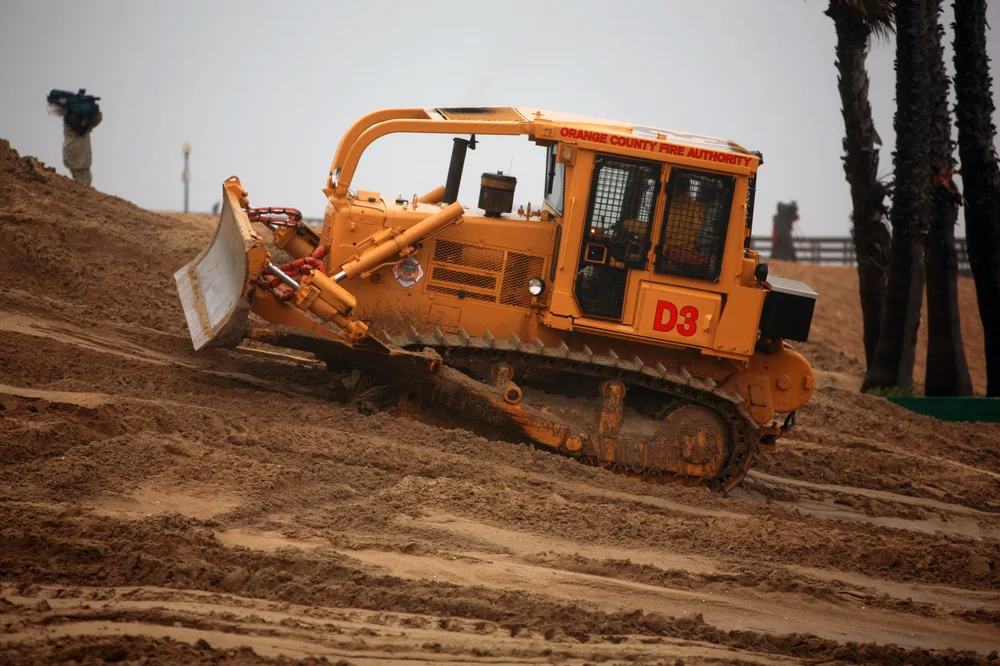
The machine’s own risks in Illinois are seasonal as much as mechanical. Winter is the quiet threat: a long shutdown means fluid, battery and rodent damage on iron nobody is looking at, and sites that sit open through the freeze. Spring is the loud one, because saturated ground and intense storms arrive at the same moment crews are trying to start. Between them sit the ordinary exposures — overturn on a spoil edge or a pond bank, blade and undercarriage damage in unexpected fill or old foundations, and transit losses moving a tracked machine along congested corridors. The land-disturbance exposure runs underneath all of it, and it is generated by correct work rather than by a mistake.
Common Illinois dozer claims we see
- Silt reaching a ditch, tile outlet or stream after a spring storm. The defining exposure here, and a liability matter rather than a floater one.
- Drainage changed onto adjoining land. A grading decision that becomes somebody else’s standing water is the quintessential flat-country claim.
- Overturn on a pond bank or spoil edge. Soft, saturated material gives way without much warning.
- Damage during a long winter idle. Machines left where they finished are exposed for months with nobody on site.
- Transport and low-clearance contact. Moving a tracked machine through the state’s freight corridors concentrates loss on loading and hauling.
Why Illinois dozer owners choose Equipment Guard Insurance
The default way to place a dozer is to treat it as a big number on a schedule and stop thinking. We would rather point out that the machine is the modest part of what you are carrying: the ground you reshaped, and where the water goes now, is what a bad year is made of. Writing equipment monoline lets us schedule and value the iron properly without touching arrangements built around your Illinois work, and it leaves room for a straight conversation about which exposures belong to a liability form rather than to the floater. We place through markets — named on our homepage — that underwrite earthmoving on its own terms.
Major Illinois dozer markets
- Chicago. Dense infill and redevelopment on made ground, under the most demanding municipal requirements in the state.
- Joliet. Intermodal and warehouse pad work at enormous scale, where a single phase opens more ground than most crews see in a year.
- Aurora and Naperville. Continuous subdivision grading on former farmland, tile lines and all.
- Rockford. Industrial site preparation on ground with rock closer to the surface than the rest of the state.
- Peoria. River-bluff work where real grade returns and slope stability becomes the operator’s problem.
- Springfield. Public and institutional earthwork with a long paper trail and close inspection.
Related
- Dozer insurance — the machine physics that hold in every state.
- Excavator insurance in Illinois — the machine that has to find the tile line the blade would otherwise discover the hard way.
- All equipment insurance in Illinois — the state hub.
- Equipment floater · Rented & leased equipment
Primary sources
- General NPDES Permit No. ILR10 — General NPDES Permit For Storm Water Discharges From Construction Site Activities (issued September 13, 2023; effective September 22, 2023; expires August 31, 2028) — Illinois Environmental Protection Agency (stormwater and land disturbance)
Illinois dozer insurance FAQs
Who runs the construction stormwater program in Illinois?
The state does. Illinois Environmental Protection Agency administers the delegated program and issues ILR10 — General NPDES Permit for Storm Water Discharges from Construction Site Activities, and the requirement reaches a land disturbance of one acre or more. What Illinois does not have is a single statewide authority over the contractor doing the disturbing — there is no statewide general contractor license, so the rest of your obligations on the same site are set locally.
So what does the municipal side add on top of the state permit?
Site-level requirements that vary by where you are standing. Illinois licenses general contracting municipally under home rule rather than statewide, and Chicago sets some of the most demanding conditions in the state. In practice a crew that works across county lines is complying with one state permit and several different local regimes for the same class of earthwork, and the differences show up in scheduling, in inspection, and in who has authority to stop you.
Why does buried farm drainage matter to a dozer contractor?
Because on land this flat, drainage is not natural — it is infrastructure. Enormous areas of Illinois farmland drain through buried tile installed generations ago and mapped inconsistently, and a great deal of development happens on ground that was in row crop the season before. A blade that cuts a line or seals an outlet does not simply create a wet corner on your own site; it can change where water stands on somebody else’s.
Is a permit violation the same thing as an insurance claim?
They are different animals and it is worth keeping them apart. A violation is a matter between you and the state or the municipality — a notice, a penalty, a suspension — and no equipment policy responds to it. A claim arises when the physical consequence reaches a third party: sediment across an adjoining property, silt into a ditch or a stream, water standing where it did not stand before. That is liability and pollution territory, not the floater.
What does the equipment floater actually do on a dozer?
It insures the machine against sudden accidental loss — fire, overturn, damage in transit, malicious damage, component theft — and it deliberately does not insure wear. On a tracked machine the undercarriage is the largest running cost and it is excluded everywhere. That leaves an owner with two separate financial questions, one about the iron and a much bigger one about the ground, and they are answered by different policies.
Can I insure the dozer without bundling other lines?
Yes. Equipment Guard Insurance writes equipment monoline in Illinois, so the machine sits on its own schedule at its own values. It also means we can talk about the land-disturbance exposure as a real subject rather than as something that quietly got assumed into a package.