

Illinois answers the two questions an excavating contractor cares about in opposite ways. Who you must warn before you dig is settled statewide and applies identically everywhere. Whether you are permitted to be doing the work at all is settled at the town line, and can change on a drive across a metro.
Then there is the ground itself. The freight network of a continent converges here, and everything that supports it — pipeline, fiber, power, municipal service laid over more than a century — shares the same corridors. For the machine questions that do not care about any of this, the excavator insurance pillar is the general reference.
What excavator insurance costs in Illinois
We do not print premiums for this class, because the same excavator can be two entirely different risks depending on where its week is spent. The inputs that actually move a quote are how deep you work, how much of your time is inside a live utility or rail corridor, whether high-consequence transmission and fiber are routine for you, the machine’s size and vintage, the attachments on the schedule, where it sits at night, and your claim history. A crew trenching in a dense metro street grid and a crew running drainage and farm work downstate are asked the same questions and give completely different answers.
Illinois excavator regulations: dig notice and the one-call duty
Facility operators must mark within 48 hours of receipt of notice or by the requested date/time, whichever is later.
That marking duty comes from the state one-call notice section, and it is the "whichever is later" wording that shapes a schedule most: the operator’s obligation is keyed to your requested date as much as to the calendar, so an early call with a distant start does not pull the marks forward. Your own floor is at least two business days ahead. What sits behind the system is the state commerce commission — the utilities regulator rather than a construction authority — which is a fair description of whose problem the legislature was solving. And the notice itself does what it does everywhere: it obliges facility owners to mark records they hold, while the abandoned line, the private lateral and the run that predates the mapping stay outside the exercise entirely. Add careless work around correct marks and you have the two ways this goes wrong, both of which land on the contractor and neither of which the ticket insures.
Common excavator risks in Illinois
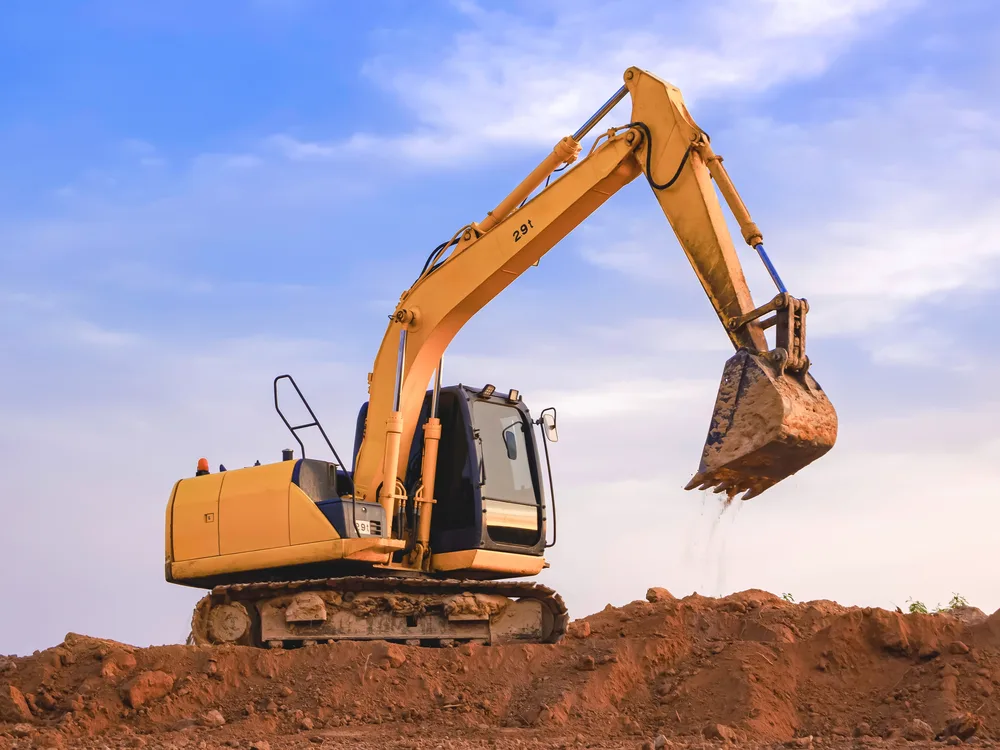
The strike is the exposure that reorganizes an account here, and the freight geography sharpens it: a cut in a corridor that serves a rail yard, an intermodal terminal or a warehouse cluster interrupts operations that measure downtime by the hour, so the consequential side of the claim can dwarf a repair bill that was already large. Working beside a railroad or inside somebody else’s right of way adds a second layer, with access rules, flagging and an owner whose permission you need before you can even recover your own machine. The state’s own two failure modes then apply as they do anywhere: the slide at an undercut trench edge on ground softened by a wet spring, and the tail swing into what the operator cannot see, which is a constant on the narrow lots the older street grid produces.
Common Illinois excavator claims we see
- Strike in a shared utility corridor. Several owners in one trench, and a restoration sequence you do not control once the first line is cut.
- Interruption to freight-dependent operations. The consequential loss that makes this state’s version of the claim distinctive.
- Incident inside a rail or utility right of way. Access, flagging and recovery all governed by somebody else, with the machine idle until they agree.
- Trench edge failure after a wet spring. Ground that stood well in one month and did not in the next, with spoil piled where the lot allowed rather than where it should have gone.
- Swing contact on a narrow city lot. Structures, vehicles and finished surfaces inside the arc on work that cannot be closed off any wider.
Why Illinois excavator owners choose Equipment Guard Insurance
In a state where the general contractor credential is municipal and the enforcement of the dig law sits with the utility regulator, the documentation around your machine is doing real work. We write equipment on its own so the schedule is exact and the attachments are listed rather than assumed, and we take the underground exposure as a subject to underwrite in its own right — how deep, how close to live service, how often inside a corridor with a third-party owner. The markets that answer those questions properly are named on our homepage, and reaching them does not require you to unpick the liability or comp already in place.
Major Illinois excavator markets
- Chicago. The oldest and most layered subsurface in the state, under a street grid where opening ground means dealing with several owners and a municipal permitting regime of its own.
- Joliet. Intermodal and warehouse ground at the point where the freight network converges, so a trench is rarely far from a corridor that somebody else controls.
- Aurora and Naperville. Collar-county build-out where new subdivisions and commercial work go in over service originally laid for far smaller communities.
- Rockford. Northern industrial reconstruction and municipal replacement, the classic setting for lines that were abandoned in place rather than removed.
- Peoria. River-corridor industrial and agricultural work, with crossings, drainage and the longest ordinary approaches on this list.
- Springfield. Capital and institutional utility replacement, where the records are long but not always in agreement with the ground.
Related
- Excavator insurance — the machine physics that hold in every state.
- Skid Steer insurance in Illinois — the machine that leaves a jobsite on somebody else’s trailer, and the filing that decides who owns it afterwards.
- All equipment insurance in Illinois — the state hub.
- Equipment floater · Rented & leased equipment
Primary sources
- 220 ILCS 50/4 — JULIE / State-Wide One-Call Notice System (dig notice and one-call)
Illinois excavator insurance FAQs
When will my locate actually be marked?
Operators must mark within 48 hours of receiving the notice, or by the date and time you requested, whichever is later. The "whichever is later" clause is the one that reorders schedules. If you name a start date further out than the minimum, the marking obligation moves out with it — so a ticket placed early with a comfortable start date does not buy you marks any sooner, and a crew that becomes free ahead of schedule cannot simply arrive and find the paint already down.
How far ahead do I have to call?
At least two business days before excavation, through the statewide one-call notice system. That is the floor for the whole state and it does not vary by municipality — which makes it one of the few things about operating here that is genuinely uniform, and worth appreciating for exactly that reason.
Who enforces the dig law, and why does that matter?
The state commerce commission — the utilities regulator. That is a meaningful detail, because the body reviewing a damage event is the same body that oversees the facility owners whose lines were hit, and it is fluent in their side of the exchange. A contractor arriving at that conversation with careful documentation of the ticket, the response, the marks and the excavation method is in a very different position from one relying on a recollection of how the day went.
What licensing do I need to run an excavator here?
There is no statewide general contractor license to hold, so the answer is local. Illinois credentials only a couple of specific trades at state level and leaves general contracting to home-rule municipalities, which means a crew working a metro and its collar communities may hold a stack of registrations rather than one credential, each with its own renewal and its own insurance filing requirements. We are not linking a document for this, because we have not verified a current one that states the whole position — but the practical consequence is easy to state: your certificates get requested more often here than your license does.
What makes digging around the freight corridors different?
Density and consequence. This is where the national rail and intermodal network converges, and the ground alongside it carries pipeline, high-count fiber and utility feeding both the yards and the metro around them. A strike in that environment does not just interrupt a neighborhood; it can put a crew inside a right of way with its own rules and its own owner, on a job where getting the machine out and the service restored involves people who were never on your schedule.
Can I insure the excavator without moving anything else?
Yes. Equipment Guard Insurance places equipment as a standalone policy, so the excavator and its attachments are scheduled on their own terms. Given how many separate registrations and certificate requests a crew here already juggles, keeping the equipment placement simple and independent tends to be the practical choice as well as the cheaper one to administer.