

Flat ground is deceptive. Most of the farmland a dozer strips in Indiana only looks like natural terrain; it was engineered from below, drained by buried tile laid over generations so that water leaves quickly and goes somewhere specific. Nothing about that network is visible from the seat of a machine, and none of it stops at the property line.
So the interesting question on an Indiana site is not only how much ground you have open — it is where the water underneath it was already being sent. The state administers the construction stormwater program itself, and the paragraphs below cover who runs it, what triggers it, and where the exposure sits once the pad is cut. For the machine on its own terms, the dozer insurance pillar holds in every state.
What dozer insurance costs in Indiana
We do not print a premium here. The number is built from your work rather than from the machine plate, and the Indiana variables that move it are hours and undercarriage condition, the size of the areas you strip at once, how much of your work is conversion of drained farmland, the distance and frequency of transport between jobs, whether the sites you take sit inside larger developments, and your claim history. It is worth saying which way the leverage runs on this class: repairing a dozer is a known, bounded amount, and cleaning a legal drain that your acreage filled is not.
Indiana dozer regulations: stormwater and land disturbance
Indiana runs the program itself through the state environmental management department. The instrument is the Construction Stormwater General Permit (CSGP) — successor to 327 IAC 15-5 (Rule 5), and it reaches a land disturbance of one acre or more.
What that means on a real Indiana job is decided by what is under the field. A construction site here usually inherits a working subsurface drainage system, so the discharge point is not the low corner of the property; it is an outlet into a county ditch or a legal drain that may be a considerable distance away and already belongs to a drainage district, a township or the farmer next door. Sediment entering that network does not sheet slowly across a field where somebody notices it — it is piped, and it arrives. That produces two separate consequences from a single wet week, and they must not be confused. The first is enforcement: a penalty from the state is your company’s to carry, uninsurable by design, and no equipment policy has ever been asked to pay one successfully. The second is the claim: silt in somebody’s drain, a plugged outlet, a neighboring field that stops shedding water the way it used to. That is physical damage to third-party property arising out of the work, it answers to liability and pollution coverage rather than to the schedule your dozer sits on, and the fact that the damage shows up off site is what makes it easy to miss until a letter arrives.
Common dozer risks in Indiana
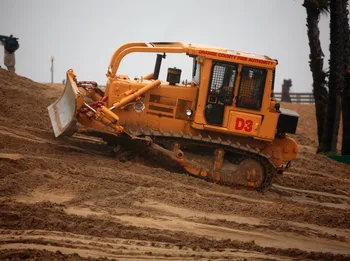
Indiana works its dozers through a real winter, and the shoulder seasons are the mechanically expensive part: frozen crust over soft ground loads a track unevenly, and a pad that carried the machine at eight in the morning may not at noon. Glacial till in the northern half of the state hides cobbles and boulders under ground that looks uniformly workable, which is where blade edges and undercarriage components actually go. Add the ordinary set — overturn on a spoil edge, engine-bay fire, damage during transport on a machine that never moves itself — and the iron side of the file is reasonably predictable. The unpredictable side is the acreage. On a conversion job the areas stripped are large, flat and drained by design, which is a description of both an efficient site and an efficient sediment delivery system.
Common Indiana dozer claims we see
- Sediment delivered through existing field tile. Piped rather than sheeted, so the first evidence is often somebody else’s outlet, not your perimeter.
- A crushed or broken tile line that changes a neighbor’s drainage. The blade did the damage in seconds; the wet corner shows up a season later.
- Track and undercarriage damage in cobbly till. Northern-tier ground that reads flat and grades hard.
- Overturn or slide on thawing spoil. Freeze-thaw makes a stockpile face behave differently in the afternoon than it did at dawn.
- Transport damage between distant phases. Long moves across the state concentrate loss on ramps, decks and tie-downs rather than on the job.
Why Indiana dozer owners choose Equipment Guard Insurance
Equipment is the whole business here, not a line item bolted onto something else, and that changes what gets asked. On an Indiana dozer the questions worth asking are about the ground: how large an area you open at once, what the site drained into before you arrived, and who owns the pipe it drained into. Writing the machine monoline means we can schedule it accurately without reopening a program built around your Indiana work, and it means the land-disturbance exposure gets discussed as its own item rather than assumed into the floater. We place through markets — named on our homepage — that read earthmoving as its own class of risk.
Major Indiana dozer markets
- Indianapolis. The freight and distribution engine of the state, where farmland becomes warehouse pad faster than anywhere else in it.
- Fort Wayne. Industrial and infrastructure work on flat, heavily tiled ground with an established network of legal drains.
- Evansville. River-valley work with a high water table, where dewatering and runoff control show up on the same job.
- South Bend. Institutional and redevelopment sites over glacial till, so the ground fights the blade more than the map suggests.
- Carmel. Dense suburban redevelopment on constrained parcels with abutters close enough to see every open face.
- Gary. Heavy industrial and brownfield ground near the lakefront, where what a blade uncovers matters as much as what it moves.
Related
- Dozer insurance — the machine physics that hold in every state.
- Excavator insurance in Indiana — the machine that cannot start until every utility operator has answered electronically, not merely been told.
- All equipment insurance in Indiana — the state hub.
- Equipment floater · Rented & leased equipment
Primary sources
- Stormwater Permitting: Construction / Land Disturbance Permitting — Indiana Department of Environmental Management (stormwater and land disturbance)
Indiana dozer insurance FAQs
Why does buried field tile matter to a dozer job?
Because it moves water off a site without asking anyone. Indiana cropland has been drained by buried tile for generations, and the pipe runs to a county ditch or a legal drain rather than stopping at a property line. When a machine converts that field into a construction pad, the existing network is still live underneath: a blade can crush a line, expose one, or simply keep loading a system that now carries sediment instead of clean field water. The site discharges somewhere you cannot see from the seat, and that somewhere belongs to somebody else.
Is the rule still called Rule 5?
Not officially, and the vocabulary lag is worth knowing. The construction stormwater requirement was consolidated into a general permit that superseded the old numbered rule, and the state environmental agency issues that permit today. A great many Indiana contractors, plan reviewers and specifications still say the old name out of habit. Nothing goes wrong when they do, but if you are reading a set of documents that uses one term and a permit that uses another, they are the same obligation described at different points in its history.
What kind of Indiana work is most exposed on this machine?
Conversion work. The state sits across the interstate freight system, and the dominant earthmoving market is turning drained farmland into distribution, logistics and light-industrial pads — large flat areas stripped at once, on ground engineered for a century to shed water quickly. That combination is exactly what the stormwater program was written about: a lot of open acreage, an existing drainage network that is very good at moving water, and a receiving ditch that already has a name and an owner.
If the state issues a violation, does insurance answer for it?
No. A notice of violation is an enforcement matter your company deals with directly, and no equipment or liability form was built to pay it. What can arrive separately is a claim, and on this kind of site the two often turn up weeks apart because the physical damage shows up somewhere else: silt in a legal drain, a neighboring field wet where it used to be dry, a plugged outlet a landowner has to have cleared. Damage to somebody else’s property arising out of your work is a liability and pollution question, not a floater one.
Does the machine itself have any Indiana-specific problems?
Two worth naming. The first is freeze-thaw: a dozer here works a genuine winter, and the shoulder seasons put it on ground that is frozen crust over soft fill, which is how tracks get loaded unevenly and how a machine that felt solid at eight in the morning is not at noon. The second is glacial till with cobbles and boulders in the northern half of the state, which is far harder on undercarriage and blade edges than the flat farmland above it suggests.
Can I schedule the dozer separately from everything else I buy?
Yes, and it is what we do. Equipment Guard Insurance writes equipment monoline, so an Indiana dozer can be valued and scheduled on its own without disturbing the rest of a program. We will also be direct about the limit of that: putting the machine on a good schedule protects the machine. It does not protect the acreage, and on a conversion job the acreage is where the serious money is. Better to hear that from a broker than from an adjuster.