

Every excavator page in the country recites a waiting period. Indiana is one of the few where the waiting period can end because somebody answered you, and that single design choice changes which document you want in your hand a year later when a fiber carrier is asking questions.
What follows is the Indiana version of the excavation problem: how the clock runs and how the responses can stop it early, what the ticket still leaves sitting with the contractor, and why greenfield logistics work puts unrecorded farm infrastructure and trunk utility corridors on the same pad. The machine physics that hold everywhere — reach, swing, undercarriage, the attachment ecosystem — live on the excavator insurance pillar.
What excavator insurance costs in Indiana
We do not publish a rate for this machine, and it is not coyness. The dominant variable is not the excavator; it is what you point it at. Depth, how routinely you work inside a live utility envelope, whether trunk gas and long-haul fiber corridors are part of your year or an exception, then the size of the unit, the attachments scheduled with it, where it sits between jobs, and your loss record. Two contractors running identical machines — one cutting building pad on open ground, one replacing service under a downtown street — are not the same submission and cannot fairly be quoted from the same number.
Indiana excavator regulations: dig notice and the one-call duty
Excavation may not begin before 7 a.m. on the next working day after two full working days elapse, unless all operators provide an electronic positive response.
Indiana states the duty in the state utility commission’s published account of the dig law, and there are two mechanisms in it rather than one. The first is ordinary: two full working days must pass and the earliest start is 7 a.m. on the working day after that, with the day of the call excluded. The second is the interesting one — where every operator on the ticket posts an electronic positive response, the wait can end without the calendar finishing. That creates a paper trail most states do not generate, and the trail is worth keeping, because after a strike the argument is almost never about whether you called. It is about what you were told, when, and what you did with it. None of which changes the underlying allocation: the notice obliges operators to mark, the response tells you what they found, and the duty to excavate carefully around those marks — plus the whole risk of anything nobody had recorded — stays with the crew holding the controls.
Common excavator risks in Indiana
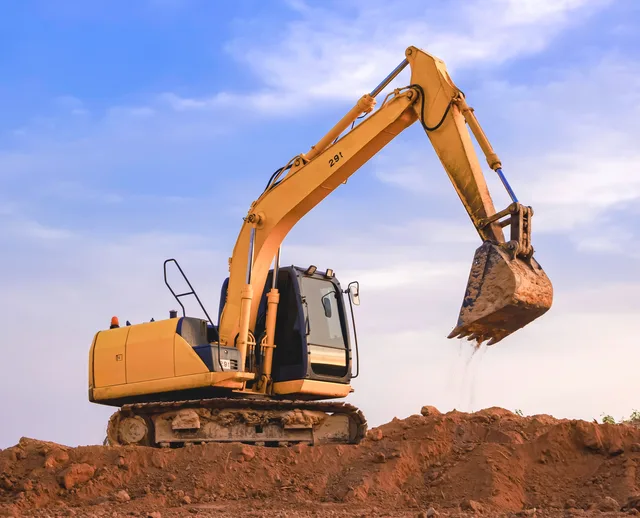
The strike dominates, and its economics are the reason this class is written the way it is: the machine is frequently untouched while the third-party file grows for months. Indiana sharpens the picture in two directions at once. Along the interstate spines, a single careless pass can take out long-haul fiber or a transmission-pressure gas line, where the loss is measured in what stopped rather than in what broke. Out on new industrial pads, the risk inverts to the small and unrecorded — field tile, abandoned farm services, private runs to buildings that no longer exist — none of which any operator will mark because no operator owns them. Underneath both sit the machine’s own two habits: the trench-edge slide, and the counterweight finding a structure the operator never saw.
Common Indiana excavator claims we see
- Long-haul fiber cut in a highway corridor. Small physical repair, very large consequential file, and a claim that runs long after the trench is closed.
- Unmarked private service on a redevelopment site. Nobody owned it, so nobody marked it, and the contractor absorbs the argument.
- Trench-edge slide taking the machine. Undercut wall or spoil stacked too near the lip on a pad that was field last season.
- Swing contact in tight municipal work. Counterweight against a wall, a parked vehicle or a meter bank on a constrained street job.
- Transit loss between jobs. A mid-size machine and a breaker on the same deck, where the schedule limit was written for a smaller load.
Why Indiana excavator owners choose Equipment Guard Insurance
With no statewide license class to vouch for an excavation firm here, the documents you produce carry the weight a credential carries elsewhere — which is a good reason to have them built rather than inherited. We write the equipment on its own, treat what happens below the surface as a question with its own answer instead of a footnote to somebody else’s liability policy, and place through markets that will underwrite excavation work on what it actually involves. Those markets are named on our homepage, and using them costs you nothing on the policies you already have in force.
Major Indiana excavator markets
- Indianapolis. The densest utility congestion in the state and the largest concentration of street and infill work, where the marks are crowded and the room is not.
- Fort Wayne. Steady municipal utility replacement over an older core, with the record and the ground diverging in the oldest wards.
- Evansville. River-adjacent industrial and public works, where soft ground and legacy infrastructure meet on the same excavations.
- South Bend. Institutional and redevelopment work on a subsurface layered by a century of factory work and rail.
- Gary and the Calumet corridor. Heavy industrial ground with the most complicated buried history in Indiana, much of it privately owned and privately mapped.
- Carmel and the northern suburbs. Continuous greenfield and roundabout construction where farm tile, new subdivision service and trunk lines share a site.
Related
- Excavator insurance — the machine physics that hold in every state.
- Skid Steer insurance in Indiana — the small machine whose defining question is who holds the lien and where it was parked overnight.
- All equipment insurance in Indiana — the state hub.
- Equipment floater · Rented & leased equipment
Primary sources
- IURC: Call Before You Dig Law — Indiana 811 (dig notice and one-call)
Indiana excavator insurance FAQs
What does “two full working days” mean for a crew starting on Monday?
It means counting days that are entirely yours, not partial ones. The day of the call does not count, the two working days after it must pass complete, and the earliest start is 7 a.m. on the working day after that. Weekends and holidays are simply not working days, so a call placed late in the week can push a Monday mobilization into midweek. Crews that build a schedule off the phone call rather than off the first full day are the ones who find a locator still marking when the trucks arrive.
What is an electronic positive response, and does it let me start sooner?
It can. Rather than making everyone wait out the full period regardless, Indiana lets the wait end early when every operator on the ticket has posted an electronic response — a machine-readable statement that they have marked, or that they have nothing in the dig area. The word doing the work is every. One outstanding operator means the clock, not the responses, governs your start, and a foreman reading four clears out of five as permission is reading it wrong.
If all the responses came back clear, is a strike still on me?
Generally yes. A clear response says a member operator has no recorded facility inside the polygon you drew; it does not say the ground is empty. Abandoned services, private lines running from a meter to an outbuilding, and anything a previous owner buried without telling the utility all sit outside that answer. The response is excellent evidence that you did the process correctly, which matters a great deal — but it is evidence about your conduct, not a warranty about the soil.
Who checks my credentials if Indiana has no statewide contractor license?
The town does, and then the general contractor does. General contracting is regulated locally here, so requirements shift between one municipality and the next, and plumbing is the trade that carries a genuine statewide license. For an excavation firm the practical consequence is that nobody hands you a state license class to point at; the certificate of insurance becomes the credential, and it gets read line by line by people who have no other way to size you up.
Why is warehouse and distribution work such a live exposure here?
Because the interstate corridors that make Indiana attractive for logistics are also where the long-haul fiber and transmission gas run, and because the sites being developed were fields last year. A greenfield pad brings two unrecorded categories at once — field tile that nobody mapped, and farm services running to structures that are already demolished — laid over a right-of-way carrying trunk infrastructure. The combination puts small unknown lines and very large known ones on the same job.
Can you write the excavator without touching my other policies?
Yes. Equipment Guard Insurance places equipment monoline in Indiana, so the machine and its attachments sit on their own schedule and the underground question is dealt with beside it, not bundled into a package you did not ask for.