
Iowa soil is the reason the state exists in its present form, and it is also the reason a dozer here carries an exposure that a machine on rock never will. Deep, fine, wind-laid material moves easily — that is what makes it good ground and what makes an opened acre of it genuinely mobile.
This page deals with the Iowa half of that: which agency administers the permit attaching to a disturbed acre, what the soil and the buried drainage under it do to the consequences, and which policy answers when material ends up off the property. The blade, ripper and undercarriage story that holds in any state is on the dozer insurance pillar.
What dozer insurance costs in Iowa
We do not put a figure on this class, and on a dozer a figure without a site would be close to meaningless anyway. The Iowa inputs that matter are the machine itself — size, hours, undercarriage condition — along with what kind of ground you take and how erodible it is, how much area you have open during the wet part of the year, whether you routinely work near or across drainage infrastructure, how far and how often the iron travels between scattered rural jobs, where it stands through a long closed season, and your own record. A subdivision grading crew and a crew shaping waterways and terraces are different accounts on identical iron.
Iowa dozer regulations: stormwater and land disturbance
Iowa holds delegation for the national discharge program, so construction stormwater is administered by the Iowa Department of Natural Resources (Iowa DNR) under a state general permit rather than by a federal office, and the obligation attaches at a land disturbance of one acre or more.
The Iowa-specific part is what lies beneath the acre. A very large share of this state’s ground has been drained deliberately, with buried lines installed to carry water off fields, and much of that network predates everyone now working on top of it. Development routinely happens on former farm ground, which means a blade is frequently reshaping a site whose drainage is already engineered and largely undocumented. Two consequences follow. Cutting or crushing a line can flood ground that has depended on it, which is damage to a third party arising out of your work rather than anything to do with your machine. And an opened line is a route for sediment that goes underneath every silt fence and sediment trap on the surface and discharges somewhere well beyond your control. Set against that, the commercial boundary is simple to state and easy to get wrong. A penalty over control measures is a regulatory matter and not an equipment claim. Soil that leaves your site and reaches a neighboring field, a county road, a drainage way or a creek is third-party damage answered by liability and pollution wording — never by the floater that repairs the dozer.
Common dozer risks in Iowa
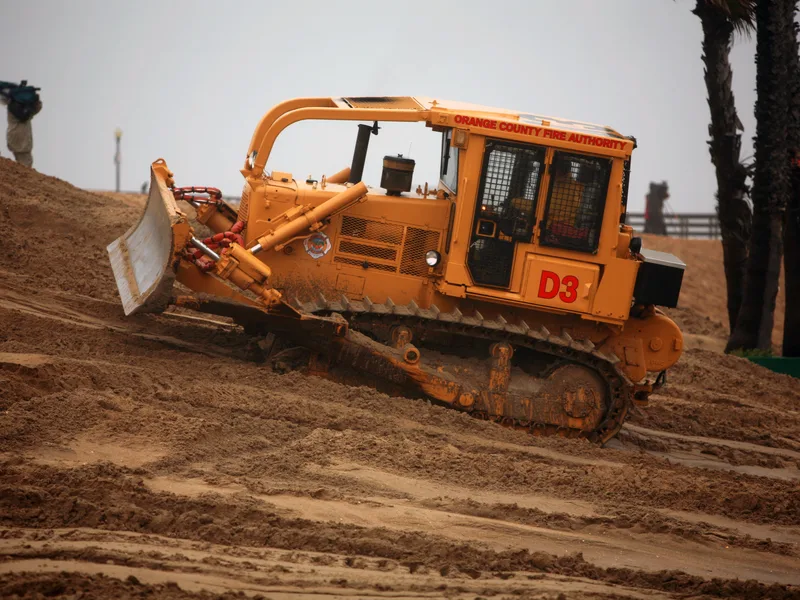
On the machine itself, Iowa is comparatively kind and seasonally brutal. The soils are not abrasive in the way granite or shale country is, so undercarriage life is decent, but working saturated spring ground is how machines get bogged, and recovery is where a routine day turns into a claim. Overturn exposure concentrates on the loess bluffs in the west and on constructed slopes, terraces and pond embankments elsewhere. Long winter shutdowns leave iron parked on rural sites for months at a time, which is a theft, vandalism and freeze exposure rather than an operating one. And around all of it sits the land-disturbance exposure, which is at its worst in the same wet weeks when the pressure to make progress is highest.
Common Iowa dozer claims we see
- Soil leaving an open site during a spring storm. The defining third-party exposure here, and the season concentrates it rather than spreading it out.
- A severed drainage line flooding adjoining ground. Property damage to somebody else arising from the work, and distinctively an Iowa loss.
- Machine bogged in saturated ground. Recovery costs and damage caused during recovery, both worth settling before the winch comes out.
- Overturn on a bluff cut or a constructed embankment. Steep loess faces and built slopes behave less predictably than they look.
- Theft or vandalism over a long winter shutdown. Iron standing unattended on rural sites in the months when nobody is on them.
Why Iowa dozer owners choose Equipment Guard Insurance
The dozer is usually the least expensive part of the risk it creates, and in this state the most expensive part can be entirely invisible from the surface. We write the equipment monoline, so the machine can be scheduled properly without unpicking arrangements already built around Iowa work, and we would rather ask about drainage, tile and what is downhill than hand over a certificate and hope. We place through markets — named on our homepage — that read earthmoving as its own class rather than as an oversized compact machine.
Major Iowa dozer markets
- Des Moines. The state’s largest and steadiest grading market, with continuous suburban expansion onto former row-crop ground.
- Cedar Rapids. Industrial and flood-mitigation earthwork on river ground where drainage and levee work are a permanent part of the calendar.
- Davenport and the Quad Cities. Mississippi-corridor commercial and logistics sites, with river drainage never far from an open pad.
- Sioux City. Steep loess bluff country in the northwest, the closest thing Iowa has to genuine sidehill work.
- Council Bluffs. Large-footprint data-center and distribution development on the Missouri floodplain, with big areas open at once.
- Waterloo and the Cedar valley. Plant, utility and agricultural earthmoving across dispersed rural sites with long approaches.
Related
- Dozer insurance — the machine physics that hold in every state.
- Excavator insurance in Iowa — the machine that has to find the buried lines the blade would otherwise discover the hard way.
- All equipment insurance in Iowa — the state hub.
- Equipment floater · Rented & leased equipment
Primary sources
- Stormwater Permit Information | Iowa Department of Natural Resources — Iowa Department of Natural Resources (Iowa DNR) (stormwater and land disturbance)
Iowa dozer insurance FAQs
Who administers construction stormwater in Iowa?
The Iowa Department of Natural Resources (Iowa DNR) does, under state delegation rather than through a federal regional office, and the requirement attaches at a land disturbance of one acre or more. Keeping the program in state hands means the office reviewing your plan is the one you already deal with on other water matters, which is a small convenience and a real one.
What is different about grading on loess?
Loess is wind-deposited silt, and in the western part of the state it is deep. It is easy to cut, holds a near-vertical face far better than it has any right to, and then erodes at a rate almost nothing else matches once water is running over it. A crew can produce a beautiful cut in the morning and watch a serious volume of it leave in a single storm, which is a very different failure mode from ordinary clay work.
We cut through a field tile. Is that an insurance problem?
It can be several at once, which is why it is worth naming. Severing a buried drainage line can flood ground that has relied on it for a century — that is damage to somebody else’s property arising out of your work, not damage to your machine. It can also open a direct route for sediment into a system that discharges to a watercourse, bypassing every control you installed on the surface. Neither is a floater question, and both are better raised before the blade goes in than after.
How much does the season really compress the work?
Enough to shape the whole risk. Deep frost closes the ground for months, spring brings the wettest and most erosive conditions of the year at exactly the moment everyone wants to start, and the productive window is squeezed at both ends. That concentration means more area open at once, more pressure on control measures, and a machine that stands still for a long stretch in between.
Does a stormwater penalty come back on our insurance?
Not as an equipment claim. A regulatory penalty over control measures is not property damage, and the policy that repairs a dozer has never promised to answer for one. What can become a claim is the physical outcome — soil that leaves your site and reaches a neighbor’s field, a county road, a drainage way or a creek. That is third-party damage arising from the work, carried by liability and pollution wording, and on this machine it regularly costs more than the machine.
Will you write the dozer without the rest of our program?
Yes. Equipment Guard Insurance places equipment monoline in Iowa, so the machine sits on its own schedule and nothing else has to move. We would rather be explicit about the ground you disturbed and what happens under it than let a floater carry an assumption it cannot support.