
A dozer on the plains works without cover of any kind. There is no tree line to break the wind, no fold in the ground to catch what moves, and often no other job within an hour’s drive. Everything the machine loosens is exposed to the full weather of the place, and the weather here does not arrive gently.
This page is about the Kansas half of that: which body holds the permit and what else that body is responsible for, what open country does to opened ground, and where the commercial exposure really sits once the blade has finished. For the machine — blade and ripper work, undercarriage economics and transport — see the dozer insurance pillar, which reads the same everywhere.
What dozer insurance costs in Kansas
We do not publish premiums for this class. What actually moves a Kansas number is the mileage — machines here travel further between jobs than in almost any state we write, and every mile is a loading, a haul and an unloading. After that it is the acreage you strip at once and how exposed it is, whether the work is highway, energy-related or subdivision, the age, hours and undercarriage condition of the iron, whether the machine sleeps on an open site a long way from anyone, and your own record. Two crews with the same dozer and different footprints are not the same risk.
Kansas dozer regulations: stormwater and land disturbance
Kansas administers the national discharge program itself. The permit is Stormwater Runoff from Construction Activities General Permit, S-MCST-2208-1, issued by Kansas Department of Health and Environment (KDHE), Bureau of Water, and it applies to a land disturbance of one acre or more. We name it from our own verified record rather than from a document we can link here, and the note below the sources block says so instead of leaving the impression that something has been cited.
Read the name of that authority once more, because it is the most useful thing on this page. Kansas does not keep its environmental program in a standalone department; it sits inside the state health agency, and the same water bureau that conditions your construction site is concerned with the supplies people draw from. That is not decoration — it explains the seriousness the state brings to material leaving a site, and it is a fair thing to understand before you argue about a control measure. Around that sits a second Kansas fact: on open ground, soil leaves by air as readily as by water, and a plume of dust across a highway is a third-party event with claimants in it. Both routes lead to the same commercial boundary. A penalty or a notice is a regulatory matter, and no equipment policy responds to it. Soil, silt or dust that reaches a neighboring section, a public road or a watercourse is third-party damage arising out of your work — liability and pollution coverage, not the floater — and on this machine it can run to a multiple of what the iron is worth.
Common dozer risks in Kansas
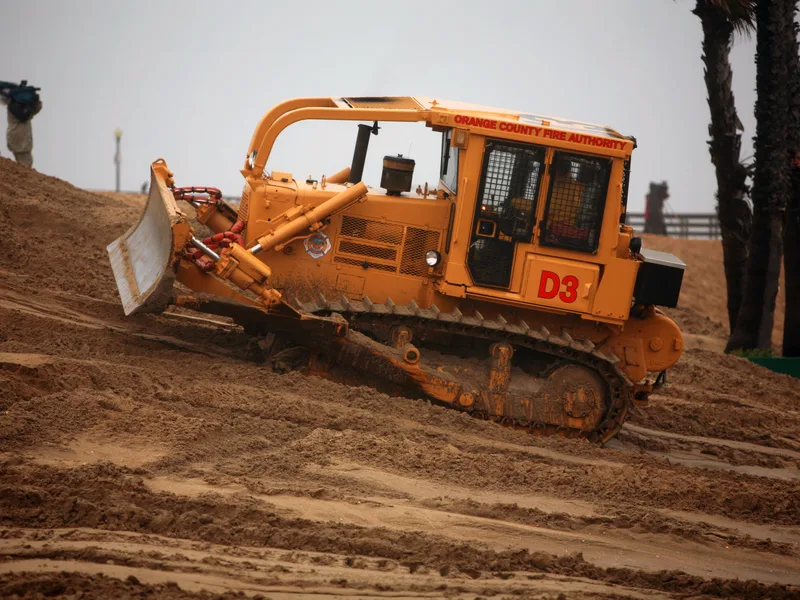
The dozer’s own exposures here are shaped by isolation and distance. A machine working a remote site is hours from help, so a fire that starts in packed debris against hot surfaces has time to finish what it began, and a breakdown means a machine standing alone in open country. Wind-driven grit accelerates undercarriage and pin wear on abrasive western ground. Overturn happens on spoil edges, terrace work and the sudden ravines that cut otherwise flat country. Transport is a category of its own given the distances, with loading, tie-down and highway damage accounting for a real share of losses. Underneath it all runs the land-disturbance exposure, generated by the work being done correctly rather than by anything going wrong.
Common Kansas dozer claims we see
- Soil moved off a stripped site by a plains thunderstorm. Short, violent rainfall on ground with little fall spreads material widely and fast.
- Dust across a highway from bare ground. A visibility event with third-party claimants and nothing to do with damage to the machine.
- Machine fire on a remote site. Distance from help is what turns an incident into a total loss.
- Overturn on a terrace edge or ravine bank. The ground that surprises operators is precisely the ground that looked flat.
- Transport damage over long hauls. More miles between jobs means more loadings, and loading is where dozers get hurt.
Why Kansas dozer owners choose Equipment Guard Insurance
Most placements treat a dozer as a value on a schedule and never ask what the machine is for. We would rather say plainly that the iron is the modest part of this risk and the ground it relocated is the serious one, and then insure both halves knowingly. Writing equipment monoline means the dozer can be valued and scheduled on its own without disturbing arrangements built around your Kansas work, and it leaves room to ask the questions that actually matter here — how far the machine travels, where it sleeps, and how much ground you have open when the wind gets up. We place through markets — named on our homepage — that underwrite earthmoving as its own class.
Major Kansas dozer markets
- Wichita. Industrial and aviation-adjacent site preparation, the largest concentration of sustained earthwork in the state.
- Overland Park and Olathe. Continuous suburban subdivision grading, most of it inside larger phased developments.
- Kansas City (KS). Rail, warehouse and river-bottom work where the receiving water is close and the ground is soft.
- Topeka. Public, highway and institutional earthwork with the closest inspection and the longest documentation trail.
- Lawrence. River-valley and campus-edge development on rolling ground with real slope to manage.
- Manhattan. Flint Hills work where rock sits close beneath thin soil and punishes an undercarriage.
Related
- Dozer insurance — the machine physics that hold in every state.
- Skid Steer insurance in Kansas — the machine that follows the blade onto the same job and is small enough to disappear off it overnight.
- All equipment insurance in Kansas — the state hub.
- Equipment floater · Rented & leased equipment
Primary sources
- Kansas Water Pollution Control General Permit and Authorization to Discharge — Stormwater Runoff from Construction Activities, General Permit No. S-MCST-2208-1 / Federal Permit No. KSR100000 (effective August 1, 2022 through July 31, 2027) — Kansas Department of Health and Environment (KDHE), Bureau of Water (stormwater and land disturbance)
- Construction | Kansas Business Center One Stop — None statewide; general-contractor licensing is handled by cities and counties (state role limited to Secretary of State business registration) (contractor licensing)
Kansas dozer insurance FAQs
Who issues the construction stormwater permit in Kansas?
Kansas Department of Health and Environment (KDHE), Bureau of Water — and the name is worth reading carefully, because the state houses its environmental program inside its health agency rather than in a standalone department. The permit is Stormwater Runoff from Construction Activities General Permit, S-MCST-2208-1, and it reaches a land disturbance of one acre or more. The body writing conditions for your site is the same body responsible for public water supply, which is a fair summary of why sediment is taken seriously here.
Who licenses me as a contractor, then?
Nobody at state level. Kansas issues no statewide general contractor license, so licensing obligations fall to individual cities and counties and vary considerably between them. The result is a split that catches new entrants: your environmental obligations are uniform across the state and your licensing obligations are not, so a crew working three counties can be perfectly compliant in one and unregistered in the next.
Is dust really an insurance issue on an earthmoving site?
On open plains it is, and it is the exposure most often left out of the conversation. Material that leaves a stripped site does not have to travel in water. A strong wind across bare ground and a highway on the downwind side produce a visibility event, and a visibility event on a road produces claimants. That is third-party damage arising out of your work, not damage to your machine, and it is answered by liability rather than by the equipment policy.
How does flat country change the water side?
It concentrates it. Rainfall here arrives in short, violent bursts rather than steadily, and on ground with little fall the water spreads instead of draining, moving soil sideways across a wide area before anything channels it. Controls sized for a gentle event are simply not in the same conversation as a plains thunderstorm, and the ground is often at its most vulnerable in exactly the season those storms come.
Is an enforcement action something my policy covers?
No. A penalty or a notice from the state is a regulatory consequence and no equipment policy was designed to absorb it. What insurance is for is the physical outcome that reaches somebody else — soil across a neighboring section, silt into a stream, dust across a highway. Those are liability and pollution questions. The floater sits on the other side of that line and answers only for the machine.
Can you write the dozer by itself?
Yes. Equipment Guard Insurance places equipment monoline in Kansas, so the machine goes on its own schedule with its real values and its real transport pattern described. Given the distances a Kansas machine travels, that pattern is a first-order underwriting question rather than a detail, and it deserves to be asked properly.