
There is a particular kind of quiet that comes over a jobsite when a tracked machine drops. Kentucky produces it more often than most states, because a good deal of the ground here is roofed rather than solid: limestone dissolved out from underneath over a very long time, with a soil lid on top that looks exactly like every other field until weight arrives.
That single geological fact puts two exposures on the same job at the same moment — damage to the machine and an uncontrolled route into groundwater — and they answer to different policies. Below is who runs the permit in this state, what triggers it, and where the commercial line falls. The machine on its own terms lives in the dozer insurance pillar.
What dozer insurance costs in Kentucky
We publish no rate here. On this class the machine plate is the least informative thing about the risk, and a Kentucky number moves on the ground you take: whether your work sits on the sinkhole plain, on the steep benched slopes of the east, or on river-city redevelopment; how much area you keep open at once and how close it sits to a stream or a swallet; the machine’s hours, age and undercarriage state; how it travels on narrow mountain approaches; and your own loss history. The pattern to hold on to is that a dozer repair is a bounded number, and what the ground does after the dozer has finished with it is not.
Kentucky dozer regulations: stormwater and land disturbance
Kentucky administers the discharge program itself, under its own state-badged permitting system rather than as a federal one operated locally. The authority is Kentucky Energy and Environment Cabinet, Division of Water; the instrument is the KYR10 — KPDES General Permit for Stormwater Discharges from Construction Activities; and it reaches a land disturbance of one acre or more.
Where that lands hardest is on karst, and it is worth setting out carefully because the geology defeats the usual instincts. A conventional site sheds water across a surface, so a crew can watch the perimeter and know roughly how it is doing. Over cave country there may be no perimeter to watch: water enters an opening in the floor of the site and is in the groundwater system immediately, unfiltered, with no plume to photograph and no ditch running brown. Enforcement here therefore tends to arrive later and colder than elsewhere, from a monitoring result or a complaint rather than from something anyone saw. Two practical consequences follow. The first is that inherited drainage deserves suspicion — a swallet that has taken field water since before anyone alive was born is not thereby approved to take construction runoff, and treating the two as the same thing is the assumption behind a good share of the files opened in this state. The second is the commercial boundary itself: a penalty is a regulatory cost your company absorbs, uninsured and uninsurable, while sediment or contaminated water reaching a neighbor’s land, a stream, a road or a private supply is third-party damage arising out of the work you were paid to do. The floater repairs the dozer. Liability and pollution coverage answer for the hole it worked over.
Common dozer risks in Kentucky
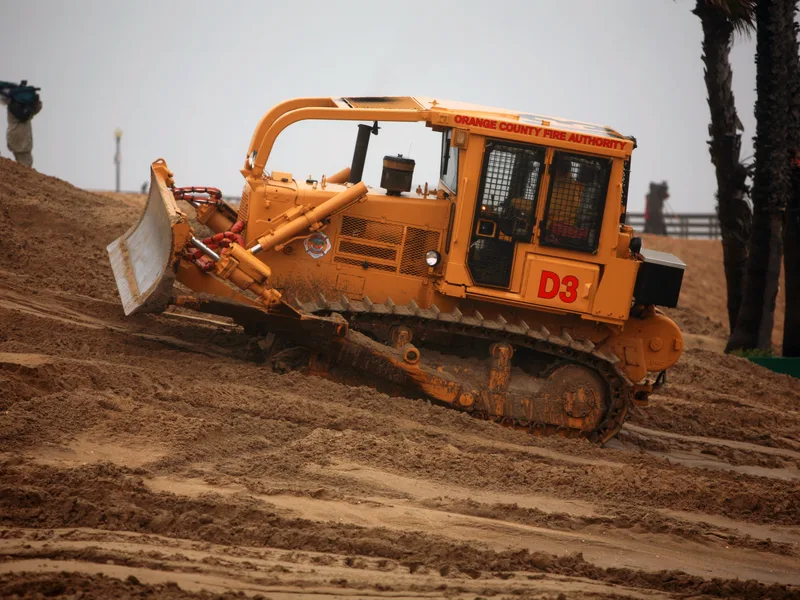
The machine’s exposure divides along the same geographic line the state does. On the plain, the distinctive event is subsidence: ground that gave no warning collapses under a working machine, which is an overturn, a recovery, and often a bent frame all at once, and it is one of the few losses on this class where the iron really is the expensive part. In the mountain counties the risk is grade — benching, cut-and-fill and narrow access, where a slip takes the machine downhill rather than merely stopping it, and where getting a lowboy to the job is a job in itself. Common to both are the ordinary items: undercarriage wear on abrasive limestone, engine-bay fire in dry conditions, blade and push-arm damage on rock, and transport losses on approaches that were never laid out for this weight.
Common Kentucky dozer claims we see
- Subsidence under a working machine. A void the survey did not find, a soil roof that held everything lighter, and a recovery that costs more than the damage.
- Runoff entering a swallet or open joint. Straight into groundwater, invisible from the site, and third-party in every direction it eventually surfaces.
- Slip or slide on a benched mountain slope. The machine follows the material downhill, which is a very different loss from an overturn on flat ground.
- Blade, edge and undercarriage damage on limestone. Abrasive, hard, and quick to turn a maintenance schedule into an argument about wear.
- Transport damage on narrow hollow roads. Tight radii, soft shoulders and low clearances do more harm than the jobs at the end of them.
Why Kentucky dozer owners choose Equipment Guard Insurance
Most brokers will schedule the dozer and stop there, which is comfortable and incomplete. On Kentucky ground the honest version has two halves: the machine can fall into something, and the same something can take your runoff to places nobody can see. We write equipment as its own line, so the iron is valued and listed correctly and a subsidence loss is not argued about after the fact, and we separate that from the land-disturbance exposure out loud rather than leaving you to infer it. Nothing about that requires reopening a program built around your other work. We place through markets — named on our homepage — that treat earthmoving as a class of its own.
Major Kentucky dozer markets
- Louisville. Logistics and industrial pad work at scale, on river-terrace ground with heavy municipal drainage infrastructure underneath it.
- Lexington. Growth on thin soils over limestone, where bedrock turns up shallower than the plan assumed on a regular basis.
- Bowling Green. The sinkhole plain proper, where karst is not an occasional finding but the standing condition of every site.
- Owensboro. River-bottom industrial work with a high water table and dewatering as a routine part of the sequence.
- Covington. Steep river-hill sites in the northern corner, where slope stability and tight urban access arrive on the same job.
- Elizabethtown. Corridor and distribution development on rolling ground between the two, with long open areas exposed at once.
Related
- Dozer insurance — the machine physics that hold in every state.
- Excavator insurance in Kentucky — the machine that has to wait for a locate before opening ground that may already be hollow.
- All equipment insurance in Kentucky — the state hub.
- Equipment floater · Rented & leased equipment
Primary sources
- Authorization to Discharge under the Kentucky Pollutant Discharge Elimination System, Permit No. KYR100000 — Stormwater Discharges Associated with Construction Activities (effective January 3, 2025; expires December 31, 2029) — Kentucky Energy and Environment Cabinet, Division of Water (stormwater and land disturbance)
- Department of Housing, Buildings and Construction (Kentucky) — No statewide general contractor license; the Kentucky Department of Housing, Buildings and Construction licenses electrical, plumbing, and HVAC trades; general contracting is regulated locally (contractor licensing)
Kentucky dozer insurance FAQs
Why does Kentucky call its discharge program something different?
Because the state took the whole thing on rather than administering a federal template. The delegated permitting system here carries its own state initials, and construction stormwater sits inside it as a general permit issued by the state water division within a cabinet-level environmental body. For a contractor the effect is that permits, notices and inspections are wholly state instruments, and the vocabulary on your paperwork will be the state’s rather than the federal agency’s.
What is the practical risk of working over karst?
Two risks that arrive together, which is unusual. The first is structural: mantled karst can leave a cavity roofed by soil that carries a pickup comfortably and does not carry a tracked machine at all, so the failure is sudden and the machine is in it. The second is hydraulic: those same openings are direct routes into groundwater, so a site can be discharging into the subsurface without producing the visible plume that would tell a crew to stop. One geology, two entirely different loss files.
Is a sinkhole on a site a drainage feature or a hazard?
Historically it has been treated as both, and that is precisely the difficulty. In sinkhole-plain country, natural swallets have long been where the local landscape sends its water, so a site plan can inherit a drainage arrangement that predates any permitting regime and still functions. Routing construction runoff into that arrangement is a very different act from letting field water take its ancient path, and treating the two as equivalent is the assumption that produces enforcement files here.
Does eastern Kentucky present a different problem entirely?
Yes. The mountain counties are about grade rather than voids: benched slopes, cut-and-fill work on steep ground, narrow access, and valley floors that take everything the hillside above them releases. A machine working a bench has less room to be wrong in, and material that gets away does not disperse gently across a field — it goes down a hollow toward whatever is at the bottom of it, which is usually a road, a stream and a house in that order.
If the cabinet issues a penalty, is that covered?
No. Regulatory penalties are not property damage and no equipment or general liability form was written to pay them; that is a cost your company carries. The insured event is separate and physical — sediment or contaminated runoff reaching a neighbor’s land, a public road, a stream or a groundwater supply that belongs to someone else. That is third-party damage arising out of your work and it answers to liability and pollution wordings. In karst country the two frequently arrive from the same event but on very different timelines.
Can I insure the dozer on its own?
Yes, and it is the only way we write it. Equipment Guard Insurance places equipment monoline, so a Kentucky dozer goes on its own schedule at its own value without anyone reopening the rest of your program. We are also plain about the boundary: the schedule pays to repair or replace a machine that fell into something, and it does not answer for what the same hole did to the water underneath it. Those are two exposures, and they are worth pricing as two.