
Most states ask an excavating contractor to worry about what other people put in the ground. Kentucky asks that too, and then adds a question almost nowhere else makes central: whether the ground is there at all. Across a wide band of the state the bedrock is limestone that water has been hollowing out for geological ages, and the soil above it is doing more work than it looks capable of.
Below: the notice rule and its unusually strict early-start condition, what solution-widened rock does to a machine and to a trench, and why a spill on a karst site is not a local problem. For the parts of the machine that behave identically everywhere — boom and swing geometry, undercarriage wear, couplers and attachments — see the excavator insurance pillar.
What excavator insurance costs in Kentucky
A premium for this machine cannot be published honestly, because most of what determines it is not the machine. The first inputs are the work and the ground: how deep the digging goes, how close it runs to live services, whether the sites sit on karst or on the steep ground east of it, and whether you are doing utility replacement, commercial site development or reclamation-adjacent earthwork. Then the unit itself — size, hours, the attachments carried on the same schedule — followed by where machines are kept between jobs and how your losses have run. Two contractors with the same equipment and different ground under them are not the same account.
Kentucky excavator regulations: dig notice and the one-call duty
Operators must respond to a normal locate request within two working days (KRS 367.4909); work may begin early only if all operators confirm marking or no facilities.
The statute behind that is published as KRS 367.4911 — Excavator to notify the notification center of work schedule, and the notice runs through the state protection notification center. Two full working days is the requirement, and the early-start route deserves the emphasis: every operator has to have confirmed before you can move ahead of the deadline, so one silent member is enough to keep the machine parked. That is the strict version of the rule, and it is worth knowing that Kentucky chose it. What the process cannot do is describe the ground. The marks address facilities that somebody owns and records; they say nothing about a solution cavity beneath the soil, a pinnacled rock surface that changes depth across a single trench, or an abandoned works from an earlier century in the eastern counties. Responsibility for reading that ground — probing, proving bearing, and stopping when the excavation stops matching the plan — has never sat anywhere but with the contractor, and no statewide license stands behind that judgment here either.
Common excavator risks in Kentucky
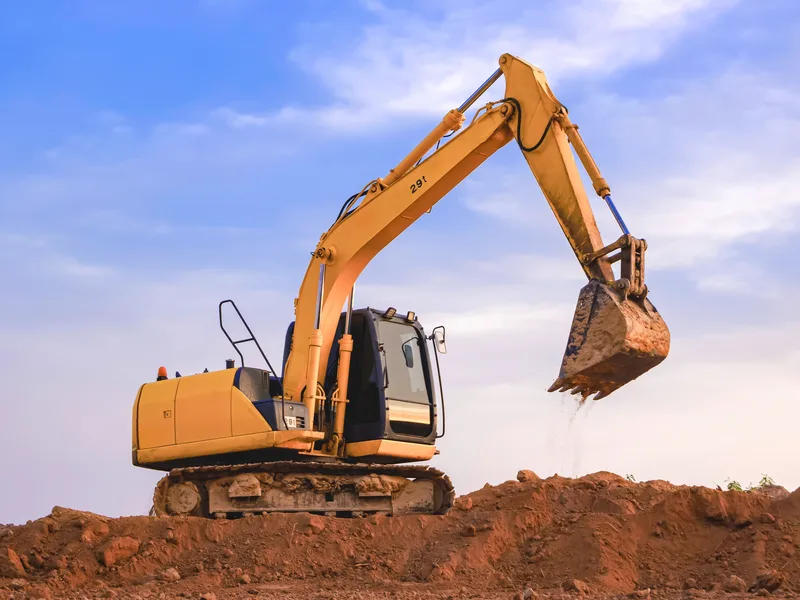
Two severities dominate, and only one of them is the usual one. The first is the strike, with the familiar shape: minor damage to the excavator, and a bill made of restoration, interrupted service and a stopped site. The second belongs to this state. A soil mantle bridging a cavity can hold for decades and then let go under a tracked machine, a stabilizer pad or a loaded truck, which is a physical damage loss, a possible injury and a site that has to be re-engineered before anyone continues. The same geology carries anything released on the surface — fuel, hydraulic oil, sediment — into groundwater that can surface a long way off, turning a modest spill into a third-party matter with regulators attached. Eastern Kentucky substitutes its own set: steep grades, side-hill work, unstable fill and legacy mine works that appear in excavations nobody expected them in.
Common Kentucky excavator claims we see
- Ground collapse into a solution cavity. A machine or a truck dropping through a soil bridge that had carried loads for years.
- Utility strike with downstream interruption. The severity claim that leaves the value of the excavator far behind.
- Release reaching groundwater on a karst site. A small quantity of fluid becoming a regulated third-party event a long way downgradient.
- Shock damage on pinnacled rock. Sudden loading into limestone that arrived well above where the borings suggested.
- Side-hill slide or rollover in the eastern counties. Steep ground, old fill and benched access roads with no room for error.
Why Kentucky excavator owners choose Equipment Guard Insurance
Ground that can fail underneath a machine and carry a spill to somebody else’s water is exactly the kind of risk that gets flattened into a class code when equipment is written as an afterthought inside a package. We write it on its own, ask about the sites you actually work rather than the ones a rating table assumes, and place through markets — shown on our homepage — that will underwrite excavation and earthwork on what it involves. Your liability and comp arrangements can be left exactly as they are.
Major Kentucky excavator markets
- Louisville. The largest continuous site and utility work in the state, on river-terrace ground with a long industrial history under it.
- Lexington. Bluegrass karst directly beneath an expanding urban service boundary, where sinkhole ground and new infrastructure meet.
- Bowling Green. The most pronounced cave and sinkhole terrain in the state, with industrial build-out sitting on top of it.
- Owensboro. River port, agricultural processing and levee-adjacent work on floodplain soils.
- Covington and the northern counties. Dense older street grid and hillside development above the river, with steep access and legacy utilities.
- Elizabethtown. Highway-corridor and distribution growth over karst, with large-scale earthwork on ground that has to be proved before it is loaded.
Related
- Excavator insurance — the machine physics that hold in every state.
- Backhoe insurance in Kentucky — the machine Kentucky lets travel between jobs without a title or a plate.
- All equipment insurance in Kentucky — the state hub.
- Equipment floater · Rented & leased equipment
Primary sources
- KRS 367.4911 — Excavator to notify the notification center of work schedule — Kentucky 811 (dig notice and one-call)
- Department of Housing, Buildings and Construction (Kentucky) — No statewide general contractor license; the Kentucky Department of Housing, Buildings and Construction licenses electrical, plumbing, and HVAC trades; general contracting is regulated locally (contractor licensing)
Kentucky excavator insurance FAQs
How much notice does Kentucky want before excavation?
Two full working days. The operators owe a response inside that same period — marking their facilities or reporting that they have none — and there is an early-start route that is worth reading carefully, because it is stricter than it first sounds: you may begin ahead of the deadline only when every operator has confirmed. One that has not answered is enough to hold the machine. That is a materially different rule from the states where an unanswered ticket releases you once the clock runs out.
What is karst, and why does it belong in an insurance conversation?
Karst is limestone that groundwater has been dissolving for a very long time, leaving solution channels, cavities and sinkholes under a soil mantle that looks entirely ordinary from the surface. Much of central and western Kentucky sits on it. For an excavating contractor it changes two things at once: what the ground will hold, and where anything you release will end up. Both of those are insurable exposures, and neither of them is visible in a set of locate marks.
How does that ground actually hurt a machine?
By failing without warning underneath it. A soil bridge over a solution cavity can carry traffic for years and then collapse under a tracked machine, a stabilizer pad or a loaded truck, and the failure is usually sudden rather than progressive. Trench walls in residual clay over pinnacled rock behave unpredictably, rock surfaces arrive at wildly different depths across a single excavation, and a bucket working into a pinnacle takes shock loading that shows up later in pins, the boom foot and the drive.
Does karst change the liability side as well?
Considerably. In these systems surface water and anything carried with it can reach groundwater quickly and travel a long way from where it entered, so a fuel or hydraulic release on a site, or sediment leaving an open excavation, is not contained by the property line in the way it would be elsewhere. Domestic springs and public water sources can sit downgradient of a job with no visible connection to it. That is a pollution and third-party exposure with its own logic, and we treat it as a distinct question rather than an afterthought to the machine schedule.
Who licenses an excavating contractor in Kentucky?
The state licenses electrical, plumbing and HVAC trades through the Department of Housing, Buildings and Construction, and does not issue a general-contractor license at all. General contracting and site work are regulated at the city and county level, where the requirements vary and in some places barely exist. So an owner or a general contractor deciding whether to put you on a job is looking at your certificates, your equipment schedule and your record, because there is no state credential to look at instead.
Will you write the excavator on its own?
Yes. Equipment Guard Insurance places equipment monoline in Kentucky, so the machine and its attachments can be scheduled by themselves. The subsurface and site-pollution questions get worked alongside that schedule, and none of it requires you to move liability or workers compensation already in force.