
Most states put a dozer to work taking ground down. Across the southern half of Louisiana the machine spends its career doing the opposite — spreading and shaping fill that arrived on a truck, building a surface up out of material that had to be bought because there was nothing solid to cut into.
That inversion runs through everything on this page: what the state permit is watching, why the exposed area on a job grows rather than shrinks, and who turns up when material leaves the site. The physics of the machine — blade capacity, undercarriage, slope limits, how it travels — do not change from state to state and sit on the dozer insurance pillar.
What dozer insurance costs in Louisiana
We publish no premium here, because on this class a figure without your particulars would mislead more than it helped. The Louisiana variables that actually count are how much of your work is fill placement against how much is clearing or cutting, whether the machine works below or above the reach of a pumped drainage system, how it is recovered and moved when ground softens, its exposure to salt air, its hours and undercarriage condition, and the loss record behind the company. The dozer is rarely the most expensive thing at stake on the job, which is precisely why it should be priced on the whole picture.
Louisiana dozer regulations: stormwater and land disturbance
Louisiana runs the national discharge permit program itself, under its own state identifier, through Louisiana Department of Environmental Quality (LDEQ). Coverage runs under LPDES Stormwater General Permits LAR200000 (small, 1 to under 5 acres) and LAR100000 (large, 5 or more acres), and the department publishes the documents directly — Construction General Permits.
Having the document is unusually useful in this state, and the reason has nothing to do with compliance theater. On a fill job the disturbed area is a moving quantity: borrow keeps arriving, stockpiles keep being repositioned, and the ground that is bare this week is not the ground that was bare last week. A plan written once and filed is a snapshot of a site that no longer exists. That is worth getting right because of where the material goes if you do not. Lower Louisiana drains through canals, ditches and pump stations built and maintained by public bodies, sized on assumptions that did not include your stockpile, so silt leaving a site does not disappear into a landscape — it arrives somewhere with a maintenance crew and a budget attached. And the split between regulation and insurance is exactly where it always is, however sympathetic the circumstances: a penalty issued by the state is enforcement, and the equipment policy is silent on it. The claim is the material itself — in a canal, across a servitude, over a parish road, onto a neighboring tract — which is third-party damage arising out of your work and answered by liability and pollution wordings rather than by the floater that puts the machine right.
Common dozer risks in Louisiana
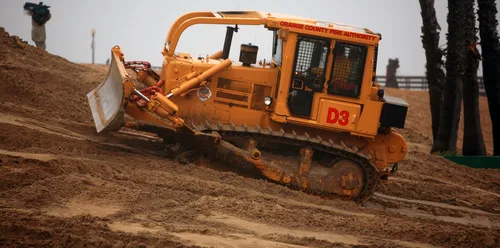
The machine’s own risks here divide into what the ground does and what the air does. Soft alluvium and a water table close to the surface mean a heavy track machine can lose bearing during a shift rather than arriving at a site that was obviously unsafe, and the recovery of a bogged dozer regularly does more damage than the bogging did. Salt-laden air along the coast works steadily on pins, bushings, fittings and paint. Fire risk rises during dry-season clearing, and transport is its own exposure on narrow approaches and soft shoulders. Beyond the iron sits the land-disturbance question, which is not a malfunction of anything — it is simply what open ground and rain do together, and here they do it often.
Common Louisiana dozer claims we see
- Silt into a parish canal or drainage ditch. The exposure most likely to generate a demand from a public body rather than a private owner.
- Machine bogged in ground that carried it that morning. Recovery damage frequently exceeds anything the original event caused.
- Fill washed off a partly built pad. Loose borrow has no structure until it is compacted and covered, and rain does not wait for either.
- Corrosion loss disputed as wear. Coastal air degrades fittings and pins steadily, and the argument is easier before the claim than during it.
- Transport damage on a soft or narrow approach. Getting a tracked machine onto a low-lying site is often the least controlled hour of the job.
Why Louisiana dozer owners choose Equipment Guard Insurance
Placing a dozer well means admitting that the machine is not the largest number in the room. What the earth did after you moved it, and who owns the water it reached, is where a bad year originates — and that half is not on the equipment schedule at all. We write equipment monoline so the iron can be valued and scheduled properly on its own, without disturbing arrangements a Louisiana contractor has built around a license tier, and we would rather map the land-disturbance side out loud than leave you to find the gap later. The markets we work through — set out on our homepage — underwrite earthmoving on its own merits rather than as an afterthought to a package.
Major Louisiana dozer markets
- New Orleans. Sites sitting below the water around them, where drainage is pumped rather than gravity-fed and anything you release enters a system with finite capacity.
- Baton Rouge. Industrial-corridor site preparation along the terrace and bluff edge, with large permitted footprints open for long stretches.
- Lake Charles. Heavy industrial expansion built largely on imported material, the purest example of fill-led earthmoving in the state.
- Lafayette. Prairie-terrace pad building and energy-services yard work spread across a wide, thinly supported service area.
- Shreveport. Northern uplands with genuine slope and gravity drainage — a completely different erosion problem from the parishes down on the coastal plain.
- Bossier City. Steady commercial and institutional build-out on river-terrace soils, with short hauls and repeat sites.
Related
- Dozer insurance — the machine physics that hold in every state.
- Skid steer insurance in Louisiana — the parish filing that records who owns the small iron parked alongside the dozer.
- All equipment insurance in Louisiana — the state hub.
- Equipment floater · Rented & leased equipment
Primary sources
- Construction General Permits — Louisiana Department of Environmental Quality (stormwater and land disturbance)
- Types of Licenses — Louisiana State Licensing Board for Contractors (contractor licensing)
Louisiana dozer insurance FAQs
Which Louisiana permit reaches a dozer job, and can I read it?
You can, and the link is on this page — the state publishes its construction general permits directly. There are two of them rather than one, sorted by how much ground the job opens, and the obligation begins at a disturbance of one acre or more (1 to under 5 acres under LAR200000; 5 acres or more under LAR100000). Reading the actual document matters more here than in most states, because the amount of ground open on a fill job changes as material arrives rather than staying where the plan drew it.
South Louisiana work is fill, not cut. Does the permit see it differently?
The duty attaches to disturbed ground either way, but the practical picture is genuinely different and it is worth understanding rather than assuming. On an import-fill site the exposed material is not the native soil that has sat there for centuries; it is loose borrow that arrived by truck and has no structure at all until it is compacted and covered. It moves in rain far more readily than undisturbed ground would, and it keeps arriving while the site is open, so the area at risk grows through the job rather than shrinking.
Where does sediment from a Louisiana site actually end up?
Usually in something engineered rather than something natural. Across the lower parishes the drainage is a built system of ditches, canals, culverts and pumps, maintained by a parish or a drainage district and depending on capacity that was calculated without your job in it. Silt that reaches it becomes somebody else’s maintenance problem immediately and visibly, which is why complaints here tend to arrive from a public body rather than from a landowner. The exposure is not abstract; it has an address and a budget.
A regulatory penalty and a claim — where is the line?
Cleanly drawn, and both can follow the same storm. Enforcement by the state is a penalty against your company, and an equipment policy has never been the instrument that answers for it. The insurable event is physical: material off your ground and into a canal, a servitude, a public road or a neighboring property, with the cost of getting it back out. That is third-party damage arising from your work and belongs to liability and pollution wordings, not to the schedule covering the machine.
What does Louisiana ground do to the machine itself?
It tests flotation and it corrodes. High water tables and soft alluvium mean a heavy track machine can be working ground that will not carry it by mid-afternoon, and recovering a bogged dozer is its own event with its own damage. Along the coast, salt in the air is unkind to pins, bushings and hydraulic fittings, and long-term subsidence means a pad that was level and drained when you built it may not be either a season later.
Can the dozer be written without unpicking the rest of my file?
Yes, and in this state that matters more than usual. Louisiana grades contractor licenses by the size of work a company may take, which means most owners already have liability and workers compensation arranged to support a tier they have qualified for. Equipment Guard Insurance writes equipment monoline, so the machine is scheduled at its own value and nothing supporting that license has to be reopened for it.