

Earthmoving in Maine is governed by a clock as much as by a rulebook. The stretch in which ground can be opened, shaped, seeded and stabilized is short, so a season is planned backward from the date the work has to be finished — and a dozer, the machine that starts every one of those sequences, is the piece of iron most exposed when the plan slips.
This page deals with the Maine side of that: who issues the stormwater authorization, the second review that larger disturbances attract, and where the money actually goes wrong once a site is open. For blade loads, undercarriage economics and transport, all of which behave the same everywhere, see the dozer insurance pillar.
What dozer insurance costs in Maine
We do not publish a rate for this class, because a rate without the site is guesswork wearing a number. The Maine inputs that count are the machine and its hours, the ground you contract for and what it does to an undercarriage, how much area you open at once and how near it sits to running water, how long the iron sits idle out of season and where it sits, the distance between your jobs, and your record. A contractor cutting a woods road and a contractor stripping a coastal commercial pad are simply not the same account, whatever the serial plate says.
Maine dozer regulations: stormwater and land disturbance
Maine took delegation of the national discharge permit program, so the construction general permit is a state instrument administered by the state environment department, and it attaches at a land disturbance of one acre or more. Our data layer also records a separate site-location review for larger earth-disturbing developments.
The consequence of that shape is worth sitting with, because it is where a Maine job goes wrong. Two approval paths mean two timetables, and a compressed season means there is no slack in either — a start pushed by review is not simply a later start, it is a smaller window in which to get ground closed before winter. That is why the most common failure here is not a control that was never installed but an area that was opened wider than the season could absorb. As for what any of this has to do with insurance: a citation is an administrative matter and stays one, whatever it costs. The insurable event is the physical one — material off your site into a brook, a ditch, a neighboring woodlot or a town road. That is third-party damage arising from your operations and it answers under liability and pollution wordings, not under the schedule that lists the dozer. On this machine that distinction is not academic: the iron is the cheaper half of what you are exposed to.
Common dozer risks in Maine
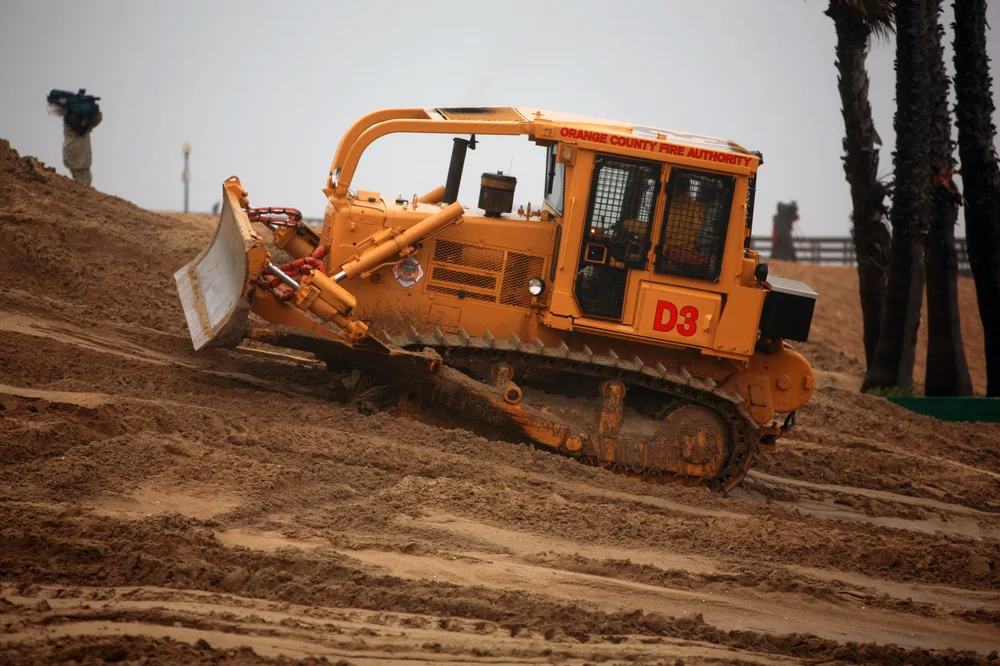
Maine loads a dozer at both ends of the year. In season, rock close to the surface and coarse glacial material grind the running gear, and steep, wooded, one-way sites concentrate the overturn risk on benches and cut edges rather than on open grade. Out of season the machine stops being a working asset and becomes stored property in a place with no one around it. Between the two sits the land-disturbance exposure, which is not caused by a failure at all — it is created by doing the job, and it is at its worst when the ground is bare, the season has closed, and the first thaw runs off frozen subsoil that cannot absorb any of it.
Common Maine dozer claims we see
- Runoff off unstabilized ground at spring thaw. The signature Maine failure, and one that reports itself months after the work stopped.
- Overturn on a bench cut or a soft shoulder. Terrain-driven rather than careless, and severe because of where these sites are.
- Running-gear damage from rock and coarse material. Frequently wear, occasionally sudden, and the two need separating before a claim is filed.
- Transport damage on narrow rural approaches. Getting the machine there is often the hardest part of a Maine job.
- Loss on a machine left through the off-season. Water ingress, component theft and seized systems on iron nobody has looked at since November.
Why Maine dozer owners choose Equipment Guard Insurance
The reason to place this machine deliberately in Maine is that its exposure is seasonal in a way most underwriting does not automatically ask about. We write the equipment monoline, so the dozer can be scheduled without reopening the rest of what you carry; we ask where it overwinters and how much ground you expect to have open when the season turns; and we are direct about the fact that the land-disturbance half of the account does not sit on the equipment form at all. The markets we place through are named on our homepage.
Major Maine dozer markets
- Portland and South Portland. The state’s densest commercial and institutional earthwork, on constrained sites close to tidal water and public drainage.
- Lewiston and Auburn. Industrial and mill-site redevelopment, where the ground has been built on before and rarely behaves as drawn.
- Bangor. Regional distribution, healthcare and roadwork, and the staging point for jobs a long way further north.
- Biddeford and the southern coast. Residential and resort development on lots where the abutter is close and the water is closer.
- Augusta. Public and institutional work, closest to the agency that reviews it and the most closely watched sites in the state.
Related
- Dozer insurance — the machine physics that hold in every state.
- Backhoe insurance in Maine — the machine that finishes what the blade started, and that has to answer for road use as well.
- All equipment insurance in Maine — the state hub.
- Equipment floater · Rented & leased equipment
Primary sources
- Construction General Permit, Stormwater Program, Maine Department of Environmental Protection — Maine Department of Environmental Protection (MEPDES-delegated) (stormwater and land disturbance)
- Professions and Occupations | Office of Professional and Occupational Regulation — No statewide general contractor license (specialty trades licensed by the Office of Professional and Occupational Regulation under the Department of Professional and Financial Regulation) (contractor licensing)
Maine dozer insurance FAQs
Does Maine issue the construction stormwater permit, or does the federal agency?
Maine issues it. The state took delegation of the national discharge program and runs its own construction general permit through the state environment department, so the authorization, the filings and the inspector are all in Augusta rather than in a federal region office. Contractors who also work across the New Hampshire line will find that the same class of job is handled by two entirely different governments.
Is there a second approval for bigger jobs?
Our data layer records a further review under the state site-location law for larger earth-disturbing developments, which sits alongside the stormwater authorization rather than replacing it. We flag it here because it is a scheduling fact before it is a legal one: a project large enough to attract that review is a project whose start date is decided by a review calendar, and a dozer booked around an optimistic start date is an expensive idle asset.
How much does the working season actually change the risk?
More than anything else on this page. The months in which ground can be moved, seeded and stabilized are limited, so Maine crews compress a year of earthwork into a stretch that ends whether or not the site is finished. The real hazard is ground left open when the season closes — exposed material through freeze, thaw and spring runoff is the condition under which a site fails quietly and everyone finds out in April.
What happens to a dozer that sits all winter?
Nothing good, and it is a genuine claims pattern rather than a hypothetical. A machine parked where it finished is a machine nobody is looking at: water finds its way in, rodents find the harnesses, components seize, and theft of parts is easier where there is no traffic. Where the iron overwinters and who checks on it is a question we ask on every Maine schedule, because the answer changes the account.
If sediment leaves a Maine site, whose problem is it?
Two separate ones, and they resolve in different places. A citation is between you and the department, and no equipment policy was ever going to pay it. Silt in a brook, on a neighboring lot or across a town road is between you and whoever owns what it reached, which is a liability and pollution question. In a state webbed with small watercourses the second consequence is rarely far from a disturbed slope.
Will you write just the dozer?
Yes. Equipment Guard Insurance places equipment monoline in Maine, so the machine sits on its own schedule and nothing else has to be reopened to make room for it. Given how much of the risk here is calendar-shaped, we would rather understand your season than sell you a package.