
Michigan is nearly surrounded by the water its construction rules exist to protect. Whatever a blade loosens here travels through a storm system or a stream and finishes in a lake, and that short, obvious chain is why the state puts erosion control at the front of a job rather than treating it as a condition attached to something else.
This page covers that sequencing, what the agency behind it is actually responsible for, and where a land-disturbance problem stops being a compliance question and becomes an insurance one. For blade loads, running-gear economics and the transport picture — the parts of a dozer that behave identically everywhere — see the dozer insurance pillar.
What dozer insurance costs in Michigan
No published figure would survive contact with an actual Michigan submission. What sets the number is the machine — size, age, hours, running gear — and then the work around it: whether you are grading sand or clay, how much area is open at once, how long ground stays bare across a freeze, whether your sites are industrial redevelopment or open-land subdivision, how far and how often the iron travels, and the record behind all of it. Identical machines on opposite sides of the state can present quite different risks.
Michigan dozer regulations: stormwater and land disturbance
Michigan administers construction stormwater within the state rather than leaving it to the federal agency, and the requirement reaches a land disturbance of one acre or more. The arrangement is unusual in shape: rather than issuing each site its own stormwater instrument, the state extends coverage by rule to a site that first holds a soil-erosion and sedimentation-control approval, with the state environment, Great Lakes and energy department behind the program. We describe that shape and deliberately quote no permit code for it — our record of the Michigan land-disturbance entry is graded general rather than verified, and an identifier is precisely the thing not to repeat on that footing.
The practical consequence is a change in sequence, and sequence is what catches out a contractor who has worked elsewhere. In much of the country the stormwater filing is the thing you do to start and erosion control is what you maintain afterward; here the erosion approval is the gate, and a crew that mobilizes expecting to sort the paperwork in parallel finds that the paperwork was the paperwork. Everything else follows the pattern that holds across the country, and the boundary is worth stating without softening. Enforcement is between the contractor and the regulator; an equipment policy has never answered a penalty and was not written to. The insurable event is the damage — material onto adjoining land, across a public road, or into a storm system whose outlet is a stream and, before long, a lake. That is third-party damage arising out of your work, it belongs to liability and pollution wordings, and on a dozer it is routinely the larger of the two exposures the account carries.
Common dozer risks in Michigan
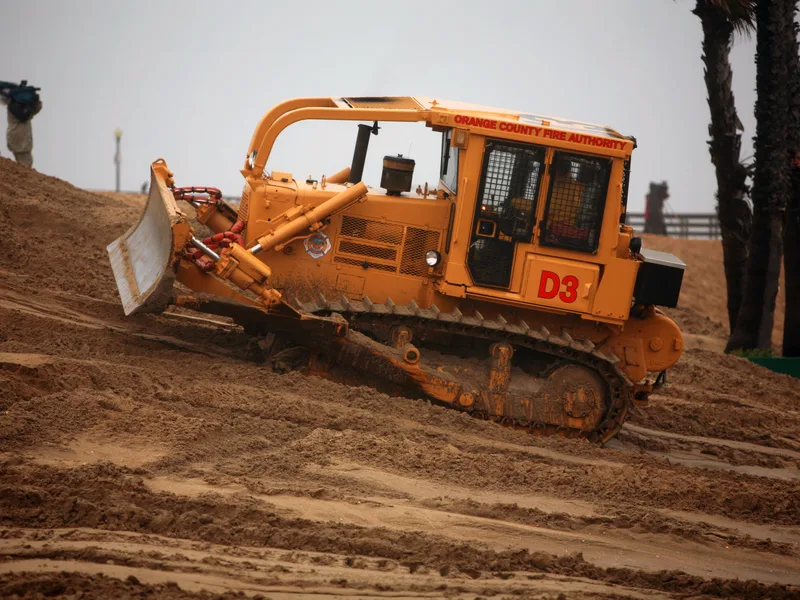
The machine’s own losses here divide roughly with the geology. On clay the risk is traction and edges — a heavy machine working saturated ground that gives way at a fill face, and recovery damage that often exceeds the original incident. On sand it is stability of a different kind: faces that will not stand, material that runs, and running gear packed with abrasive fines. Both sides of the state share a freeze that ends the stabilization season before the work is finished, and a transport pattern that puts a tracked machine on a low-bed frequently. Around all of it sits the land-disturbance exposure, produced by doing the job rather than by getting it wrong.
Common Michigan dozer claims we see
- Sediment into a storm system after a heavy rain. Short chain to open water in this state, and a third-party matter rather than an equipment one.
- Machine bogged or dropped at a saturated clay edge. The recovery is frequently the expensive half of the loss.
- Slope failure in sand on an unfinished face. Ground that behaves nothing like the clay an operator learned on.
- Loading and unloading damage. Frequent moves between metro sites concentrate loss on the ramp and the tie-down.
- Winter loss on ground and iron left open. Bare material through the thaw, and machines standing where the season stopped them.
Why Michigan dozer owners choose Equipment Guard Insurance
Most equipment placements here price the iron and leave the land-disturbance side unspoken, which is a strange way to underwrite the one machine whose entire purpose is disturbing land. We write equipment monoline, so the dozer can be scheduled properly without reopening arrangements built around your Michigan work; we ask about the erosion approval and the sequence rather than only about serial numbers; and we say plainly which half of the exposure the floater answers. Our markets are named on our homepage.
Major Michigan dozer markets
- Detroit. Industrial redevelopment and demolition-led grading on ground that has been built on repeatedly, with an old and complicated drainage system underneath it.
- Warren and Sterling Heights. Industrial-corridor site work on heavy clay, where saturated ground and tight plant schedules meet.
- Grand Rapids. The west-side commercial and residential build-out on sand and glacial material that drains fast and holds a face poorly.
- Ann Arbor. Institutional and research development on constrained sites with close neighbors and close scrutiny.
- Lansing. Public, institutional and highway earthwork, and the shortest distance to the agency reviewing it.
- Kalamazoo. Industrial and logistics pad work in the southwest, on mixed ground that changes within a single site.
Related
- Dozer insurance — the machine physics that hold in every state.
- Backhoe insurance in Michigan — the machine that spends part of its life on the road between these sites, under registration rules of its own.
- All equipment insurance in Michigan — the state hub.
- Equipment floater · Rented & leased equipment
Primary sources
- Residential Builders — LARA Bureau of Construction Codes, Licensing Section — Michigan Department of Licensing and Regulatory Affairs (LARA) (contractor licensing)
We do not link a Michigan stormwater permit document here. The land-disturbance threshold and permit class described above follow Michigan’s own record as our data layer holds it; where the state publishes a document that states it directly, this page links it.
Michigan dozer insurance FAQs
How does Michigan handle construction stormwater differently?
By coupling it to erosion control rather than treating it as a standalone application. Our data layer records that stormwater coverage for a qualifying construction site arrives by rule, and that the rule is conditioned on the site first holding a soil-erosion and sedimentation-control approval. Practically, the erosion permit is the gate: get that in order and the stormwater side follows from it, which is close to the reverse of how contractors from most states expect the sequence to run.
Why does this page not quote a permit number for Michigan?
Because our own data records the Michigan land-disturbance entry at a general rather than verified confidence level, and a permit identifier is exactly the kind of detail that should not be repeated on that basis. We will describe the shape of the requirement and name the agency that administers it, and we will not put a code in front of you that we cannot stand behind. Your plan reviewer will give you the current identifier for your site.
Which agency am I dealing with?
The state environment, Great Lakes and energy department, through its water resources division, sits behind the program. That department’s remit is worth noticing: it is not a construction-permit office that happens to look at runoff, it is the agency answerable for the lakes your site ultimately drains to, and its interest in a graded slope follows from that rather than from paperwork.
Does the ground change much across the state?
Enough to change how you work. The southeast is heavy clay that holds water, moves when it is wet and sets hard when it is not; much of the west and north is sand and glacial material that drains fast, carries readily and will not hold a steep face. A control layout copied from one side of the state to the other is a control layout that is about to be tested, and the same is true of an operator’s instincts about what a slope will do.
Is a sediment problem an insurance matter or a compliance one?
Both, in sequence, and the two are settled in different places. The enforcement side is between you and the regulator, and an equipment policy has never paid a penalty. The insurance side begins where the material does damage — onto an adjoining property, across a public road, or into a storm system that discharges to a river and then to a lake. That is third-party damage arising out of your operations, so it belongs to liability and pollution wordings rather than to the schedule your dozer sits on.
Can I schedule the dozer without moving my other coverage?
Yes. Equipment Guard Insurance writes equipment monoline in Michigan, so the machine is handled on its own. We would rather use the underwriting conversation on the sequence your sites actually follow — erosion approval, disturbance, stabilization — than on assembling a package around a machine that only needs scheduling.